
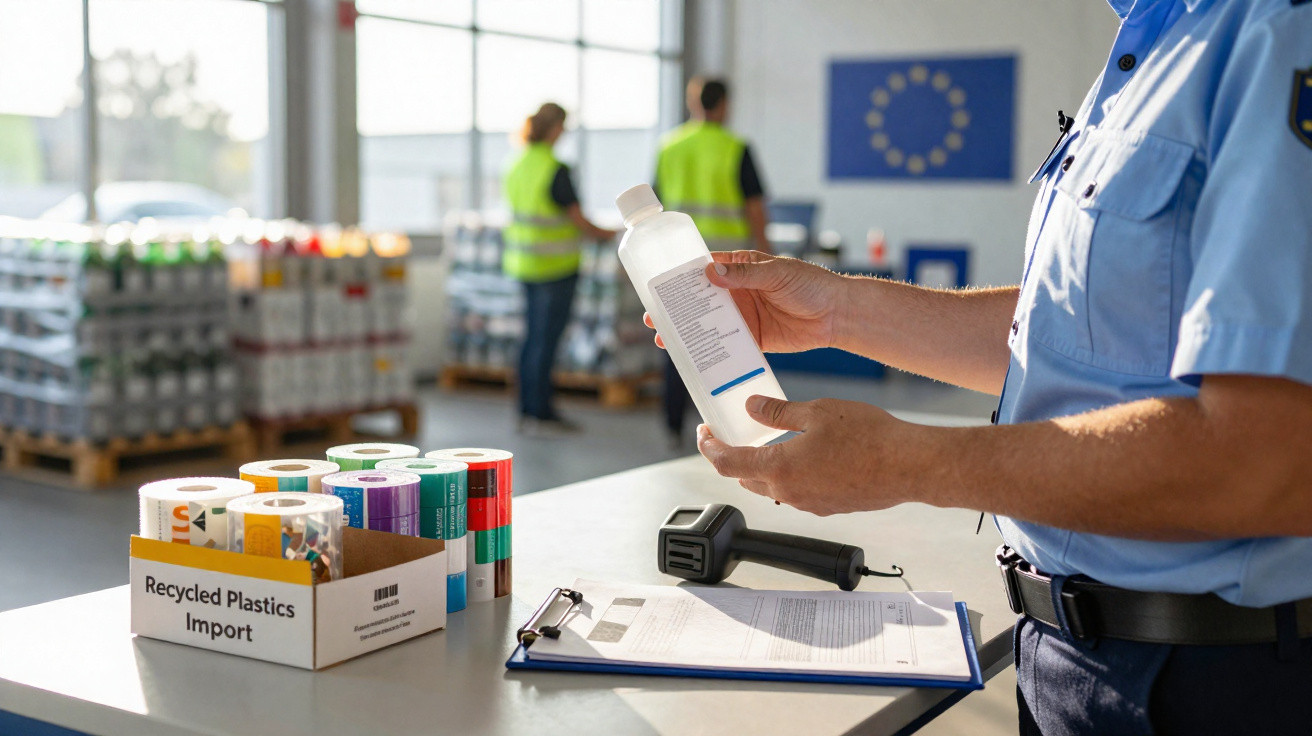
Plastic labels have become central to a new European effort to enforce what “recycled” genuinely means, particularly for plastics moving across EU borders.
By strengthening customs requirements and monitoring recycled content more rigorously, the EU aims to support hard-pressed recyclers, reduce fossil-fuel consumption, and prevent low-cost virgin plastic being passed off as a greener alternative.
Checks at Europe’s borders
At the border, customs documentation can determine whether recycled plastic competes on equal terms or is underpriced by cheaper material merely presented as recycled.
This situation has led European regulators to scrutinise plastic movements, labelling practices and the verification of those labels more carefully.
Leonidas Milios at the European Commission’s Joint Research Centre led this work.
His research considered how more precise rules could extend the use of materials, lower emissions and lessen dependence on imported virgin plastic.
Its conclusions helped build the argument for tougher safeguards distinguishing genuine recycled plastic from misleading claims.
Defining waste and products
Throughout Europe, a recycled pellet may be treated as a product in one country but as waste in another.
The Waste Framework Directive, an EU rule, allows officials to establish end-of-waste criteria. These conditions define the point at which waste becomes a product.
The draft standard was made available for public consultation and sought to reduce administrative burdens for smaller businesses.
A common threshold ought to limit disagreements at ports, although it can only succeed if inspectors assess material consistently.
Stronger recycled plastic import checks
Distinct customs codes – numbers used to categorise imports – could enable customs officers to identify recycled-content claims that do not make sense.
Virgin plastic, or new resin produced from fossil fuels, tracked low oil prices in 2025. Consequently, recycled material appeared costly in comparison.
“The recycling sector is facing high energy costs, low and unpredictable prices for virgin plastic (linked to oil prices) and competition from imports of cheap plastics (often virgin plastics wrongly claimed to be recycled),” said the European Commission.
Unambiguous labels could also safeguard purchasers, but enforcement will rely on audits and sanctions that continue to differ between countries.
Bottles set the next direction
Requirements for PET (polyethylene terephthalate) – the plastic found in many bottles – now have particular importance across packaging markets.
The Single-Use Plastics Directive, an EU law restricting disposable plastic items and setting recycling requirements, introduced recycled-content targets.
The new calculations would cover chemical recycling, processes that convert plastic back into feedstock.
As this route breaks polymer chains into smaller molecules, it can process contaminated offcuts that block mechanical recycling systems.
However, those credits carried conditions, as high-temperature processes may consume excessive energy and need robust controls to prevent greenwashing.
Demand gaps hold back progress
Manufacturers are frequently reluctant to purchase recycled resin when availability and quality are inconsistent, even if they seek more sustainable products.
The Commission intended to relaunch the Circular Plastics Alliance, allowing bottle manufacturers, PET purchasers and recyclers to establish common standards.
When purchasers commit to defined grades, recyclers can operate lines for longer and remove contamination that might otherwise spoil whole batches.
Without such coordination, the market remains limited, while stricter recycled-content requirements could become paperwork rather than actual material use.
Finance depends on rules and trust
Spending on sorting facilities and new reactors increased gradually as the Commission prepared a wider Circular Economy Act for 2026.
To accelerate schemes, the Commission said it would collaborate with national banks and the European Investment Bank.
A trial Competitiveness Coordination Tool was intended to connect regional hubs, enabling waste to be directed to the most suitable nearby equipment.
These financial signals may reduce borrowing costs, but they cannot resolve the problem if recycled plastic cannot be sold at stable, foreseeable prices.
Single-use rules face review
A new review began with a public consultation. Officials aimed to establish whether bans, collection targets and bottle obligations had genuinely reduced litter and exposure to plastic debris.
As the directive altered which goods companies could market, it also reshaped production lines by requiring redesigns and substitute materials.
The findings may strengthen or relax the requirements, but any revision will overlap with the quicker pace of recycling reform.
Circular systems and carbon
Eurostat recorded the EU circular material use rate – the proportion of materials sourced from recycling – at 12.2 percent.
Milios’ team calculated that circular measures could prevent roughly 83-93 million tons of climate pollution annually by 2050.
The analysis also forecast an annual €18 billion increase in trade, as recycling substituted imported oil and gas with domestically produced material.
One study found that most plastic waste was never recycled, leaving demand reduction as a central priority.
Quality, chemicals and trust
Recycled plastic earns confidence only when purchasers understand what it contains, including additives left over from its initial use.
Heat and mixing during recycling can distribute these chemicals through fresh pellets, potentially restricting their use in food packaging.
For bottle-grade PET, recyclers commonly required further cleaning, while minor faults could result in an entire batch being sent for incineration.
Even with improved regulations, the Joint Research Centre observed that expanding the circular system could reduce employment in certain sectors without proper planning.
What the new codes alter
By linking trade labels to precise definitions and stronger checks, the EU sought to ensure recycling remained genuine rather than simply rhetorical.
The outcome will rest on inspectors, buyers and investors following the same approach, alongside reductions in plastic demand and energy costs.






Comments
No comments yet. Be the first to comment!
Leave a Comment