
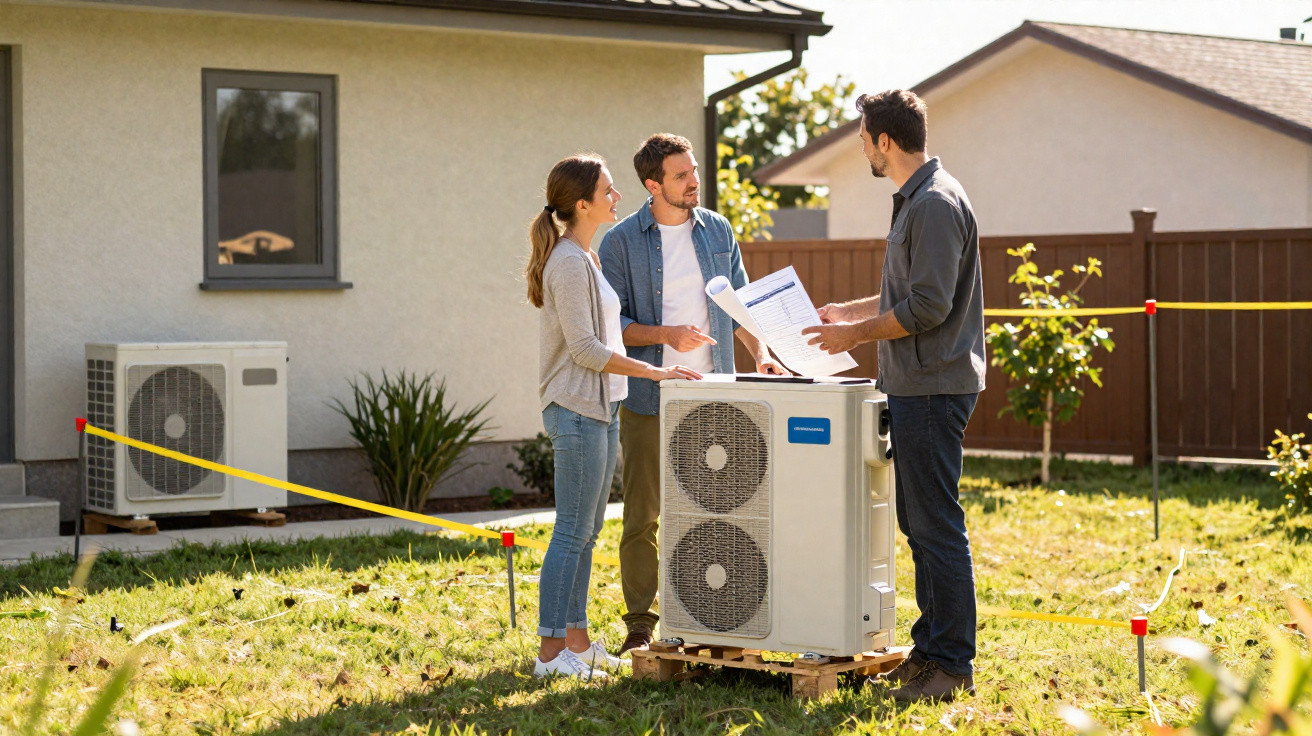
More and more homeowners are replacing gas- or oil-fired heating with a heat pump. On paper, the process appears straightforward: remove the old system, install the new one and place an outdoor unit in the garden. In reality, however, choosing the wrong garden location can lead to trouble with the planning authority, costly documentation and, in the worst case, a complete redesign of the system.
When a heat pump suddenly becomes a building project
A recent case in Bad Cannstatt, a district of Stuttgart, shows just how quickly an apparently harmless replacement can become complicated. A homeowner intended to replace an existing heat pump. The outdoor unit was to return to its previous location at the rear of the garden, on the owner’s land, where it had stood for years.
For the responsible planning authority, though, this was far from a routine replacement. It requested site plans, extracts from the property register and detailed information about the unit’s precise position. The homeowner put the additional cost of obtaining these documents at around €1,600 - simply to be allowed to keep the heat pump where it had effectively always been.
A heat pump in the garden can, depending on its location, generate more than a thousand euros in extra paperwork costs - before it produces a single kilowatt of heat.
The issue, therefore, is not the heat pump technology itself but its legal position on the plot.
Exempt from permission does not mean free from problems
Many homeowners assume: “Heat pumps do not need planning permission.” That is often true, but it can be misleading. Being exempt from the procedure merely means that, in many German states, there is no need for a conventional planning application, waiting period and formal approval notice.
It does not automatically mean that the outdoor unit may be placed anywhere in the garden. What matters is what the local development plan permits.
The building envelope as a hidden cost trap
Development plans set out which parts of a plot may be built on - commonly known as the building envelope or developable area. Placing equipment within this area is considerably easier in many cases. Outside it, the situation becomes less clear.
- Within the building envelope: The heat pump is close to the house and is usually unproblematic.
- At the edge of the garden: This is very often outside the building envelope, making documents and assessments necessary.
- Freestanding in the garden: From the planning authority’s perspective, it is no longer simply “technical equipment”, but a structure.
One legal basis for this is, among others, Section 23 of the German Land Use Ordinance, which applies throughout Germany. The Stuttgart case is therefore not an unusual one-off, but a warning sign for many other areas.
Why homeowners find a garden heat pump location appealing
In day-to-day terms, positioning the heat pump further away from the house, in the garden, can seem entirely sensible:
- Greater distance from bedroom windows because of operating noise
- A better appearance, as the outdoor unit is not attached to the façade
- Avoiding space constraints along narrow terraced-house walls
- Easier access for maintenance from the garden side
Yet these are often precisely the locations that are difficult from a planning-law perspective. They frequently fall outside the building envelope, placing a “structure” in the part of the garden that is intended to remain clear.
Anyone who moves the heat pump far to the back of the garden to reduce noise often merely shifts the problem - from the neighbour to the planning authority.
How replacing a heating system can quickly add €1,600
Once an outdoor unit stands outside the building envelope, many planning authorities want to establish whether it is permitted in that exact location at all. To assess this, they may demand documents that are often available only from architects or surveying practices.
Typical cost traps include:
- An up-to-date site plan prepared by a surveyor
- An extract from the property register
- Recording the heat pump with exact dimensions and distances
- Assessing setback distances from neighbouring plots
- In some cases, a noise report where neighbouring homes are close by
What may sound like “a bit of paperwork” in an individual case can add up rapidly. In the Stuttgart example, roughly €1,600 in additional costs arose before installers could even begin fitting the unit.
What homeowners should clarify before buying
Anyone planning a heat pump should consider its location well before the installation date approaches. Three conversations can help prevent expensive surprises:
- Check the development plan: Is there a defined developable area at all, and exactly where are its boundaries?
- Make a short call to the planning authority: Is an installation exempt from the procedure sufficient, or will the authority require documents?
- Coordinate with the installer: Can the outdoor unit be sensibly positioned within the building envelope?
A ten-minute phone call to the planning authority can, in doubtful cases, save hundreds of euros on surveying documents and reports.
This is particularly worthwhile in densely built-up residential areas with strict development plans, before obtaining quotations.
Technology meets planning law: further location pitfalls
The outdoor unit’s position is not only relevant under planning law; it also has technical and financial implications. Too great a distance between the outdoor and indoor units increases pipework losses and may push up electricity use. Longer pipe runs also add material and labour costs.
Noise levels are another factor. Modern units have become considerably quieter, but sound pressure levels towards a neighbouring plot remain important. A homeowner who places a heat pump near a neighbour’s patio door may avoid issues with the planning authority, only to encounter difficulties with nearby residents instead.
Practical examples of suitable heat pump locations
Some common solutions avoid many of these problems:
- Installation directly against the house wall, within the building envelope
- Positioning on a small plinth beside the rear of the house
- Using a narrow strip of land between the house and garage
- Siting the unit in a service courtyard classified as developable in the development plan
In many instances, a joint site visit with the installer and, where applicable, the architect is worthwhile. Moving the proposed location by only a few metres can determine whether a heat pump may be installed without difficulty or turns into a small building project burdened with paperwork.
Why so many people are falling into this trap now
Pressure to replace heating systems has risen sharply since the debate around the new German Building Energy Act. Many manufacturers, tradespeople and online platforms promote simple all-inclusive packages, brief cost examples and attractive subsidy grants. The focus is on subsidy rates, seasonal performance factors and noise levels - while the development plan often appears, if at all, only in a small footnote.
In addition, homeowners who already have an outdoor unit in the garden often assume that replacing it can be done with no formalities whatsoever. However, changed interpretations of the law by local authorities or stricter assessments can mean that existing systems are suddenly reviewed again when they are replaced.
Terms to know before speaking to the planning authority
Those speaking with the planning authority will quickly encounter specialist terminology. Three terms are especially relevant for a heat pump:
| Term | What it means |
|---|---|
| Building envelope | The part of a plot where buildings and structures are generally permitted. |
| Exempt from procedure | No formal planning-permission process is required - but every other rule must still be observed. |
| Setback distances | Minimum distances from neighbouring plots and buildings, which may also be relevant to technical installations. |
Having these terms ready enables homeowners to speak to the case officer on equal terms and ask directly whether additional documents are required in the specific case.
Heat pump in the garden - planning rather than guesswork
A heat pump can reduce heating costs and make a property less dependent on fossil fuels. The key issue is rarely the technology; it is the interaction between the development plan, location choice and neighbouring properties. Anyone choosing a garden location purely on instinct risks unexpected extra costs.
The process is much less stressful when the proposed location, development plan and noise issues are discussed properly before signing the order. That keeps the heat pump what it is meant to be: a step towards the future - rather than a cost trap in the homeowner’s own garden.




Comments
No comments yet. Be the first to comment!
Leave a Comment