
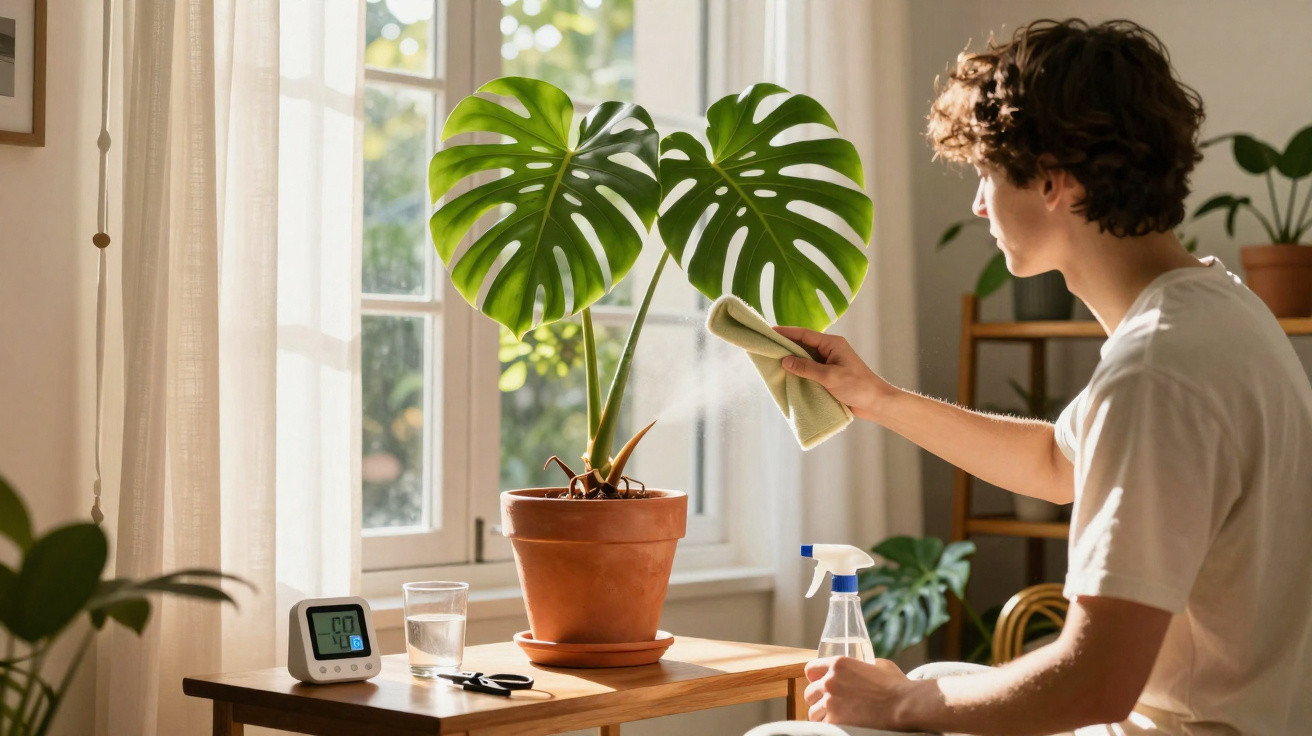
But what role does the Monstera really play in the air we breathe?
Many people are asking the same question today: can a jungle of green leaves in the living room make the air noticeably cleaner? The Monstera, often called the Swiss cheese plant, is particularly central to this debate. It is large, has a tropical look, and is frequently credited with purifying indoor air.
What the Monstera actually does to the air
Like every green plant, a Monstera uses photosynthesis: it absorbs carbon dioxide and releases oxygen. Its enormous, deeply split leaves provide a large surface area for this exchange of gases. Those leaves also capture dust particles from the room.
“The Monstera improves the indoor climate – but gently rather than spectacularly.”
Scientific research indicates that Monstera plants can absorb certain volatile organic compounds (VOCs) from the air, including pollutants such as formaldehyde and benzene compounds. In an ordinary living room, however, the impact is considerably smaller than many marketing claims suggest.
Several factors are crucial:
- The size and number of plants in the room
- The plant’s health, whether vigorous or weakened
- Light, temperature and humidity
- How effectively the room is ventilated
One Monstera in the corner of a 20-square-metre room will alter air quality only gradually and to a limited degree. Calling it a “natural air filter” therefore sounds much more impressive than the evidence supports.
How strongly Monstera affects different substances
Laboratory studies offer an indication of which substances the Swiss cheese plant can influence more effectively and which it affects less well. Importantly, these are generally controlled conditions rather than real homes.
| Type of substance | Effect of the Monstera | Particular considerations |
|---|---|---|
| Carbon dioxide | Moderate absorption | Active only in daylight, as it depends on photosynthesis |
| Formaldehyde | Slight reduction | Several large plants are required to produce measurable effects |
| Dust particles | Good capture | Broad leaves trap dust, but they need wiping regularly |
| Benzene compounds | Limited effect | Much weaker than particularly hard-working air-purifying plants |
These findings make one thing clear: a Monstera can do some useful work, but it is not a replacement for ventilation or a filtered mechanical air purifier.
Comparing Monstera with well-known air-purifying plants
Many households deliberately choose particular species to help clean the air. Spider plants, devil’s ivy and snake plants are regarded as classic options. Studies often show that they outperform Monstera when absorbing certain pollutants.
The Monstera’s benefits lie elsewhere:
- Humidity: Its large leaves release water through evaporation, increasing indoor humidity.
- Oxygen production: Its strong growth means it produces a noticeable amount of oxygen during the day.
- Visual impact: One large plant can noticeably transform the character of a room.
“Anyone wanting clean air is better off combining a Monstera with other plants – and an air purifier.”
Experts assume that roughly two large plants are needed per 10 square metres for noticeable effects. In a typical living room, that can quickly mean five or more substantial specimens, which is simply unrealistic in many flats.
Getting the most from your Monstera
For a Swiss cheese plant to use its potential at all, it needs the right care. A half-dried plant covered in yellow patches does very little work on the air; it is busy trying to survive.
The key care points at a glance
- Watering: Water only once the top roughly 3 cm of compost has dried out. Avoid waterlogging.
- Light: Choose a bright position without direct midday sun; bright, indirect light is ideal.
- Humidity: A level of 60 to 80 per cent is optimal, for example with a bowl of water or a humidifier nearby.
- Feeding: During the growing season, feed about once a month with a complete liquid fertiliser.
- Leaf care: Wipe the leaves regularly with a damp cloth. This supports photosynthesis and dust capture.
- Repotting: Move it into fresh compost and a slightly larger pot at least every two years.
Following these points will give you a vigorously growing Monstera with plenty of large leaves, which is exactly what creates the greatest effect on the air and indoor climate.
Positioning: where a Monstera delivers the most
Where you place the plant also affects the benefits it provides. In bedrooms, many people want better sleep and fresher air. A Monstera can work here, although it is only actively working on the air during daylight hours. Plants such as the snake plant, which also release oxygen at night, complement it well.
In a living room or home office, the Swiss cheese plant can make better use of its strengths. Heating, computers and cooking fumes are present during the day, meaning the room generally needs more humidity and oxygen. A large Monstera near a desk or sofa can significantly improve the sense of wellbeing.
Realistic expectations of plant-based air purifiers
One of the biggest misconceptions is that a handful of houseplants can completely replace modern air purifiers. Studies clearly show that HEPA filters, ventilation systems and regular rapid airing have a far stronger effect on air quality than individual plants.
“Plants are not competitors to filters – they are the green addition.”
Even so, Monsteras and other houseplants offer genuine benefits:
- They reduce stress levels and have a calming effect, especially in workspaces.
- They improve concentration when sufficient daylight is available.
- They create more pleasant acoustics because leaves absorb sound.
- They make dry heated air easier to tolerate by releasing water.
Many people automatically perceive rooms with plenty of greenery as “fresher”, even where measuring equipment shows only moderate differences. This psychological effect is well documented and is a clear argument for having as many plants as possible in daily life, including a Monstera.
How useful are plant combinations?
Anyone aiming to improve air quality is often best served by a “mixed planting scheme in the living room”. The principle is that different plant species take on different roles.
One possible set-up for a 20-square-metre living room could look like this:
- 1 large Monstera for humidity and visual impact
- 1 snake plant for pollutant reduction and oxygen at night
- 1–2 spider plants for additional VOC filtering
- 1 smaller devil’s ivy for areas with slightly less light
This creates a type of “mini ecosystem” that balances humidity, oxygen levels and pollutants more effectively than one standalone plant.
Risks and limitations: what households should consider
Despite all its benefits, the Monstera also comes with a few considerations worth knowing. It is not ideal around pets and young children: its leaves and sap contain substances that can cause irritation if eaten or after substantial skin contact. Anyone with cats or dogs should position the Swiss cheese plant out of their direct reach.
There is another issue: very high humidity, which would be perfect for a Monstera, can lead to mould problems more quickly in poorly ventilated rooms. More plants therefore mean not only more moisture, but also a greater responsibility to ventilate regularly.
For allergy sufferers, dust capture has two sides. On the one hand, the Monstera catches particles; on the other, its leaves must be kept consistently clean. If plants are never wiped down, dust is simply moved from the air to the leaf surface.
What Monstera can really contribute to the air
A Monstera does not clean the air magically, but it does make a contribution: slightly fewer pollutants, more humidity, more oxygen and, above all, a noticeably more pleasant feeling in the room. Combined with ventilation, a mechanical air purifier and a well-considered plant mix, it can create a noticeable effect that many people would no longer want to be without.
Anyone who keeps expectations realistic and cares for their plant properly will get exactly what a Monstera promises: a green housemate that makes the home more attractive and improves the air, at least to some extent.


Comments
No comments yet. Be the first to comment!
Leave a Comment