
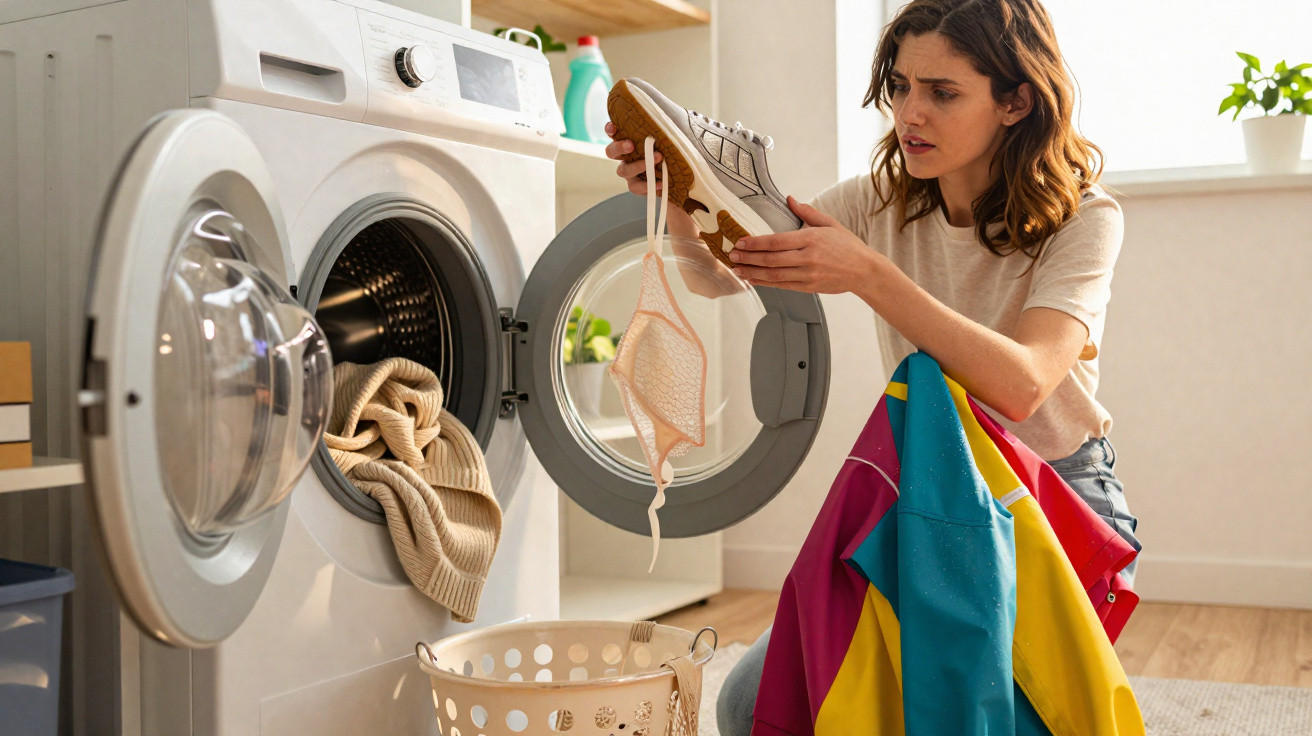
Many households wash their laundry on autopilot: put everything in together, choose the standard cycle and use the highest spin speed. It seems efficient and convenient – until the washing machine suddenly starts to ‘walk’, the noise becomes alarmingly dull, or an expensive jumper emerges from the drum two sizes smaller. In most cases, this is not a fault with the appliance but the result of washing unsuitable fabrics on the wrong programme.
Why certain textiles put real strain on the washing machine drum
A washing machine drum is not an armoured container. It is a metal basket that is repeatedly accelerated and slowed down. Anything hard, heavy or saturated with water acts like a small hammer inside it. During every spin cycle, these ‘hammers’ hit the same areas, putting greater pressure on the bearings and making the machine more likely to become unbalanced.
Hard inserts, heavy soles, delicate fibres and fabrics that retain large amounts of water are especially troublesome – damaging both the laundry and the washing machine.
There is another issue, too: some textiles simply cannot cope with standard washing treatment. They felt, snag, lose their shape or stop functioning as intended. Take these three warning signs seriously:
- unusually loud or harsh banging sounds during washing or spinning
- a spin cycle that seems to be struggling or stops altogether
- laundry coming out of the drum noticeably misshapen, shrunken or stretched
These symptoms frequently have the same cause: items that should never go into a normal programme have ended up there out of habit.
Special case 1: Bras – small items, major damage
Bras may look harmless, but they can cause problems in a washing machine. Styles with underwires and hooks in particular can create trouble in two ways: they may lose their shape, while also harming the drum.
Hooks readily catch on lace, tights or T-shirts. The resulting pulling forces can stretch or tear both the bra material and other garments. Underwires are even more problematic: they can bend, work loose from their seams and then rotate inside the machine like small metal rods.
Metal underwires in bras can not only ruin their shape but, in the worst case, scratch the drum or become lodged in the gap between the drum and outer tub.
How to protect bras and the washing machine
- Always fasten bra hooks and place bras in a laundry bag.
- Choose a delicates or hand-wash programme with a low spin speed.
- Avoid high-speed spinning; take them out while still slightly damp instead.
- Never put them in a tumble dryer; dry them flat or over a towel.
If you own particularly delicate lingerie, hand-washing is genuinely the best option. It takes only a few minutes, yet can quickly save the cost of replacing a bra – while reducing the chance that a bent underwire will damage the washing machine.
Special case 2: Shoes – heavy, hard and risky
It is a familiar scenario: trainers smell, so they go straight into the washing machine. Although they may appear clean afterwards, this puts the appliance under serious technical strain. Shoes have heavy, hard soles, which slam against the drum wall without restraint during spinning.
The result can be severe vibration, loud knocking and, in some cases, a washing machine that moves across the floor. Over time, the bearings, suspension and motor suffer far more than they would with ordinary laundry. The shoes themselves rarely cope well either: glued sections can come apart, cushioning components may shift, and plastics can harden in water that is too warm.
When shoes can go in the washing machine – and how
Shoes should only be washed in a washing machine in exceptional cases – and never without protection.
If there is genuinely no alternative, make the process as gentle as possible:
- Put shoes in a thick laundry bag or an old pillowcase.
- Wash 2–3 large towels alongside them to cushion the impacts.
- Select a cold or, at most, lukewarm programme.
- Reduce the spin speed considerably.
Traditional hand-cleaning is gentler: wash removable insoles and laces separately, clean the upper material with a brush and mild soapy water, then allow them to air-dry slowly. Keep them away from radiators and strong sunshine so that nothing warps.
Special case 3: Wool – a standard programme is guaranteed to cause tears
Woollen jumpers, cardigans and scarves are all extremely sensitive to heat and vigorous movement. On a normal cotton programme, the fibres felt, the surface becomes dull, and the garment shrinks and loses its elasticity. The well-known effect of turning an adult jumper into a child-sized one is not a myth; it is simply physics.
Wool tolerates only low temperatures, even less friction – and no high-speed spin cycle at all.
Keeping wool soft and in shape
Anyone who values their knitwear should follow a few basic rules:
- Always use a cold or dedicated wool programme.
- Use a suitable wool detergent, never standard detergent.
- Keep spinning to the lowest setting, or preferably use only a brief drain spin.
- Never wring or twist wet wool.
- Reshape items for drying and lay them flat on a towel.
The fabric will reward you with a longer life, less pilling and the same comfortable feel it had when new. For complete peace of mind, hand-wash especially high-quality pieces briefly in lukewarm water, without vigorous rubbing.
Special case 4: Waterproofed and water-repellent fabrics
Technical jackets, waterproof trousers, outdoor blankets and coated shower curtains come with their own risk. They prevent water from passing through the outer surface, yet can trap it within the fabric or in folded sections. This can create a genuine pocket of water in one area during washing.
When spinning, this water-filled pocket acts like a heavy counterweight. The drum no longer rotates smoothly but starts to wobble. The washing machine then attempts to compensate and may, in the worst case, cancel the spin cycle. Over time, this repeated unbalanced operation can damage the whole system.
Water-repellent textiles can suddenly shift the load during spinning – throwing the washing machine off balance.
How to wash technical clothing correctly
- Wash only a few items at once and do not overfill the drum.
- Use a gentle spin at a moderate speed.
- Refresh the waterproofing regularly after washing.
- Do not use fabric conditioner, as it damages functional layers.
This helps rain jackets stay waterproof, keeps the washing machine running more quietly and ensures expensive outdoor clothing retains its performance.
How to spot a problematic wash cycle early
Many types of damage develop gradually. However, anyone who pays a little attention to their washing machine can intervene early. Look out for:
- sudden loud banging during spinning
- a drum that visibly shakes more than usual
- programmes that remain unusually long in the spinning stage
If this happens, simply stopping the machine, redistributing the laundry or removing particularly heavy items to wash separately can often solve the problem. This significantly reduces the strain on the mechanism.
Small changes, significant results
In everyday use, only a few adjustments are usually needed: keeping an extra laundry bag in the cupboard, consciously selecting the wool programme, or deciding to clean trainers briefly with a brush after all. This greatly lowers the risk of costly repairs, while helping favourite items last longer.
A regular check before pressing start is useful: are there metal parts, hard soles, delicate fibres or coated fabrics in the load? If so, it is worth choosing another mode, adding protection such as a laundry bag – or using the sink rather than the washing machine.

Comments
No comments yet. Be the first to comment!
Leave a Comment