
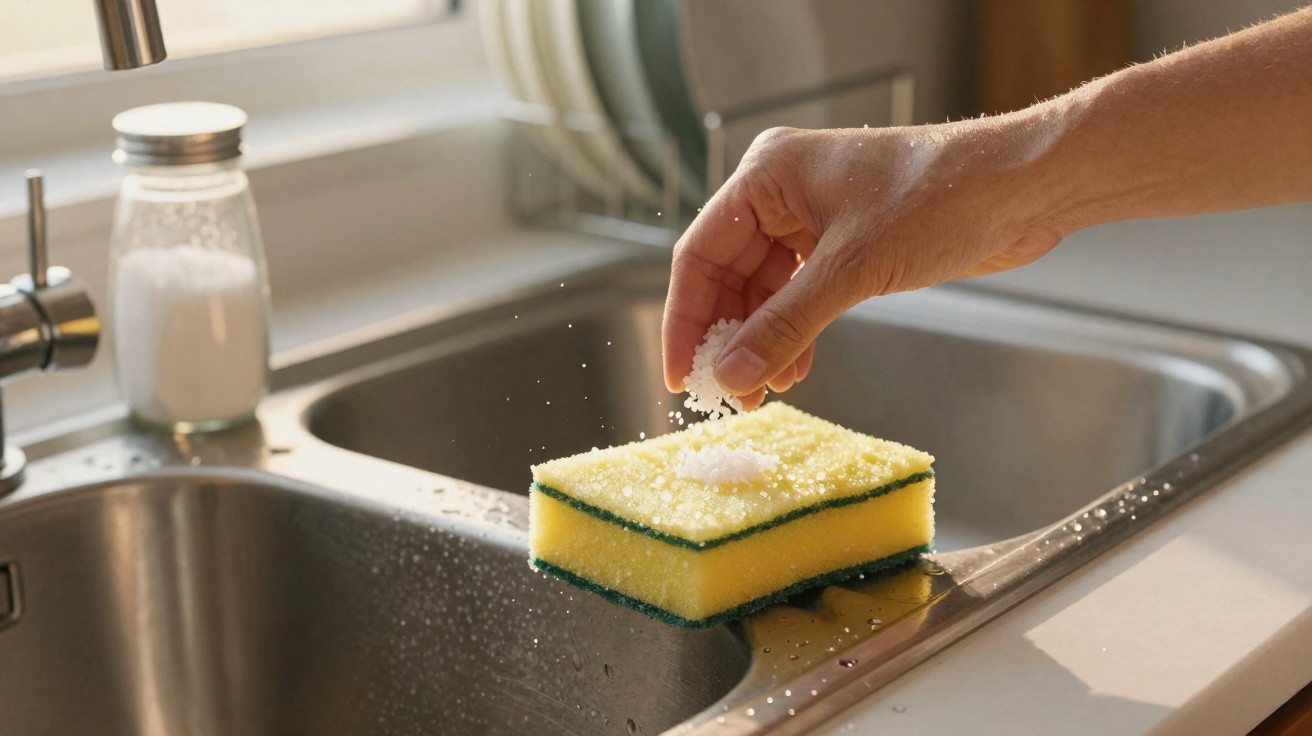
Sprinkling salt on the washing-up sponge at night is an old household trick for cutting down moisture, unpleasant smells and the sense that grime has built up. Salt can help the sponge stay drier, but it is not a replacement for regular replacement.
Why does salt help to care for a washing-up sponge?
After it has been used, a sponge can remain damp for many hours, holding food particles, grease and water. This creates conditions that encourage unpleasant odours and the growth of micro-organisms, particularly if the item is left wet on the sink overnight.
Sodium chloride is the main component of ordinary salt and is also known for its role in preserving food. When used on a sponge, its practical household benefit is that it draws out some moisture and makes the proliferation encouraged by damp conditions more difficult.
This trick is recommended for the following reasons:
- Moisture: salt helps to reduce the water retained in the sponge.
- Unpleasant smell: less moisture means less of the odour associated with a stale, enclosed sponge.
- Durability: overnight care can help to keep the item in better condition.
- Routine: applying it at night gives the sponge time to dry more thoroughly.
- Limitation: salt does not turn an old sponge into a sanitised sponge.
How should you sprinkle salt on a washing-up sponge correctly?
Once you have finished washing the dishes, rinse the sponge thoroughly to remove suds, grease and food debris. Then squeeze out the excess water and sprinkle one teaspoon of salt over the damp part of its surface.
Leave the sponge somewhere well ventilated, ideally on a draining holder, without direct contact with standing water. In the morning, rinse it before using it again to remove the accumulated salt and any loose residue from the night.
Why does the hygroscopic property matter?
Salt is hygroscopic, meaning it can attract moisture from the surrounding air and from the surface to which it is applied. On a sponge, this helps to reduce retained water, making the item less likely to develop an unpleasant smell.
A less damp sponge in the morning
The trick works best when combined with ventilation.
Sprinkling on salt but leaving the sponge enclosed greatly reduces the effect.
The ideal routine is to rinse, squeeze, salt and leave it on a dry holder.
This effect does not eliminate every micro-organism, but it creates conditions that are less favourable for rapid multiplication. For that reason, the trick is useful for maintenance, rather than as a substitute for cleaning, drying and periodic disposal.
To use it without waste, follow this order:
- Rinse the sponge after you have finished the washing-up.
- Squeeze it firmly to remove excess water.
- Sprinkle one teaspoon of salt over the sponge.
- Leave it on a draining holder overnight.
- Rinse it in the morning before using it again.
How does salt compare with boiling and the microwave?
Boiling is more intensive than using salt, but it requires care around hot water and may distort some sponges. The microwave is often mentioned as a quick method, but for safety, it should only be used with a damp sponge that has no metal parts.
Salt is simpler and less harsh because it does not rely on heat, require a saucepan or involve extra equipment, and it can fit into a daily routine. On the other hand, it is less powerful than heat-based methods and will not solve the problem of a sponge that is already dark, torn or has a persistent odour.
In practical terms, consider the following:
- Salt: helps the sponge dry and reduces smells, but does not sterilise it.
- Boiling: sanitises more effectively, but requires care to prevent burns.
- Microwave: may reduce micro-organisms, but requires a damp sponge with no metal.
- Regular replacement: remains the safest approach for worn-out sponges.
When should a washing-up sponge be replaced even if you use salt?
As with the warning that a washing-up sponge can collect dirt, the salt trick should not become an excuse to keep using the same item for too long. A sponge with a strong smell, slime or tears should be removed from the kitchen without delay.
The best habit is to combine careful rinsing, drying in a ventilated place, occasional salt at night and frequent replacement. This helps the sponge last better, smell less and avoids compromising the hygiene of the dishes, sink and household routine.




Comments
No comments yet. Be the first to comment!
Leave a Comment