
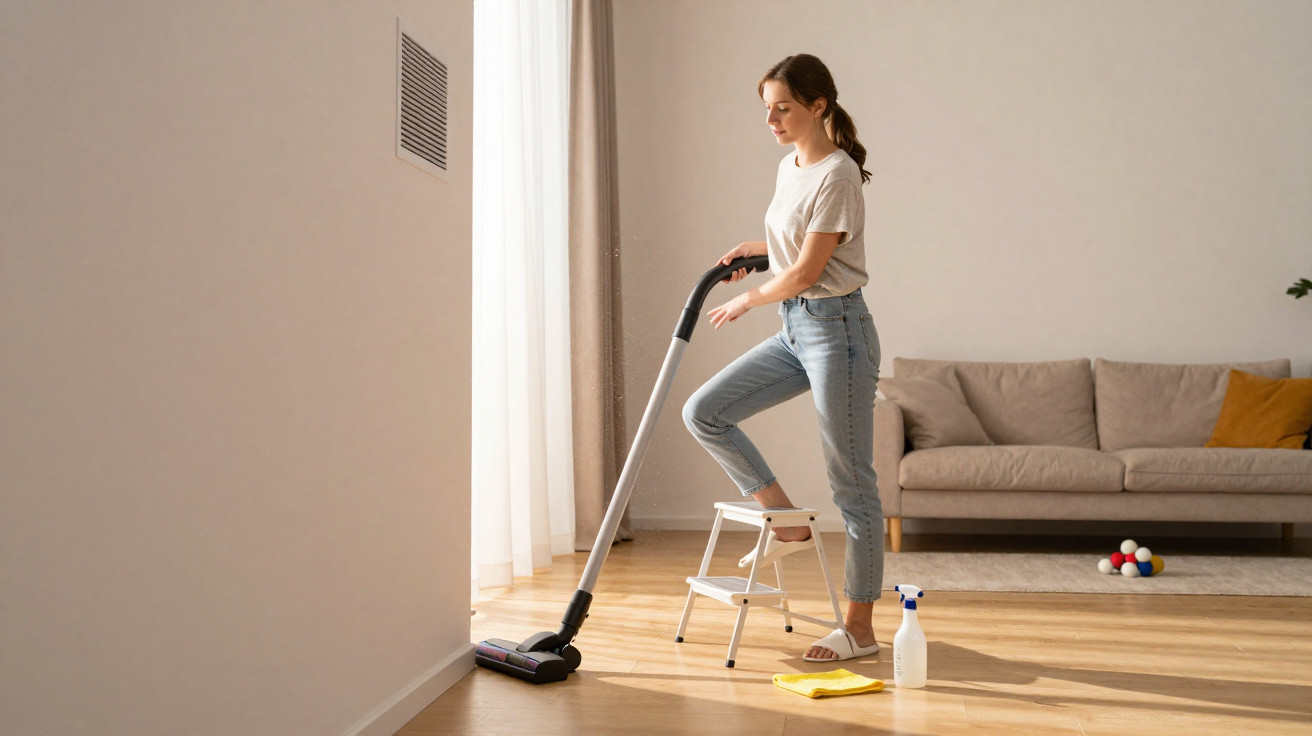
Two overlooked areas are usually to blame.
Many people put real effort into cleaning their home yet still feel that dust returns faster than they can remove it. Poor cleaning habits are rarely the reason. More often, the issue lies with two places that are almost never cleaned, despite being among the biggest dust magnets in the home and potentially affecting health.
Why dust hides in places you would not expect
When cleaning, most people focus on floors, tables and shelves: the horizontal surfaces that are immediately visible. Dust does not follow that logic. It circulates in the air, clings to textiles and builds up in ventilation systems.
The areas nobody considers in everyday life can become genuine reservoirs of fine dust. Over weeks and months, particles settle there before finding their way back into the indoor air.
According to environmental authorities, indoor spaces can be two to five times more polluted than outdoor air – and dust plays a central role.
These dust deposits contain more than skin flakes and fibres. They can also include pollen, pet hair, mite droppings and mould spores. People with sensitive airways or allergies, as well as households with young children or older people, often notice the effects clearly: irritated mucous membranes, headaches, a blocked nose and worsening asthma symptoms.
First problem area: curtains as an invisible dust trap
Curtains and drapes usually hang there unnoticed. They barely register in daily life, which is precisely what makes them ideal dust collectors. Every draught, open window and person walking past causes them to move, allowing them to capture fresh particles constantly.
For dust, textiles work rather like Velcro. Their fibres hold on to particles instead of repelling them. Yet because fabric does not necessarily look visibly “dirty”, it is missing from many cleaning schedules.
How often curtains should actually be cleaned
If someone in the household has asthma or allergies, curtains deserve attention far more regularly than is customary. A practical schedule might look like this:
- Once a month: Take curtains down and shake them thoroughly outdoors.
- Every three months: Clean machine-washable curtains at around 30°C on a gentle cycle.
- In between: Carefully vacuum delicate fabrics with a handheld vacuum and a soft brush attachment.
For routine care, the monthly “fresh-air shock” is generally enough: remove the curtain, shake it firmly on the balcony or in the courtyard, leave it to air briefly, and it is done. This already removes a substantial amount of loose dust with very little effort.
Many fabrics can go in the washing machine without any difficulty. A cool or lukewarm gentle wash with detergent for delicate fabrics is entirely sufficient; high temperatures are unnecessary for removing dust. The care label is the only thing that needs checking. Anyone who gets into the habit of washing their curtains every quarter often notices over time that the air feels fresher and their nose is less irritated in the morning.
What to do with dry-clean-only fabrics
Heavy decorative fabrics and specialist curtains often cannot be washed normally. In such cases, use a handheld vacuum with a brush attachment. Choose a low suction setting so that the material is not pulled in or damaged, then work across the curtain section by section.
For heavily soiled, especially delicate curtains, it may be worth arranging professional cleaning around once a year. Between services, regular vacuuming can significantly reduce the amount of dust.
Second hotspot: ventilation grilles that spread dust throughout the home
Even more underestimated than curtains is an area that affects air quality throughout the whole home: ventilation grilles and air ducts. Whether these are simple wall vents, extractor grilles in the bathroom or complex central ventilation systems, air passes through all of them and carries particles along with it.
Dust catches on the grille slats, attracts further particles and gradually works its way into the ducts. If these areas are never cleaned, a densely packed mixture of dust, pollen, pet hair and moisture can accumulate over the years.
Dirty ventilation grilles can become blocked, disrupt air circulation and actively blow contaminated air back into the room.
Why dirty ventilation grilles can become a health hazard
The consequences are often gradual rather than immediately obvious:
- The air in a room feels “heavy” or stale.
- Headaches and tiredness occur more frequently.
- People with allergies experience more symptoms.
- In damp spaces such as bathrooms or kitchens, mould can develop inside the ducts.
Dust is particularly likely to settle on slightly damp surfaces. If condensation forms in a duct, mould can take hold easily. Its spores may then be carried back into living areas, with corresponding effects on the airways.
Cleaning ventilation grilles: easier than you think
Anyone with a little practical ability can manage the basic cleaning without difficulty. The process is as follows:
- Check the system’s power supply and switch it off if necessary.
- Carefully remove the grille – it is usually secured by only a few screws or clips.
- Vacuum away loose dust using a brush attachment, including around the edge of the opening.
- Wipe the grille thoroughly with warm soapy water and a cloth.
- Let every part dry completely before refitting it.
This usually takes no more than ten minutes per grille. Repeating it roughly every three months is completely adequate for most homes. Anyone with pets or living directly beside a road should shorten the interval slightly.
When a professional is genuinely worthwhile
Complex ventilation systems with several filters, heat recovery or hard-to-reach ducts are a different matter. In these cases, annual servicing by a specialist may be sensible. Professionals do not simply clean the visible grilles; they also inspect filters, seals and the internal air pathways.
After this sort of professional clean, many people find that the system runs more quietly and the air feels noticeably more pleasant. Those concerned about the cost can alternate: carry out the basic cleaning themselves one year, then arrange a professional inspection the following year.
Build a smarter cleaning routine around dust hotspots
Once you understand where dust is most likely to collect, small changes to your cleaning habits can make a considerable difference. Rather than wiping the same table every week, redistributing a little effort often achieves much more.
A realistic plan could look like this:
| Task | Interval |
|---|---|
| Shake curtains thoroughly | once a month |
| Put machine-washable curtains in the washing machine | every three months |
| Vacuum and wipe ventilation grilles | every three months |
| Have a large ventilation system checked by a specialist | once a year |
Making these tasks part of a regular routine – for example, during seasonal deep cleaning or when changing the battery in a smoke alarm – can substantially reduce dust exposure over the long term.
How to tell when dust has become a problem
Alongside visible layers of dust, several signs can indicate that too much is trapped in curtains and ventilation systems:
- Your nose runs unusually often indoors but improves outside.
- Your eyes itch or sting, especially when sitting on the sofa in the evening.
- Children cough more at night than during the day.
- Damp patches remain on the bathroom ceiling for a long time after showering.
Anyone noticing these signs in themselves or other household members should check the curtains and ventilation grilles first. In most cases, they have not been touched for months, and sometimes for years.
Why people with allergies and children benefit most
Fine dust particles can travel deep into the lungs. Healthy adults can usually tolerate this to a limited extent, but more sensitive groups are less able to do so. Children breathe faster and closer to the floor, where many particles collect. People with asthma or house-dust allergies can react even to small quantities.
By addressing this and keeping the two major dust traps in view, people can often save themselves medication, tissues and sleepless nights in daily life. Many affected people report that their symptoms ease noticeably within just a few weeks of thoroughly cleaning curtains and ventilation grilles.
The aim is not to create a clinically spotless home. A little dust is part of life. What matters is keeping control of the places that continuously affect the air: the large areas of fabric in front of windows and the air routes inside the walls.





Comments
No comments yet. Be the first to comment!
Leave a Comment