
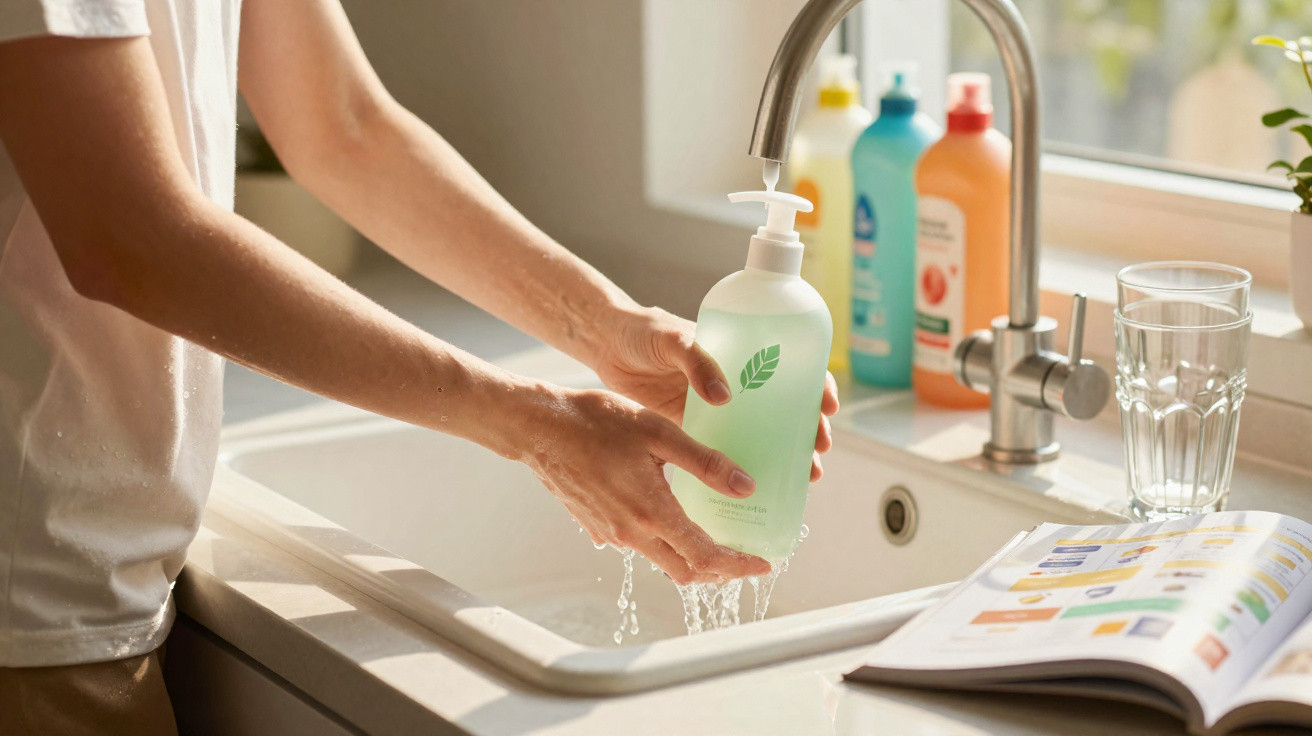
Anyone reaching for the washing-up sponge after a meal rarely considers what is actually in the suds. The French consumer magazine “60 Millions de consommateurs” examined 40 washing-up liquids, revealing major differences in their effects on health and the environment. One product in particular stands out.
Why washing-up liquid has become a health issue
Washing-up liquid is generally seen as an ordinary household essential. It is expected to cut through grease, smell pleasant and cost little; many people ask no more of it. This is precisely the attitude criticised by “60 Millions de consommateurs”: focusing only on fragrance, foam and price can mean overlooking risks to the skin, respiratory system and environment.
The assessment of 40 washing-up liquids shows that attractive bottles often contain potentially problematic surfactants, preservatives and fragrance blends – with consequences for people and nature.
The French consumer publication carried out a wide-ranging market study in January 2024. It covered established branded products as well as liquids marketed as eco-friendly or “sensitive”. The assessment considered:
- ingredients and their possible health risks
- the potential for allergies and irritation in sensitive skin
- how readily substances break down in the environment
- the impact on waterways and aquatic organisms
- whether advertising claims and environmental labels are truthful
The findings show that a green leaf on a bottle does not necessarily mean a gentle formula. Several products presented as “natural” or “ecological” performed unexpectedly poorly under environmental or health criteria.
The most concerning substances in washing-up liquid
The report particularly highlights two groups of substances found in many products. They either provide cleaning power or extend the product’s shelf life.
Surfactants: essential, but not harmless
Surfactants lift away grease and dirt; without them, plates would not get clean. Yet some of these compounds can irritate the skin and eyes, or place a substantial burden on aquatic life.
Frequently cited concerns include:
- intensive removal of the skin’s natural oils, which can lead to cracking and eczema
- limited biodegradability of certain synthetic surfactants
- toxicity to fish and other aquatic organisms
People who wash up every day without gloves are exposed to these substances particularly often and for prolonged periods. That can increase the likelihood of sore, cracked or allergic skin reactions.
Preservatives and fragrance blends
Manufacturers use preservatives to stop washing-up liquid from becoming contaminated in a damp kitchen. Some of these ingredients are suspected of encouraging allergies or contact dermatitis.
Fragrances intended to create “citrus freshness” or a “sea breeze” are another consideration. For sensitive people, they may trigger headaches, skin reactions or asthma symptoms. According to “60 Millions de consommateurs”, this particular combination of surfactants, preservatives and fragrances creates a genuine “chemical cocktail” at the kitchen sink.
The more often hands, airways and the environment come into contact with this cocktail, the greater the cumulative effect may become – even if each individual wash-up appears harmless.
How “60 Millions de consommateurs” tests washing-up liquids
The editorial team does not simply read product labels. Its overall rating incorporates laboratory testing, toxicological assessments and an evaluation of scientific studies.
| Criterion | Questions considered in the test |
|---|---|
| Health | How irritating are the ingredients? Are there recognised allergens or sensitising preservatives? |
| Environment | How effectively do the substances biodegrade? How toxic are they to aquatic organisms? |
| Transparency | Do promotional claims and environmental labels match the formula actually used? |
| Practical use | Cleaning performance, foaming and ease of use – in other words, day-to-day usefulness in the kitchen. |
This blend of laboratory evidence and practical testing gives each brand an individual profile. Some well-known eco labels fare poorly because, while they are better than conventional products, they still contain substances that can affect rivers and lakes.
This washing-up liquid comes top: number 1 for health and the environment
Although many products produced concerning results, there are positive findings too. One washing-up liquid manages the balance between effective cleaning, good skin tolerance and a lower environmental impact especially convincingly.
“Palmolive Peaux Sensibles” takes first place in the “60 Millions de consommateurs” ranking – as the clear favourite for people with sensitive skin and environmental awareness.
According to the investigation, this product performs particularly well because of:
- a reduced number of potentially irritating substances
- a formula that avoids especially harsh surfactants
- good cleaning results, including on grease and dried-on food residues
It is therefore aimed specifically at users whose hands dry out quickly or who have already reacted to other washing-up liquids. Its combination of cleaning strength and a milder formula earns it the leading position.
Other recommended alternatives in the test
“Palmolive Peaux Sensibles” is not the only strong performer. Two further products score well in the study and offer alternatives, especially for households aiming to make more informed purchases.
Arbre Vert Peaux Sensibles: emphasis on a gentle formula
As its name suggests, “Arbre Vert Peaux Sensibles” is designed for people with sensitive skin. The test report states that it contains considerably fewer irritating ingredients than many standard products, while still maintaining respectable cleaning performance.
Those who regularly wash up without gloves, or who already have atopic dermatitis, eczema or known contact allergies, may benefit from this type of formula. The editorial team notes that it achieves a fairly successful compromise between effectiveness and gentleness on the skin.
Ecoplanet Amande by Carrefour: an environmental alternative
“Ecoplanet Amande” by Carrefour also receives particular attention. Its composition is identified in the test as comparatively environmentally considerate. Its effect on waterways is substantially lower than that of many conventional competing products.
According to “60 Millions de consommateurs”, “Ecoplanet Amande” is among the most environmentally interesting products in the entire ranking.
The formula is intended to offer improved biodegradability and lower toxicity to aquatic organisms. For households concerned not only about their own skin but also about rivers and lakes, it represents a relevant option.
What the study means for UK consumers
The products tested come from the French market. Even so, the investigation offers broader lessons that also apply in the United Kingdom.
- Labels such as “Sensitive” or “Gentle” may indicate milder formulas, but they are no substitute for checking the ingredients.
- An eco label does not automatically guarantee an ideal environmental profile.
- Less fragrance, less colour and fewer marketing slogans often point towards more simply formulated products.
Anyone who does not wish to buy a French washing-up liquid can use the same criteria: a formula with as few unnecessary ingredients as possible, credible transparency and reliable assessments from consumer organisations.
How to recognise a more skin-friendly washing-up liquid day to day
On the next visit to the supermarket, it is worth reading the back of the bottle and the detailed product information. A few straightforward principles can help when choosing:
- Choose products explicitly marketed for sensitive skin and without heavy fragrance.
- If in doubt, avoid products that indicate recognised problem ingredients, such as harsh preservatives.
- Use sparingly: the amount added to the washing-up water directly affects the burden placed on waterways.
- Wear gloves where possible, particularly if washing up every day.
Simply switching to a milder product can ease irritated hands. Combining several measures has an even greater effect: making a better product choice, using a lower dose and giving the skin occasional breaks.
Cumulative effects: why small choices add up
A single squirt of washing-up liquid quickly disappears down the drain. Over time, however, the amounts accumulate: families wash up several times a day, restaurants do so even more frequently, and millions of households are doing the same at once. As a result, surfactants, fragrances and preservatives enter the water cycle continuously.
The same cumulative effect applies to the body. Anyone working for years with irritating substances, always without gloves, may risk persistently dry skin or the development of contact allergies. Changing to a better-tolerated washing-up liquid may seem unremarkable at first, but it can prevent considerable trouble over the longer term.
Practical examples: how changing products can affect everyday life
Consider a realistic example: a person with sensitive skin washes up twice a day without gloves. After moving from a heavily fragranced standard liquid to a product tested for sensitive skin, the feeling of tightness in their hands noticeably decreases. Evening hand cream becomes sufficient again, instead of needing to be reapplied several times each day.
In another household, environmental considerations take priority. The family chooses a product with better biodegradability and cuts the dose by one third. The plates still come clean, the bottle lasts longer, and the household’s environmental footprint gradually becomes smaller.
Above all, the study by “60 Millions de consommateurs” demonstrates that washing-up liquid is not an insignificant purchase to make based on scent and price alone. Looking closely and using the tested products as a guide protects more than plates and pans: it also helps safeguard personal health and the environment, every day and with every wash-up.




Comments
No comments yet. Be the first to comment!
Leave a Comment