
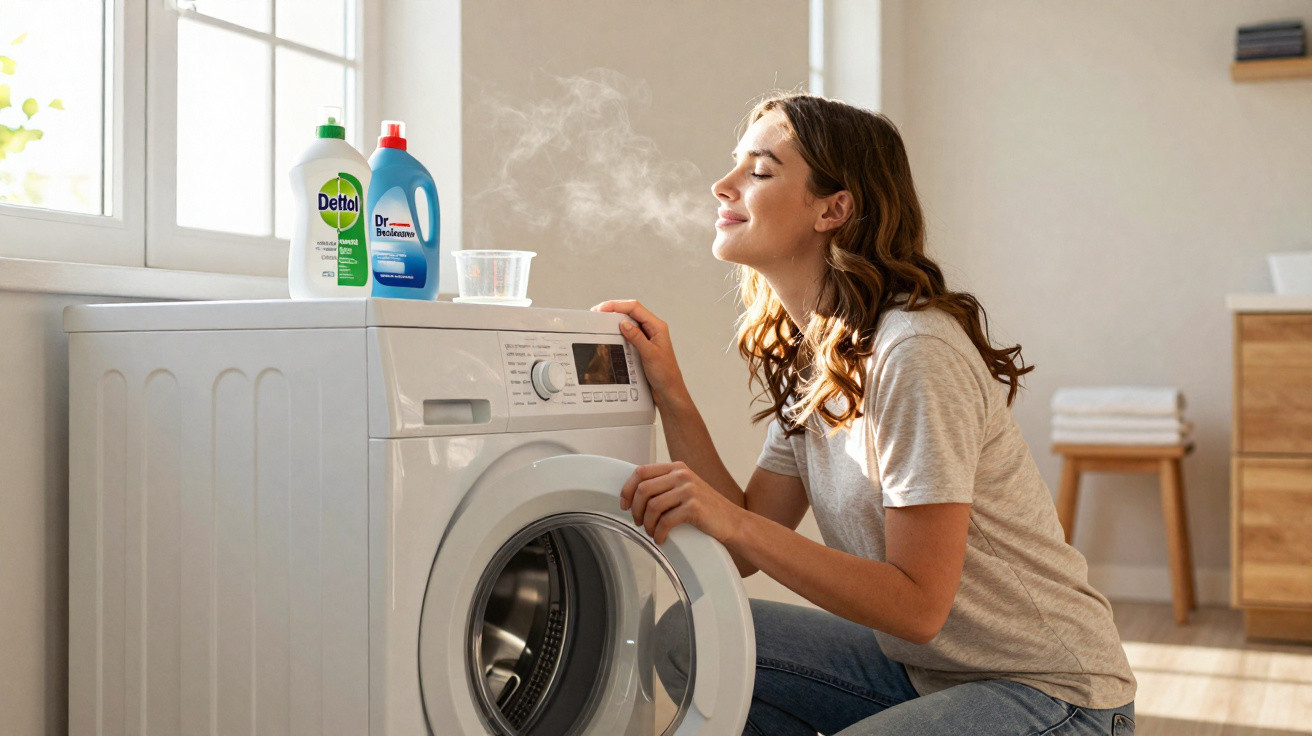
A British front-loading washing machine had a persistent damp-basement smell, despite its drum and door looking spotless. Rather than immediately calling an engineer, its owner put two widely available specialist cleaners to the test: liquid Dettol Washing Machine Cleaner and powdered Dr Beckmann Service-it Deep Clean. Both claim to deliver hygienic freshness, but this practical comparison revealed which product could genuinely remove stubborn washing-machine odours.
Why apparently clean washing machines can still smell
From the outside, a washing machine can look immaculate: no grime around the drum, a clear door and seemingly nothing to worry about. The smell, however, can tell a very different story. Over months, detergent residue, grease, skin flakes, lint and limescale can collect in hoses, behind the drum, inside the detergent drawer and around the rubber seal. These are precisely the areas where bacteria and mould can thrive.
The following common household habits are particularly problematic:
- regularly using quick cycles at 30°C or 40°C
- continually selecting low-temperature Eco programmes
- washing with liquid detergent and fabric conditioner
- keeping the door and detergent drawer closed after a wash
This creates a warm, damp environment that is ideal for microorganisms. They break down the residue and produce the musty smell that can then transfer to towels and bed linen.
“A drum may look sparkling clean and still smell unpleasant – the real problem areas are hidden behind plastic and metal.”
Dettol vs. Dr Beckmann: the test conditions
The test used a persistently smelly front-loading washing machine in a British household. The owner had previously tried soda crystals without success, as the odour returned after every wash.
Both products came from the supermarket shelf and were similarly priced: Dettol is a liquid machine cleaner, while Dr Beckmann comes as a single-dose powder. To make the comparison fair, each cleaner was used in the same empty 60°C maintenance wash. This made it possible to assess how much the smell and visible build-up changed after just one application.
What Dettol actually cleaned on the washing machine
Dettol was used first, although the method was slightly adapted to clean the visible surfaces thoroughly too. One tablespoon of cleaner was mixed with around 200 millilitres of hot water. This solution was first used to scrub three typical problem areas:
- the detergent drawer, which had dried-on detergent deposits
- the rubber door seal, which had a soap line and black spots
- the glass door, which had light surface residue
The results were clearly visible: the crusted deposits in the drawer came away, the seal looked substantially cleaner and the glass was free of greasy film. The cleaner had a noticeable effect here, making Dettol well suited to cleaning the visible parts of the machine.
The drawer was then put back into the machine, the remaining Dettol was poured in, and an empty 60°C cycle was run. Once the programme had finished, the drum looked slightly shinier, suggesting that deposits had also loosened inside.
However, opening the door still released a lingering musty odour. It was less intense than before, but was unquestionably still there. The machine had improved visually, yet the underlying smell deep inside had not been completely removed.
“Dettol restored shine to the drawer, glass and seal – but the treatment alone was not enough to tackle the deeply embedded smell inside.”
Why Dr Beckmann came out ahead in the direct comparison
Dr Beckmann’s powder was used in the second round. This time, the tester did not carry out any additional scrubbing, as the clearly visible areas had already been cleaned. That made it easier to see what the product could achieve deeper inside the machine.
The full contents of the powder were placed in the detergent drawer. Rather than using the 40°C programme recommended on the packaging, another 60°C wash was selected to keep the test conditions identical. The machine ran empty, with no detergent or other additions.
Then came the moment of truth after the cycle: when the door was opened, there was no longer a damp-basement smell, only a light floral fragrance. Towels washed afterwards no longer picked up a stale note, strongly indicating that the odour had been largely removed from inside the machine rather than merely masked.
Dr Beckmann presents its product as a deep cleaner that removes residue and limescale, kills 99.9 per cent of bacteria and fungi, and is intended to help extend the machine’s lifespan and efficiency. The practical comparison supported that claim: in terms of odour removal, the powder clearly outperformed its liquid rival.
“In the test, the stubborn washing-machine smell disappeared only after using Dr Beckmann – and later loads smelled neutral again too.”
Which washing machine cleaner is suitable for whom?
The trial offers several practical takeaways for everyday use:
| Product | Strengths | When does it make sense? |
|---|---|---|
| Dettol Washing Machine Cleaner | Good visible cleaning performance on the drawer, glass and seal; antibacterial effect | For slightly musty machines, routine maintenance, or when appearance is the main concern |
| Dr Beckmann Service-it Deep Clean | Strong effect on deeply embedded odours and hidden residue; also combats fungi | For persistent, pungent smells, as an occasional intensive treatment |
Regular hot washing, such as washing bed linen and towels at 60°C with biological powder detergent, can prevent many of these problems. In households with children, sportswear and predominantly 30°C washes, however, biofilm develops more quickly. In these cases, specialist cleaners can be useful every one to two months.
How to prevent washing-machine odours
Whichever product is chosen, a few simple routines can help keep smells under control over the long term:
- leave the door and detergent drawer open after every wash so that everything can dry
- run a 60°C programme with biological powder detergent at least once a month
- use liquid detergent and fabric conditioner sparingly, without exceeding the marked dosage
- wipe the rubber seal and drawer with a cloth every few weeks
- clean the lint filter regularly, especially in homes with pets
People who prefer household remedies often use vinegar or bicarbonate of soda. While these can loosen deposits in the short term, acid in high concentrations can eventually damage seals and metal. Specialist washing-machine cleaners are formulated specifically not to harm internal materials, which is particularly worthwhile for newer appliances.
What the test means for households in Germany
Many households in Germany will already know both brands from supermarkets. The products tested are aimed at users who want to keep their machine clean not only on the outside, but also tackle concealed sources of odour. The trial makes the difference fairly clear: liquid cleaners such as Dettol perform well on visible dirt and provide a quick refresh, while a powerful powder such as Dr Beckmann can reach further into the washing machine’s system.
Anyone who repeatedly notices a hint of basement or wet-dog smell from a freshly washed load, even though the drum is gleaming, should plan a proper deep clean rather than simply scrubbing the rubber seal. A targeted intensive cycle with a deep cleaner, followed by regular hot washes and allowing the machine to dry properly, can make the difference between “it will do” and genuinely fresh laundry.





Comments
No comments yet. Be the first to comment!
Leave a Comment