
There is another way.
When this happens, many people instinctively reach for harsh drain cleaners or combine vinegar with bicarbonate of soda. Both approaches can work, but each has drawbacks. It becomes interesting when an unassuming item from the kitchen cupboard is involved – something few people associate with drainage problems, yet which can be surprisingly effective.
Why bathroom basins and kitchen sinks so often become blocked
Before using a household remedy, it is worth considering the cause. A blocked drain is rarely simply bad luck; it is usually the result of everyday habits.
- In the bathroom, hair, beard trimmings and nail clippings collect in the trap.
- Soap residue, shower gel and shampoo also create a sticky coating.
- In hard-water areas, limescale builds up on the pipe walls as well.
- In the kitchen, grease, food scraps and coffee grounds end up in the drain.
- Installation issues, such as insufficient fall or poorly positioned bends, slow the flow of water.
As a result, the internal diameter of the pipe gradually narrows. At first, water merely takes a little longer to drain. Eventually, a genuine blockage develops: first noticed through gurgling and unpleasant smells, then through standing water.
Regularly removing grease, soap film and light deposits from drains prevents costly emergencies – usually without any chemicals.
The surprising miracle remedy: ordinary table salt
Most guides recommend concentrated vinegar and bicarbonate of soda first, or a chemical drain cleaner straight away. These can certainly work, but they have disadvantages: vinegar and bicarbonate of soda are not always powerful enough, while chemical cleaners harm the environment and may damage pipes.
One modest option is often overlooked: ordinary table salt. It is not a specialist product or an organic miracle cure – simply salt from the kitchen cupboard. It can make a remarkable difference, particularly when a blockage is only just beginning.
How to use salt in the drain correctly
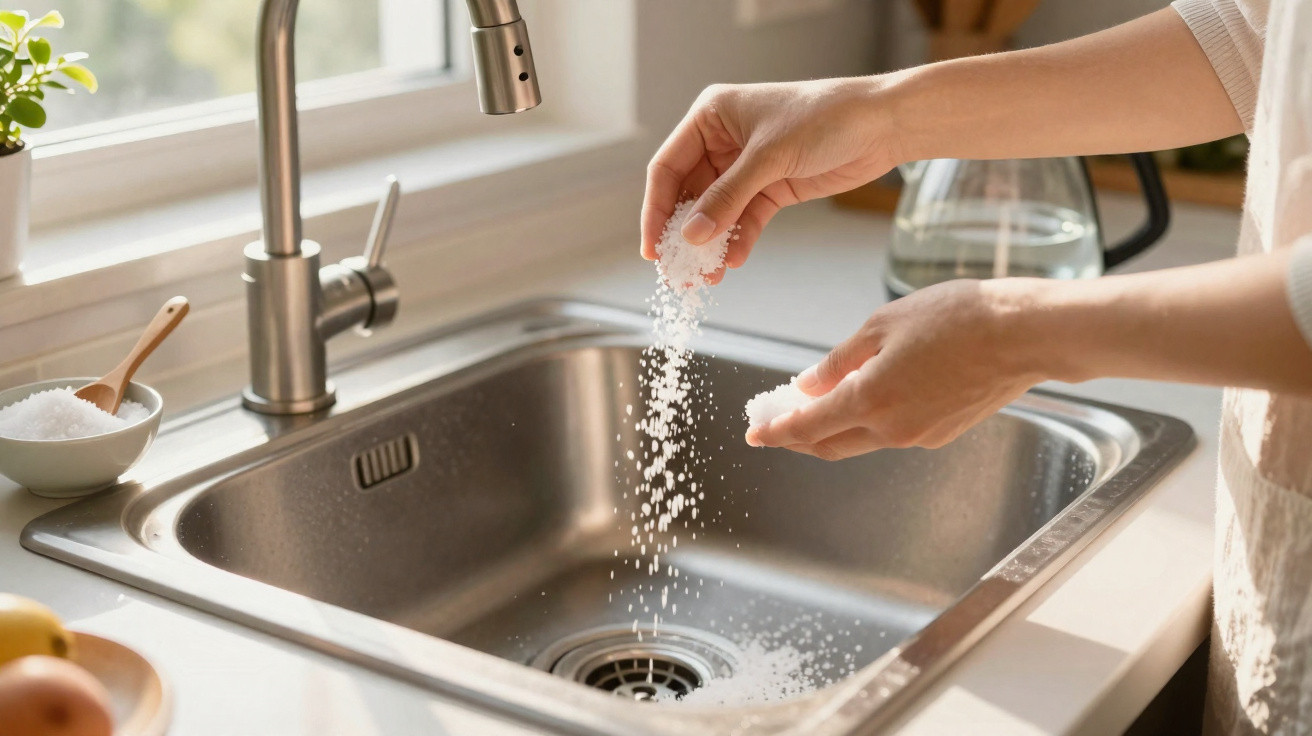
This method takes only a few minutes to prepare and needs just two ingredients: salt and hot water.
- Let any water drain away until the drain opening is accessible.
- Pour 5 to 7 tablespoons of table salt directly into the drain.
- Leave it for 30 minutes without running any water.
- Then slowly pour around 2 litres of boiling water down the drain.
- Allow it to work for 10 minutes, then flush with hot tap water.
- Repeat the process a second time if needed.
The salt binds grease and loosens deposits from the pipe, while the boiling water washes away the softened residue – often one treatment is enough.
Why salt works so well in a drain
Salt does not work by “magic”; its effect is based on straightforward physical and chemical properties – and that is precisely what makes it useful.
| Property of salt | Effect in the drain |
|---|---|
| Crystalline structure | Acts as a gentle abrasive, rubbing at deposits. |
| Hygroscopic (attracts water) | Helps grease and soap residue swell and loosen. |
| High solubility in water | Is carried away effectively by hot water, taking dirt particles with it. |
| Low aggressiveness | Has little effect on plastic and metal pipes. |
There is also the cost: table salt costs only a fraction of the price of commercial drain cleaners. Almost every household already has it in the cupboard, so an impromptu emergency drain-clearing treatment is easy to carry out.
Salt instead of harsh chemicals: everyday advantages and disadvantages
The main benefits of the salt trick
- Cost benefit: One treatment costs only a few pence, even when using a generous amount.
- Environmental aspect: No harsh surfactants or strong alkalis are needed.
- Kind to materials: Salt is considerably milder than many chemical cleaners.
- Easy storage: It is not hazardous, has no child-warning symbol and produces no fumes.
- Prevention: Used as a preventative treatment, salt helps pipes stay clear for longer.
The method does have limits, however. A completely blocked drain, perhaps with a solid foreign object lodged inside, is unlikely to respond much. Thick, old grease plugs that have developed over years may also require mechanical assistance.
When it is better to combine other methods
In some cases, pairing salt with simple tools is more effective than using salt alone:
- Blocked kitchen sink with a lot of grease: Start with salt and boiling water, then pump firmly with a rubber plunger.
- Clump of hair in the bathroom: Unscrew and clean the trap beneath the basin mechanically, then use the salt treatment to maintain the pipework.
- Recurring light blockages: Apply the salt treatment once a week to stop deposits building up in the first place.
Salt does not replace a plumber in every situation, but it postpones many call-outs – and can make some unnecessary.
Common mistakes that make drains block more quickly
Slightly changing everyday habits means the salt trick will be needed far less often. Several common mistakes are easy to avoid:
- Pouring grease down the drain: Collect cooking fat, frying oil and sauce leftovers in a container and dispose of them with general household waste instead.
- Rinsing away coffee grounds: They settle in pipes like sludge. Put them in food waste or use them as garden fertiliser instead.
- Wet wipes and cotton pads: They barely break down and can form hard blockages.
- Not using strainers: A simple basin or sink strainer reliably catches hair and food residue.
- Rarely using hot water: Rinsing only with cold water allows grease to build up much faster.
Adding a salt-and-hot-water routine every few weeks counteracts these mistakes. It is especially worthwhile as a regular habit in larger households, perhaps at the weekend after a major cooking or laundry day.
Practical situations: when the salt trick works particularly well
A quick look at everyday scenarios shows how differently the method can perform.
Situation 1: The drain is merely “sluggish”
The water still drains, but noticeably more slowly than it used to. This is where salt shows its strengths. The deposits are still soft, and light grease films and soap residue loosen quickly. One or two treatments are usually enough to restore the previous flow.
Situation 2: It gurgles and smells, but water is not standing
Gurgling noises often indicate air bubbles forcing their way through partly narrowed sections. Salt and hot water frequently clear these constrictions. There is a further benefit: unpleasant odours disappear because less organic material remains caught in the pipe.
Situation 3: The drain is completely blocked
Here, the method can sometimes reach its limits. Water that remains completely still may indicate a solid object is stuck or that the trap is full. Mechanical cleaning often comes first in these cases: open and clean the trap, then flush the downstream pipes with salt and hot water.
Risks, limits and useful additions
Salt is among the safer household remedies, but it is not entirely risk-free. Anyone with plastic pipes should pour boiling water in slowly, allowing it to cool slightly inside the pipe and preventing thermal shock.
The quantity also matters. Using one larger portion of salt occasionally is unproblematic. Pouring large amounts down the drain every day may, over time, contribute to slight corrosion in very old pipework – especially metal pipes in poor condition. Under normal household use, though, this is rarely an issue.
Combining it with other gentle methods is sensible:
- use a plunger from time to time
- fit drain strainers
- use a simple drain snake occasionally where hair is a major problem
What terms such as “limescale” and “deposit” actually mean
Many people refer to “limescale” or “deposits” in blocked pipes without knowing exactly what these terms mean. Limescale forms when hard water is heated. Calcium and magnesium ions precipitate and settle as a solid layer on pipes and fittings. This limescale readily combines with grease, soap residue and hair – creating ideal conditions for blockages.
A “deposit” is usually a mixture of limescale, organic material such as skin flakes, food residue and hair, plus surfactants from cleaning and personal-care products. Salt and boiling water do not attack the limescale core, but they do shift the softer outer layers. This reduces the size of the plug, gives water more room to flow again and allows it to carry away parts of the build-up.
Anyone wishing to reduce limescale problems further can consider a water softener, or at least descale taps, shower heads and traps regularly. This reduces the risk of substantial hard layers forming in pipes, against which household remedies have little chance of succeeding.





Comments
No comments yet. Be the first to comment!
Leave a Comment