
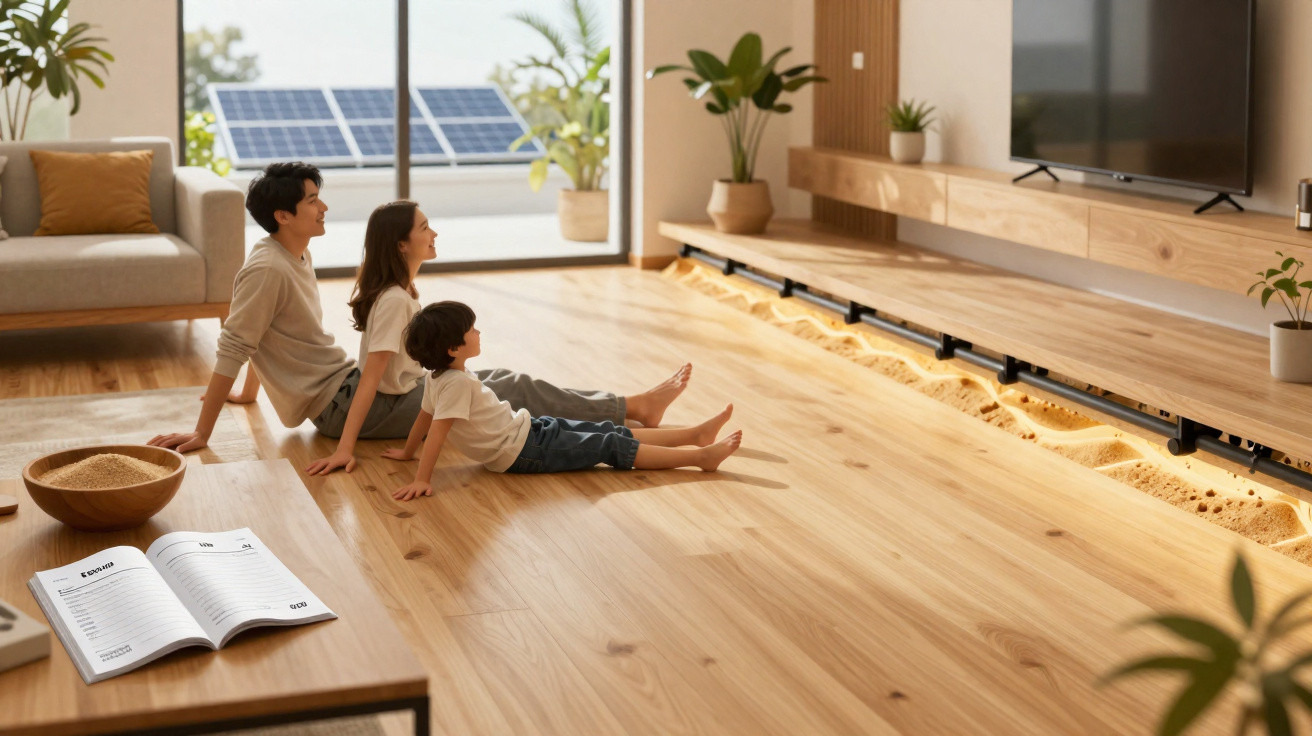
In laboratories thousands of miles from London and New York, an ambitious system with a decidedly low-tech name is being developed: a solar-powered floor containing sand that stores warmth like a vast rechargeable battery beneath your feet.
An unexpected challenger to radiators and gas boilers
With the climate getting warmer and energy prices fluctuating sharply, established heating systems face pressure on several fronts. Gas boilers are being phased out, oil supplies are politically vulnerable, and electric heaters can consume a household's budget during one cold month.
Scientists at China's Zhongyuan University of Technology and Dalian University of Technology believe they have identified a markedly different solution: make a home's entire floor a smart thermal sponge. The principle is straightforward, despite its ambition - inexpensive, widely available sand serves as a heat store, supplied by solar power and assisted by a heat pump.
Instead of heating the air quickly and losing warmth just as fast, the new system slowly charges a sand layer beneath the floor, then releases steady heat for hours, even when the sun is gone.
That is a clear departure from most existing approaches, which either burn fuel as required or draw electricity in brief, costly surges. Under this model, the building itself becomes part of its energy system.
How the sand-based solar floor works
The three-part system under your feet
The Chinese prototype combines three principal elements that operate together continuously:
- Solar panels on the roof generate electricity whenever daylight is available.
- A solar heat pump concentrates that energy and transfers heat into the property.
- A 20-centimetre sand layer beneath the floor retains the heat before releasing it gradually.
When conditions are sunny, the panels supply power to the heat pump. Rather than using all that energy solely to heat air or water immediately, the system sends much of it into the sand bed underneath the occupied space. The sand then performs the role of a large thermal battery, preserving heat until it is needed.
Think of it as charging your floor during the day so it can quietly keep you warm at night, without the boiler kicking in every half hour.
Once clouds arrive or evening begins, the retained warmth moves upwards through the floor construction, delivering a mild and consistent temperature for residents. During an extended cold, overcast period, the heat pump can fall back on grid electricity, although it would operate at lower power than a standard whole-house heating system.
A different kind of comfort
Conventional radiators and fan heaters force out hot air, which can create sharp temperature changes and colder areas of a room. Sand storage beneath the floor operates more gradually and consistently. Heat rises from below and spreads more evenly through rooms, often making it possible to lower the thermostat slightly without reducing comfort.
The method may also limit air circulation. For people with allergies, or those affected by dust, reduced convection means fewer particles are moved around and a calmer indoor setting.
Why sand makes sense as a heat battery
Sand may not initially seem like an advanced material, but it offers several notable engineering benefits:
- Abundant and cheap: it is available in most places and does not rely on exotic materials.
- Stable and non-toxic: there are no chemicals that can leak and no difficult recycling procedure.
- Good thermal capacity: a relatively thin layer can retain a substantial quantity of heat.
- Static installation: after installation, it requires very little upkeep.
By using ordinary sand as the core storage medium, researchers aim for a system that can scale without depending on rare minerals or fragile global supply chains.
The 20-centimetre layer specified in the research balances heat-storage capacity with practical construction requirements. A deeper layer would retain more heat, but would require structural alterations and greater initial expenditure. Shallower layers react more quickly, but store less energy.
Could this cut household bills?
No official price for commercial installations has been announced, and the prototype remains at the research stage. Even so, several factors suggest favourable long-term economics:
| Factor | Impact on costs |
|---|---|
| Rooftop solar production | Reduces dependence on grid electricity and gas |
| Heat storage in sand | Shifts energy use to cheaper or free hours |
| Continuous low-level heating | Prevents sharp peaks in power demand |
| Limited moving parts in the floor | Potentially lower maintenance than complex boilers |
The Chinese researchers expect the system could be relatively inexpensive to build because its principal materials - sand and concrete - cost little. The heat pump, solar array and installation work are likely to account for most of the expense.
For householders, its financial value will vary according to local weather, electricity tariffs, available grants and building restrictions. In colder locations with strong winter sunshine, including parts of the US Mountain West or southern Europe, payback may be quicker than in dark, damp climates.
What this could mean for older homes and new builds
New constructions: where it fits most easily
The sand-floor approach is especially well suited to new-build properties. From the outset, architects can specify deeper floors, insulation beneath the slab, and room for the heat pump and solar cabling. In certain projects, it could replace both radiators and conventional underfloor water pipe loops.
For developers working under tighter emissions regulations, this type of system could help meet energy-performance targets without relying on more complicated mechanical systems.
Renovations: promising but tricky
Installing the technology in existing properties presents a different challenge. Raising whole floors to accommodate a 20-centimetre layer of sand and insulation could cause considerable disruption, particularly in flats or older homes with timber joists.
The technology may first appear in pilot projects, eco-districts and high-efficiency new homes before slowly spreading to renovation markets where structure and budget allow.
Hybrid arrangements are possible too: one section of a property might use sand-floor storage, while other spaces retain conventional radiators or electric panels. Intelligent controls could manage both, prioritising stored solar heat as the first defence against cold weather.
How it compares with other low-carbon heating options
Today's households must choose from a complicated range of “green” heating technologies. The sand-based system sits alongside several more familiar options:
- Air-source heat pumps: widely encouraged across Europe and the US, they are straightforward to install but become less efficient in extreme cold.
- Ground-source (geothermal) heat pumps: very efficient, although costly to fit because they require boreholes or trenches.
- Biomass boilers: these burn wood pellets or chips, which may be low-carbon but require fuel storage and deliveries.
- Standard underfloor heating: this relies on water pipes embedded in concrete and is commonly powered by a boiler or heat pump.
The Chinese sand-floor system does not directly compete with every one of these alternatives. Instead, it brings together features of underfloor heating and ground-source storage, placing the storage element immediately beneath the living area rather than in deep soil or large water tanks.
Its principal advantage is that it can smooth energy use over time: it captures solar power when available, then releases it when the home needs heat most, without requiring residents to repeatedly adjust controls.
Key concepts behind the technology
Several technical principles underpin this innovation and determine how effectively it may work:
- Thermal inertia: Sand and concrete warm up and cool down gradually. This helps maintain stable indoor temperatures, although it makes very rapid changes more difficult.
- Coefficient of performance (COP): This indicates how much heat a pump provides for each unit of electricity consumed. Higher COP values mean the system can make each solar watt it receives more useful.
- Seasonal storage: Although the Chinese system currently focuses on daily and weekly cycles, researchers are already considering whether deeper layers or coupling with deeper ground could preserve summer heat for winter.
For households, these ideas become practical questions: How consistent will indoor temperatures feel? How much electricity will be needed during a dark week in January? How long will the investment take to repay itself?
What living with a sand-heated home could look like
Picture a normal winter day in a medium-sized northern city. Frost covers the garden at sunrise, yet stored heat has already warmed the floor. Rather than being woken by a boiler starting noisily, you experience steady warmth that is almost unnoticeable in the background.
By midday, roof-mounted solar panels are producing excess electricity. A controller routes some of that power to the heat pump, adding more warmth to the sand layer below the living room. When you get home from work later and outdoor temperatures fall, the system does not need to race to recover - it has been replenishing its heat store quietly throughout the day.
In this kind of scenario, the home behaves less like a consumer and more like a small, self-managing energy system, trading short spikes of demand for a calm, predictable profile.
Important questions remain, including performance in severe cold, the floor structure's long-term durability, and how the system could be repaired or upgraded without significant disruption. However, as nations seek scalable ways to warm millions of homes without fossil fuels, using sand as a quiet everyday battery is beginning to look less like a novelty and more like a serious option.





Comments
No comments yet. Be the first to comment!
Leave a Comment