
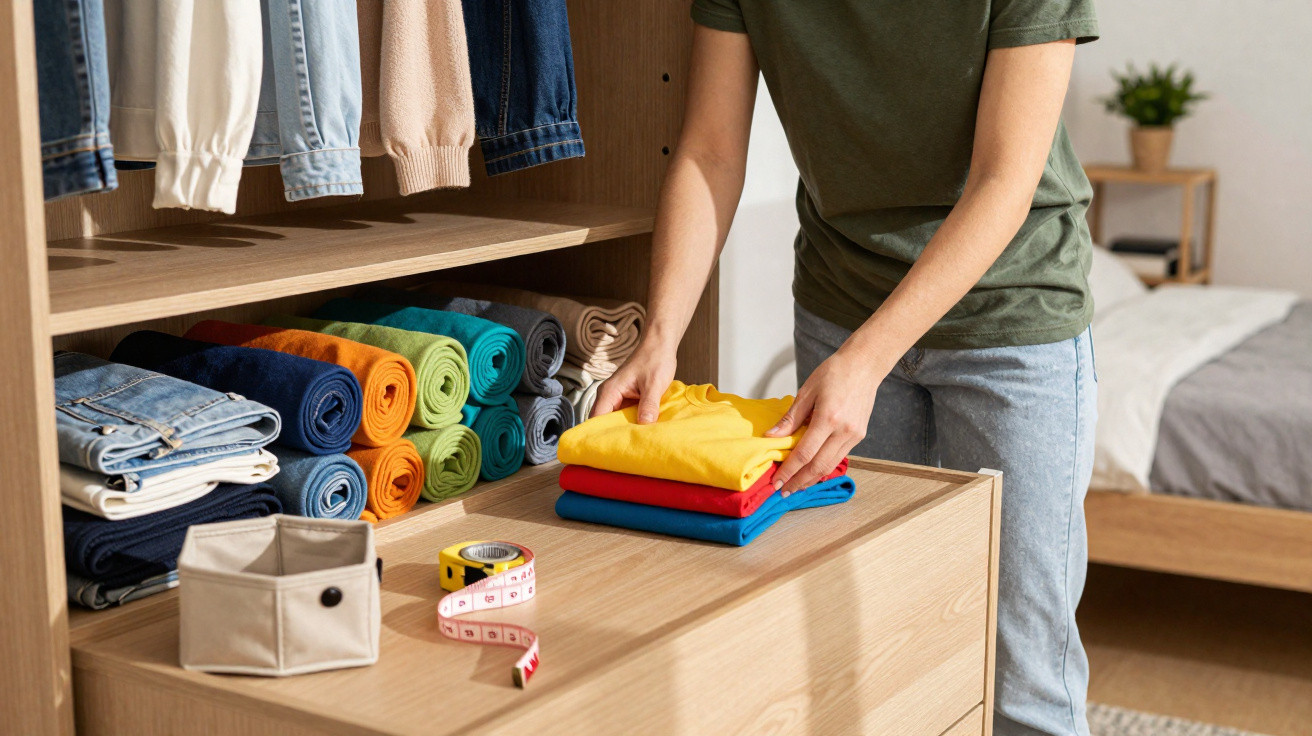
You fling open the wardrobe in a hurry, pull out a T-shirt… and an avalanche of clothes lands on your head.
Half of them are creased, while you had forgotten the other half even existed. The rail looks ready to bend, the shelves are permanently covered in lopsided stacks, and that favourite shirt always disappears just when you need it. The feeling is almost physical: clutter, wasted time and space slipping through your fingers. Then comes the automatic thought: “I need a bigger wardrobe.” But do you really?
The quiet problem of a full wardrobe and wasted space
We have all had that moment when the wardrobe door barely shuts and you have to push it with your knee to make it “work”. Clothes are crammed on top of each other, garments slide about and drawers jam. Yet when somebody organises things properly, almost as if by magic, half the space seems to return. It is not an illusion; it is technique. Professional organisers often say that the issue is not how many clothes you own, but how they are folded and stored. The good news is that you can learn this quickly.
A personal organiser working in São Paulo says she can typically cut the space taken up by 30% to 50% simply by changing the folding method. She recalls one striking example: a couple were considering replacing their wardrobe with a larger one. After one day’s work, without giving away a single item, everything fitted comfortably and there was even an empty shelf left over. The T-shirts that had previously been stacked in unstable towers were placed upright in the drawer. Trousers were all folded using one consistent method. The owners felt as though they had gained a new walk-in wardrobe without having to knock down a wall.
There is an almost mathematical principle behind it. Folding clothes into large rectangles and piling them up wastes vertical capacity, leaves pockets of air between garments and makes everything prone to the familiar “domino effect”: remove one item and the rest fall down. The method that can halve the space used works in the opposite direction. Rather than thinking in terms of stacks, it relies on small, compact blocks designed to stand upright beside one another. That changes everything: how the fabric sits, how easily you can see what you own and how much the wardrobe can hold. It may sound like a simple trick. It is.
The ‘folding in thirds’ trick that makes clothes take up less space
The essence of the trick is folding garments “in thirds”, finishing with a firm roll. It works especially well for T-shirts, lightweight knitwear, pyjamas and even shorts. Start by laying the item flat on a smooth surface, then run your hand over it to remove major creases and picture its width divided into three sections. Fold one side into the middle, then bring the other side over, creating a long, narrow strip. Next, fold the lower hem towards the neckline, again working in three sections, until you have a compact rectangle. Finally, roll or fold the garment back over itself so it gains enough structure to be self-supporting and stand upright.
This may seem like a minor movement, but it transforms how a wardrobe functions. Instead of tall, collapsing towers, you get low rows of equal height, like books on a shelf. You can see every print and colour without rummaging through the back. The biggest pitfall is trying to do it hastily, without a system. Let us be honest: no one manages it perfectly every day. However, if you choose one way to fold T-shirts, another for trousers, and repeat those methods whenever possible, the benefits build up. The wardrobe becomes less hostile and more peaceful to use.
“When someone learns a good fold and repeats it, it is like learning to ride a bike. At first it seems slow, then it becomes almost automatic,” says a personal organiser who teaches the method in in-person workshops.
- Begin with just one category, such as T-shirts.
- Choose one fixed ‘folding in thirds’ method.
- Tackle a few garments each day instead of attempting the entire wardrobe at once.
- Do not pack the drawer too tightly; leave a little breathing room.
- Use boxes or dividers to keep the rolls in a straight line.
When the wardrobe shrinks, life expands a little
Tidying the wardrobe will not solve every problem in the world, but it changes something very tangible: your everyday relationship with time and your own body. When you open the door and can see every item without effort, you choose more calmly and get dressed with less stress. A fold that uses half the space does more than make drawers go further; it also makes you confront what you have been keeping, what no longer makes sense, what you own too many versions of. The space-saving trick becomes a quiet reflection of consumption habits, past phases of life and earlier versions of yourself that have been left behind.
Trying a new folding method is almost a test of patience, but it is also an invitation to be curious. How little space do your clothes truly need? Which garments take on a new life when you can finally see them in front of you rather than buried underneath everything else? By adopting the logic of compact blocks, you free up not only centimetres of shelf space but also a little mental breathing room. Perhaps the next step is to share the method with someone else in the household, turning an afternoon of shared clutter into practical learning, almost a small ritual. Then notice how, little by little, one simple folding movement quietly begins to reorganise your entire routine.
| Key point | Detail | Value for the reader |
|---|---|---|
| ‘Folding in thirds’ | Divide the garment into three sections and compress it into a block or roll | Can reduce the volume used in the wardrobe by up to half |
| Garments upright, not stacked | Store items side by side, like books, in boxes or dividers | Makes everything easier to see and prevents mess when removing an item |
| Organise by category | Use the trick on T-shirts first, then trousers, and so on | Keeps the process manageable, gradual and more sustainable as part of your routine |
FAQ:
Question 1 Does it really work for a very small wardrobe?
Yes. The smaller the wardrobe, the more noticeable the difference this method makes. Compact folding frees both vertical and horizontal space, allowing you to fit in more garments without creasing everything.Question 2 Does this technique not crease clothes more?
If the garment is smoothed properly before folding and is not packed extremely tightly, it is likely to crease less than it would in tall stacks. The key is to adjust the pressure: firm, but not crushing.Question 3 Can I use this trick for jeans and smart trousers?
Jeans work very well with folding in thirds and a compact finish. Smart trousers require a little more care: folding along the seam and avoiding excessive rolling helps preserve the crease.Question 4 How long does it take to fold an entire wardrobe this way?
It depends on how much you own, but a good approach is to set aside 20 to 30 minutes each day and focus on one category. Within a week, most standard wardrobes will look completely different.Question 5 Is it worth teaching children to use this method?
Absolutely. Upright garments are easier to see and pull out without creating a mess. After a few repetitions, children understand the principle and begin putting away their own clothes more independently.



Comments
No comments yet. Be the first to comment!
Leave a Comment