
Your mop is probably sulking in the darkest part of the cleaning cupboard. The vacuum cleaner is trapped behind a suitcase. Sponges sit beneath the sink, covered by carrier bags and half-used bottles. You know all of it is there, yet whenever you think, “I should clean the living room,” your mind immediately pictures the disorder: rummaging around, bending down and getting your hands wet merely to locate a cloth.
So you put it off. Again.
Now picture a different scene. You notice a crumb on the floor, open a cupboard and can see everything straight away. Each item is within reach and almost seems to invite you to use it. You pick something up, wipe the mess away and you are finished.
Same flat, same clutter, same person. A different way to store your tools. A completely different life.
Why hidden, disorganised cleaning tools destroy your motivation
Think back to the last time you planned to clean “just a little bit” but ended up doing nothing. It was not because you lacked time. Your mental energy had already run out before you began. If cleaning tools are awkward to reach, your brain identifies “effort” well before a broom ever touches the floor.
It is easy to overlook the effect of that small amount of friction. Opening a box, dragging out a heavy vacuum cleaner or reaching for a bucket hidden behind shopping bags: every additional action becomes another tiny excuse. You are sitting on the sofa, and suddenly those crumbs no longer seem especially bad.
A family living in a small Paris flat once shared an interesting experience with me. Their living room always looked a little untidy: dust gathered on the TV unit, footprints appeared near the balcony door and pet hair was quietly claiming the rug. Every cleaning item was kept in a deep cupboard in the hallway. Mops were piled up, while cleaning products were mixed in with DIY equipment, lightbulbs and spare bedding.
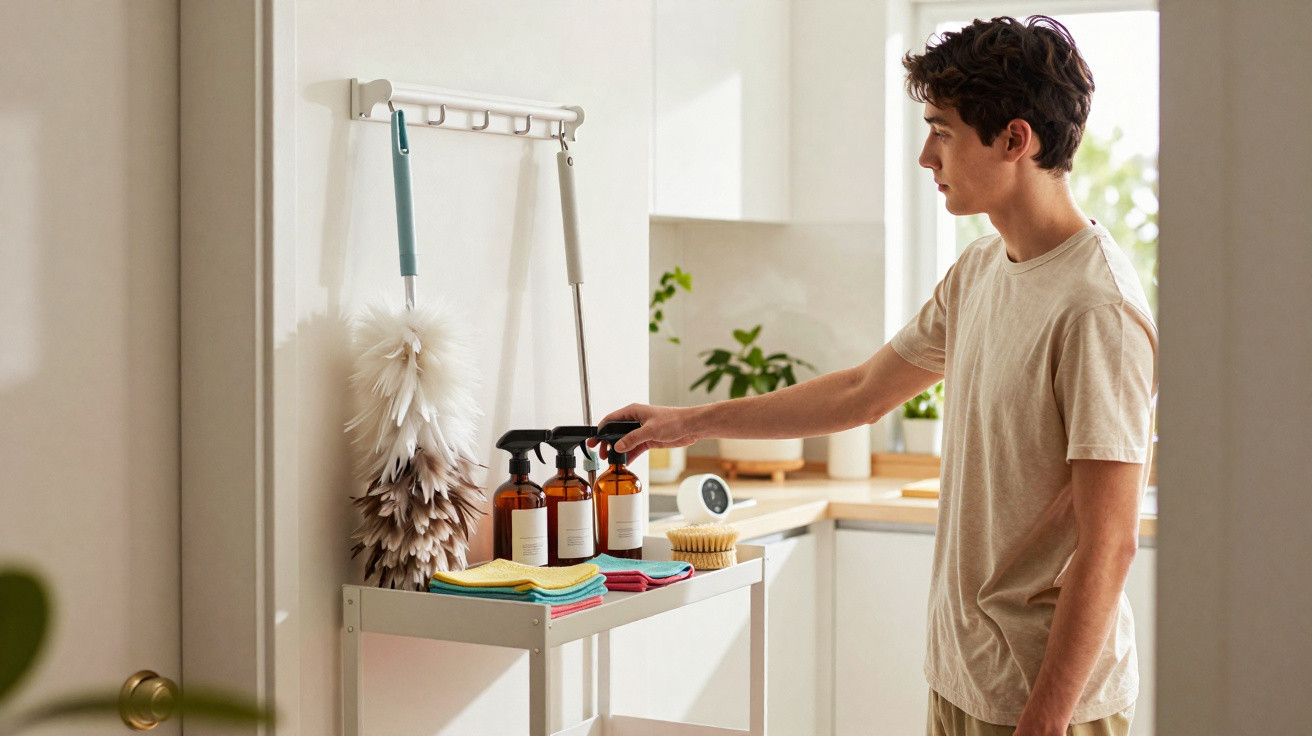
After a small leak one day, they needed to clear out the cupboard. Rather than returning everything to the same place, they set up a “cleaning station” in the kitchen: a single shelf, a rail with hooks and a small wheeled basket. It was nothing elaborate, simply easy to see and access. Within two weeks, they noticed something unexpected. They had begun dealing with small messes every day without intending to. Their major Saturday cleaning session became shorter and less unpleasant.
The reasoning is almost painfully straightforward. Hidden tools make your brain view cleaning as a project. Tools that are visible and arranged according to their use, rather than their type, turn cleaning into a simple gesture. That change alters everything.
Behavioural researchers refer to “activation energy”: the small push required to begin a task. Keeping tools deep inside a cupboard, too high, too low or jumbled with unrelated items increases that activation energy. Leaving them in clear view and grouping them by room or activity cuts it in half. You don’t become more disciplined, you just remove obstacles.
As a result, wiping the sink after brushing your teeth no longer feels like “cleaning”. It simply feels like spending another two seconds.
How to store cleaning tools so cleaning feels almost automatic
Begin by changing the rule followed in most homes: do not keep tools wherever there happens to be room; keep them where you actually use them. Put glass cleaner and a microfibre cloth close to the mirrors, for example. Keep a small handheld vacuum near the sofa and create a mini cleaning kit for the bathroom.
Choose one location in each room. Use one hook for the broom, one basket for products and one shallow tray for cloths. The moment you open the door, everything should be visible: no searching, no heaps of supplies and no “Where did I put the sponge again?”
When you can pick up an item with one hand while holding a phone or coffee in the other, you are likely to use it three times more often.
There is a familiar pitfall here: the desire for a “Pinterest-perfect” cleaning cupboard. Matching bottles, labels and colour-coded cloths are the dream. Then you buy containers, fill and stack them, only to create a beautiful but entirely impractical wall of supplies. Everything becomes overfilled, over-arranged and too precious to disturb.
In reality, nobody manages this perfectly every day. Everyday life includes half-folded cloths and bottles missing their caps. Prioritise accessibility over appearance. If taking out the vacuum cleaner involves three actions, that is two actions too many. If the mop is stored behind the ironing board, you will not mop “quickly”.
You are not trying to impress Instagram. You are trying to persuade your exhausted 9 p.m. self to wipe the worktop.
Sometimes the cleanest homes belong to people who hate cleaning the most - they’ve just made it absurdly easy to start.
Create “micro-stations”
Keep a basket beneath the bathroom sink containing spray, a sponge and a microfibre cloth. Place a tote in the hallway for a shoe brush and mini mat cleaner. When all the supplies for one task are stored together, your brain no longer has to negotiate.Use vertical space wisely
Fit hooks for brooms and dustpans, use over-door racks for cloths and install magnetic strips for small brushes. In compact flats, walls are valuable allies, particularly when the floor is already crowded.Separate “daily” from “heavy-duty”
Keep everyday tools visible and at arm’s height. Equipment for deep cleaning, such as a steam cleaner, large buckets and specialist products, can be stored higher or lower down. When the basics are easier to reach than procrastination, you quietly win.
When cleaning tool storage becomes a quiet habit
Eventually, the question changes from “Am I a tidy person?” to “How easy is it for me to act on a tiny impulse?” You spot crumbs on the table and reach for something before your brain can object. Water splashes on the mirror, and the cloth is right there behind the door rather than in another room.
How you store your cleaning tools determines whether cleaning belongs in the “ugh, later” category or the “I’ll just do it while I’m here” category. The divide between them is narrower than we imagine. One extra movement, one confusing drawer or one heavy basket can transform a 20-second wipe into a chore you postpone.
When someone says, “I’m messy by nature”, they often really mean, “My environment doesn’t support tiny actions.” The amusing thing is that you do not need more tools, improved tools or the latest miracle product. What you need is a more direct route between noticing a mess and reaching the item that can deal with it.
No rigid routine, no systems that take an hour and no guilt-based strategy. Instead, ask yourself one question in every room: if I noticed a stain right now, could I deal with it in under 30 seconds with the items I can see in front of me?
Sometimes the answer is no. And that “no” is rooted in the way you store your broom.
| Key point | Detail | Value for the reader |
|---|---|---|
| Store tools by place of use | Keep essential products and cloths in every main room rather than in one central cupboard | Lowers physical and mental effort, making quick clean-ups almost automatic |
| Reduce “activation energy” | Choose hooks, open baskets and visible shelves rather than deep, overcrowded cupboards | Makes it easier to start a task than delay it, even when you are tired |
| Separate daily from deep-clean gear | Put everyday tools at arm’s height; heavier-duty equipment can be kept farther away | Encourages small, frequent cleaning actions without requiring major motivation |
FAQ:
How many cleaning tools do I actually need?
You usually need far fewer than you own. One all-purpose spray, one degreaser, one bathroom cleaner, glass cleaner, several good cloths, a broom or vacuum cleaner and a mop will normally meet 90% of daily needs.Where should I store my vacuum in a small flat?
Keep it as near as possible to the area you clean most regularly, generally the living room or hallway. A corner behind a curtain, a tall cupboard or even a visible location with a wall hook is preferable to a faraway storage room.Is it okay to keep cleaning products in every room?
Yes, provided you follow safety guidance, particularly where children or pets are concerned. Small bottles or diluted solutions near where they are needed can be more convenient than one overfilled cabinet.How do I stop my cleaning cupboard from turning into chaos again?
Restrict the overall number of products and assign every item a permanent “home”: one hook, one basket or one shelf. Whenever a new item comes in, allow an old one to go out.What if I hate visual clutter and don’t want tools on display?
You can still make accessibility the priority by using shallow baskets, clear organisers and door racks inside cupboards. The principle remains unchanged: every item should be reachable in one or two easy movements.


Comments
No comments yet. Be the first to comment!
Leave a Comment