
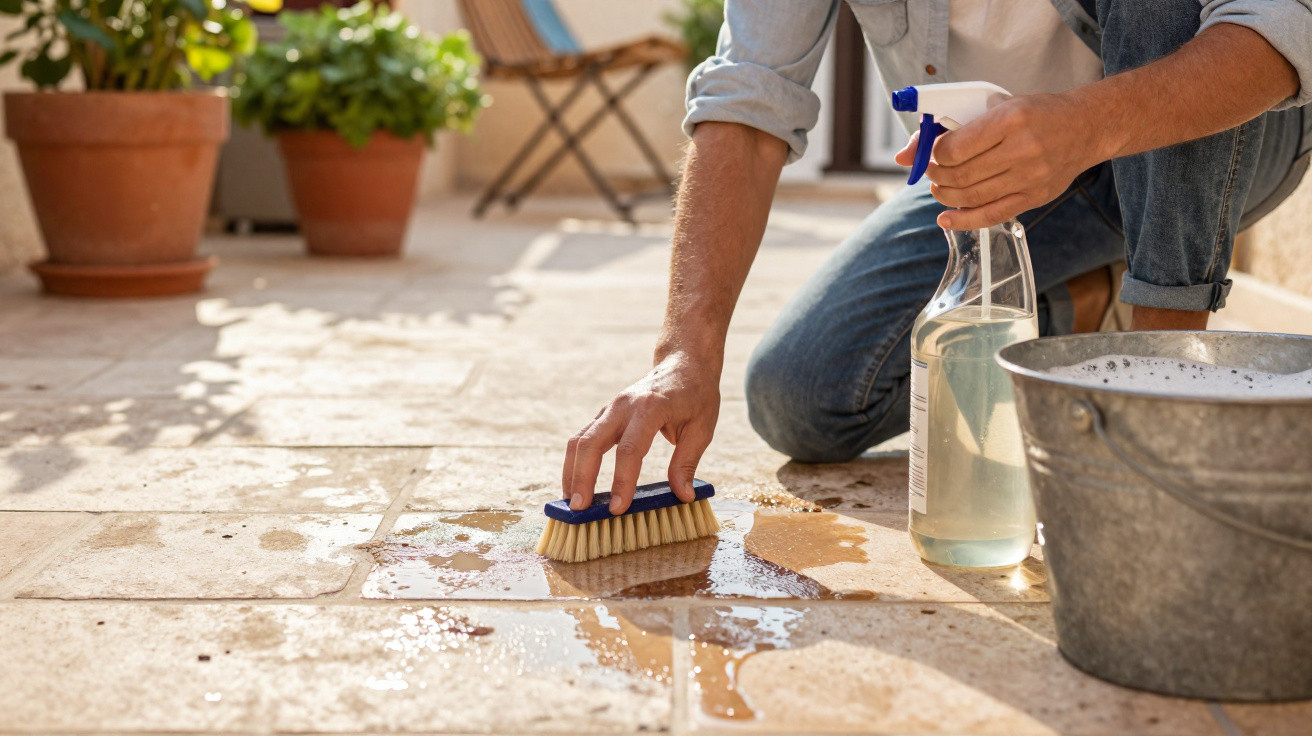
On the first warm Sunday of the year, Jess walked outside with a coffee and abruptly stopped at the patio’s edge.
The pale, honey-coloured stone terrace she remembered had become a blotchy record of old barbecues, winter dirt and pale circles left by plant pots that had stayed in one spot for too long.
She had told herself, “this will be the year I finally pressure wash everything.”
But then she looked up pressure-washer hire costs and remembered the noise, the mess and the possibility of blasting away half the grout.
So the stains remained. When visitors arrived, she apologised quietly while everyone politely ignored the marks.
That changed in less than an hour, thanks to one inexpensive household product.
All it took was a plastic bucket, a scrubbing brush and something that is probably already beneath your kitchen sink.
The understated pantry ingredient that tackles most patio stains
Let’s return to Jess for a moment.
After seeing one too many social-media posts featuring spotless stone terraces, she eventually disappeared down an online cleaning rabbit hole.
She was not looking at power tools or expensive chemical treatments.
Instead, she found grainy videos recorded on old phones, in which people tipped cloudy liquid over filthy paving slabs and scrubbed away quietly.
One item appeared again and again: ordinary distilled white vinegar.
It is cheap, sharply scented and found beside the cooking oil and washing-up liquid in almost every supermarket.
Jess doubted it would make any difference to dark algae streaks or greasy barbecue shadows.
Nevertheless, she poured it on, waited, scrubbed - and watched grey sludge come away like wet chalk.
We all know the feeling of standing over a task delayed for years and thinking, “This is going to cost me.”
Some homeowners spend hundreds on professional patio pressure washing, only to worry for the rest of the season about loosened grout or etched stone.
Yet, in many places, a large bottle of white vinegar costs less than a takeaway coffee.
Combined with warm water and a small amount of washing-up liquid, it can begin loosening algae, light moss and everyday dirt from concrete, paving blocks and many natural stones.
One reader shared a before-and-after photograph: after twenty minutes of scrubbing, with no pressure washer, only a stiff brush, vinegar solution and a rinse, the change was striking.
The difference in colour was so dramatic that it resembled property-listing photographs taken years apart.
There is a straightforward explanation for the effect.
Vinegar is mildly acidic, helping to break down mineral deposits and the biofilm that allows algae to cling to surfaces.
When it is paired with the surfactants in washing-up liquid, the mixture not only releases dirt but helps wash it away during rinsing.
Rather than “bleaching” the patio into submission, as harsh chlorine products do, you are breaking up the film that keeps grime attached.
That is also why scrubbing remains essential.
The vinegar mixture softens the staining, the brush supplies the physical action and rinsing completes the process.
There is something oddly satisfying - almost meditative - about seeing cloudy water carry months of dirt towards the nearest drain.
How to clean a stained patio with vinegar without pressure washing
The process is surprisingly uncomplicated.
First, sweep the patio thoroughly. Remove leaves, loose soil, gravel and anything else that could stop the mixture reaching the stone.
Fill a bucket with warm water, then add around one part white vinegar to two parts water.
For particularly stubborn patches, some people use an equal vinegar-and-water mix, although you should test a small concealed area first, particularly on fragile stone.
Add a small squeeze of washing-up liquid and stir it carefully.
Working one section at a time, pour or mop the solution across the stained areas until the surface is clearly wet and lightly foamy.
Allow it to sit for 10–15 minutes, giving the mixture time to soften the dirt.
Next, scrub using a stiff outdoor brush and firm, short strokes, then rinse with clean water from a hose or watering can.
This is often the stage at which people expect flawless results immediately.
They make one pass with the brush, rinse and conclude “it doesn’t work” because a few marks are still visible.
In reality, stains built up over years rarely vanish after one half-hearted effort.
A second application may be needed, especially for old barbecue grease, mouldy corners or spots where plant pots have released tannins into porous stone.
That is not a failure.
It simply means the patio has accumulated a history, and you are asking it to release several seasons at the same time.
Let’s be honest: nobody really does this every single day.
Even a single proper cleaning session each year can transform how you feel when opening the patio door.
Jess shared something that stayed with us:
“I’d convinced myself I needed a machine or a professional.
Spending €3 on vinegar and actually doing the work felt oddly empowering.
Like, oh, I’m not helpless here.”
She also learned several lessons the difficult way, so here is a brief reality check for anyone considering the same approach:
- Try the mixture first in a small, hidden area on natural stone or coloured paving blocks.
- Do not use strong vinegar on polished marble or delicate limestone.
- Never mix vinegar with bleach or another chlorine-based product.
- Rinse nearby plants if they are splashed.
- Clean in the shade so that the solution does not dry too quickly on hot days.
Beyond stains: how this modest patio fix changes your view of home
The most unexpected aspect of this low-tech patio rescue is not the cleaning result itself.
It is how it subtly changes the way you feel about your outdoor space.
After the stains came away, Jess did not suddenly become a home-decor influencer.
She simply added a second-hand bench, hung a string of solar lights and moved her favourite plant nearer the door.
That was all.
Yet the patio changed from “the embarrassing bit we walk past” into “the place we sit for ten minutes after work with a drink.”
It is a small shift that can feel enormous across an entire summer.
There is something reassuring, too, about using a basic, affordable product that you understand.
There are no complicated labels, humming machines or worries about ruining grout in a single afternoon.
You mix, scrub and step back to see your own effort in stone that is a little brighter.
It is an honest result - the opposite of filtered images and instant makeovers.
Perhaps your patio will not resemble a glossy catalogue.
Perhaps faint traces of old stains will still show if you inspect it closely.
But you will know the space was reclaimed not by a contractor’s van or hired machine, but with your hands, a bucket and a liquid that most people put on salad.
If you give it a try, you may spot something surprising.
Neighbours may slow down and look over, then a few days later ask, “Did you get your patio done professionally?”
You explain about the vinegar, the brush and the aching shoulders the following day.
They nod, partly amused and partly curious, and before long you are exchanging ideas about shade-loving plants and DIY seating.
Patio cleaning hardly sounds like a story worth sharing.
Still, it quietly raises larger questions: how many things around us seem “too big” to tackle when they are really only 45 honest minutes of slightly dull, slightly satisfying work?
That is the real secret of this “affordable household solution.”
It is not magical; it simply brings neglected corners of our homes gently back into daily life.
| Key point | Detail | Value for the reader |
|---|---|---|
| Use a white vinegar solution | Combine roughly 1 part vinegar with 2 parts warm water and a little washing-up liquid | A low-cost, easy-to-find alternative to pressure washing |
| Work in sections and allow it to sit | Apply the solution, leave for 10–15 minutes, scrub with a stiff brush and rinse | Maximises cleaning power without machines or harsh chemicals |
| Test surfaces and safeguard plants | Test a concealed spot, avoid delicate stone and rinse splashes from nearby greenery | Lowers the risk of damage while keeping the method safe and accessible |
FAQ: Cleaning a patio with white vinegar
Question 1: Can I use vinegar on all types of patio stone?
Not entirely. It is usually suitable for concrete slabs, many paving blocks and rough natural stone, but it may dull or damage polished marble and certain limestones. Always test a small hidden area and allow it to dry before treating the full surface.Question 2: Will vinegar remove black mould and green algae completely?
It can reduce both significantly, and it often clears light to moderate growth effectively when paired with thorough scrubbing. Very heavy, well-established mould or lichen may require several treatments or a specialist outdoor cleaner.Question 3: Is this method safe for pets and plants?
Diluted vinegar is less aggressive than many patio chemicals, though it is still acidic. Keep pets away during cleaning, avoid saturating flowerbeds and rinse plants or grass with clean water if they are splashed afterwards.Question 4: How often should I clean my patio this way?
For most people, once or twice yearly is sufficient, alongside an occasional quick sweep. A shaded patio or one that remains damp may need a light refresh more regularly to prevent algae building up again.Question 5: What if I do not see much difference after one attempt?
Do not give up straight away. On a test patch, try a slightly stronger vinegar mixture, leave it on for a little longer without allowing it to dry, and scrub with more pressure. Some deep, old stains are “scar tissue” in the stone and may never disappear, but patience will fade most everyday dirt.


Comments
No comments yet. Be the first to comment!
Leave a Comment