
You know that brief burst of panic when you are running late and your keys have somehow simply… vanished?
They were on the table five minutes ago, yet they have disappeared into a household Bermuda Triangle somewhere between the remote control and your final shred of patience.
You begin searching coat pockets, the sink and, for no logical reason whatsoever, the fridge.
It feels as though the entire house is quietly mocking you.
That is the frustrating thing about small objects: they weigh next to nothing and often cost very little, but they can still throw your whole day off course.
Your memory is not necessarily the issue.
The problem is that your home gives these items every opportunity to vanish.
Once you recognise that, it is impossible to ignore.
Why tiny things keep disappearing at home
Look around a typical home and you will find the same familiar scenes.
There is a bowl crammed with unmatched earrings, stray screws, coins from three countries and a flat battery that nobody felt able to bin.
There are drawers fit for a museum exhibition called “Miscellaneous Stuff, 2008–present”.
And there is usually a chaotic pouch where cables, earphones and USB keys have tangled themselves into one stressed-out knot.
Small items do not disappear purely by chance.
They go missing because they were never given an obvious place to belong.
They exist in limbo, and limbo swallows things.
Imagine a Sunday evening at the kitchen table.
One person empties their pockets: keys, a USB key, a receipt, AirPods and loose screws from a bike seat.
Someone else puts down a hair tie and a SIM card they “need to keep safe”.
A child contributes two Lego pieces and a mysterious toy wheel.
Jump ahead three days.
Some of those belongings have moved to a worktop, while the others have slipped behind a chair or been put into a bag “just for now”.
By the weekend, nobody can remember what went where, or the reason it was there.
A British survey from a few years ago estimated that people spend several days each year hunting for misplaced possessions.
Keys, glasses, bank cards and chargers were at the top of the list.
Tiny items, enormous mental burden.
There is a straightforward reason for this.
Your brain remembers locations that are precise: “top left shelf, blue box, next to the cookbooks”.
It finds vague locations much harder: “somewhere in that drawer”, “around the TV” or “in my bag”.
When you leave something in an indistinct area, your mind does not properly log its location.
That means the item becomes mentally invisible long before it has genuinely gone missing.
We describe this as “losing” something, but often we never actually “put away” the object at all.
Storage for small objects isn’t about containers, it’s about decisions that are so clear your brain can work on autopilot.
Simple systems to stop small objects disappearing
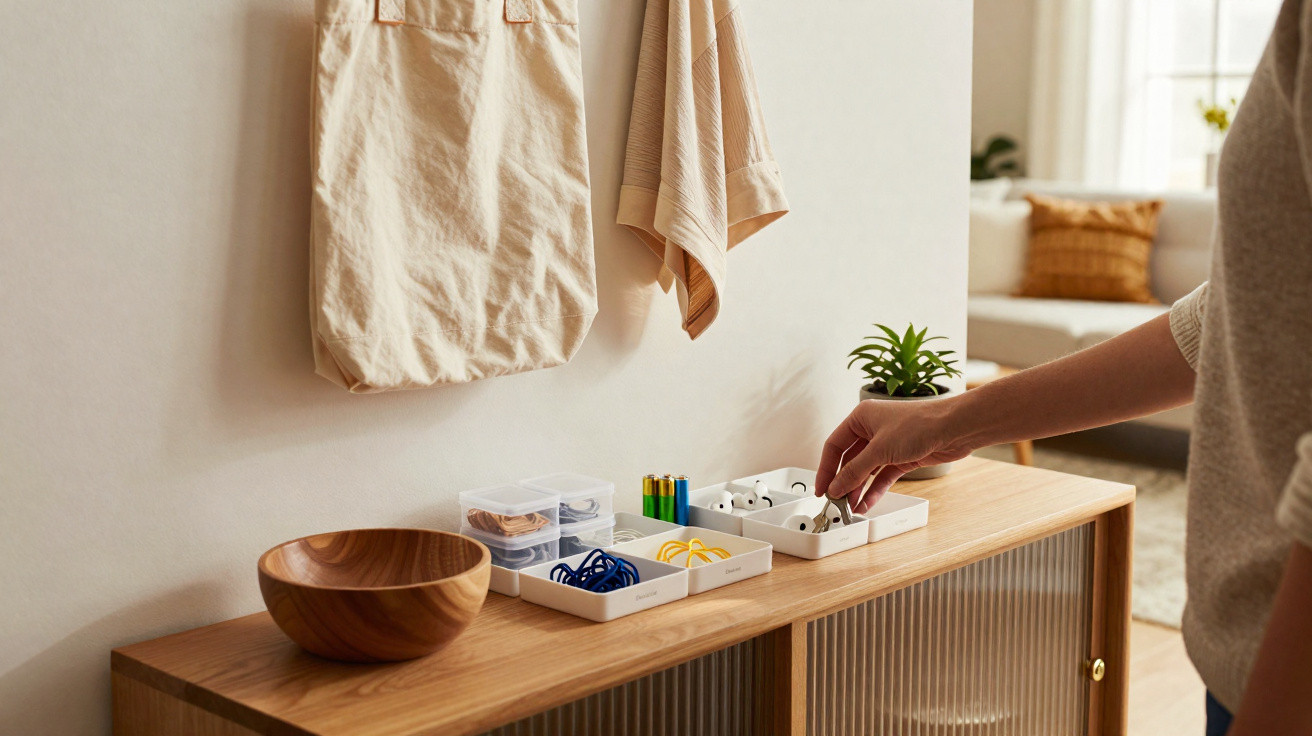
The first approach is almost comically straightforward: make “landing pads” for small belongings.
This does not mean using one random bowl. It means assigning a dedicated mini-zone to each type of item.
Have one tray for entrance-hall essentials such as keys, headphones and transport cards.
Keep one box for technology bits: USB keys, memory cards and adaptors.
Use another for miniature hardware, including screws, spare wall plugs and small tools.
The key is cutting down the number of places an item could possibly be.
If there are only two or three clearly assigned homes, your brain has no need to make a guess.
It sends objects to the same place repeatedly, until doing so feels almost automatic.
Keys are a useful test case.
Choose either a hook or a shallow tray directly beside the door.
Stick with it for a week.
Whenever you come in, make contact with that exact spot.
Do it even when you are worn out, cross or carrying ten bags of shopping.
By the third day, you will probably find yourself reaching for the hook without conscious thought.
By the seventh day, the surprising moment is when the keys aren’t there. You immediately know they are either still in the front door or in your bag.
The same principle applies to nail clippers, lip balm, spare batteries and SD cards.
Give every item a “home address”, repeat the action and the mental effort begins to fade away.
There is a cognitive element here too.
Because tiny items are inexpensive, we often regard them as disposable clutter.
We throw them into spaces reserved for “later” - the catch-all drawer, the tote bag that never gets emptied or the box beneath the TV.
Those spaces turn into black holes.
Once an item crosses that threshold, it leaves the world of useful belongings and enters the category of “stuff we own but can’t use”.
Let’s be honest: nobody properly checks the junk drawer every week.
The drawer wins.
The small objects lose.
Moving from junk zones to small, defined containers is not simply about “being more organized”.
It reduces the number of choices your brain has to make every day.
That is when belongings stay in sight - and remain easy to find.
Tools, tricks and small rituals that work
One practical method can make a major difference: use transparent, labelled containers.
Choose small boxes or zip pouches that can sit on a shelf or fit inside a drawer, rather than oversized storage bins.
Sort your tiny belongings by real-life scenario rather than by strict category.
For example: “Travel tech”, “Bike bits”, “Spare keys”, “Pet stuff” and “Sewing emergencies”.
Write labels using the words you would naturally think of.
Rather than “miscellaneous accessories”, write “Phone + laptop bits”.
Put each container in a clear, visible place instead of hiding it behind winter coats.
The aim is for you to open a drawer on a tiring Tuesday and see immediately: cables here, hair ties there and screws over there.
No uncertainty and no scavenger hunt.
The most common error is creating an overly complex system too quickly.
Colour coding, tiny labels and 25 separate boxes for “batteries AAA”, “batteries AA”, “used batteries” and “almost used batteries”… you will soon resent it.
Begin with an almost absurdly simple setup.
Use one small box for “spare tech stuff”.
Keep another for “maintenance bits”, such as screws, wall plugs and Allen keys.
Add one for “body accessories”: nail clippers, tweezers, tiny scissors and hair clips.
You do not need Pinterest-perfect styling.
You need a system you will continue using on a chaotic Monday morning, while the washing machine beeps and somebody is asking where their headphones are.
Keep asking yourself: would I maintain this system on my worst day?
“Organizing isn’t about putting things away. It’s about creating habits that survive your laziest self.”
- Entryway zone
Keys, wallet, headphones and transport card. One tray, one hook and nothing else. - Tech survival kit
Keep cables, USB keys, SD cards and adaptors in a clear pouch or box near your workspace. - Repair & tiny tools
Store mini screwdrivers, screws, wall plugs and odd little parts in a labelled container on one dedicated “fixing things” shelf. - Body & beauty smalls
Put nail clippers, hair ties, cotton pads and tweezers in one bathroom box rather than scattering them through bags and pockets. - On-the-go pocket
Keep a small zipped pouch in your bag for coins, a spare SIM, tiny receipts and those one-earbud survivors.
Living with fewer lost things and a calmer brain
The difference is not limited to tidier drawers.
It also removes that background tension of constantly wondering where your belongings might be.
You no longer repeat the same old question - “Has anyone seen my…?” - ten times a week.
Instead, you begin to trust that your things are where they “should” be, because “should” finally has a specific meaning.
The amusing part is that once every small item has a home, you start to see how many of them are not actually needed.
There may be loose buttons you have kept for years, or a cable for a phone you no longer own.
Some containers will fill quickly, while others will remain nearly empty.
That provides quiet feedback about your real life - the one you actually live, rather than the one you imagine.
You can refine the arrangement as you go: combine boxes, replace a tray with a better one or remove an entire category.
Then one morning, you will pass the place where your keys always sit and feel… nothing.
No surge of worry and no miniature panic.
Just the calm of finding what you need exactly where your hands expect it to be.
| Key point | Detail | Value for the reader |
|---|---|---|
| Clear “homes” for tiny items | Landing pads, trays and small containers organised by situation | Fewer lost objects and faster daily routines |
| Simple, realistic systems | Transparent boxes, plain labels and low-effort habits | Organization that survives busy, messy days |
| Reduce mental load | Less decision fatigue, less searching and fewer junk zones | More calm, more time and more control over your space |
FAQ:
- How do I start if my place is already a chaos of tiny objects? Begin with a single hotspot, such as the entrance hall or your desk. Divide the small items there into three piles (keep, toss, “not here”), then set up only one or two containers. Leave the rest of the house alone for a week.
- What if my family never puts things back? Reduce the number of possible locations. Use one visible tray for shared items and one box for tech, with nothing elaborate. Explain the system once, then quietly return items to those places for a few days until the routine takes hold.
- Do I really need to label boxes? Yes, even if you are certain you will remember. A simple label prevents you from repurposing a box “just once” and keeps the system intact when you are tired or somebody else tidies up.
- How many categories of small objects are too many? You have too many if you cannot name the categories from memory. Aim for 5–8 broad groups based on real-life situations rather than microscopic detail.
- What about things I only use once or twice a year? Put them in a clearly labelled “rare but useful” box and store it slightly higher up or further back. They stay out of the way while remaining findable when that unusual occasion comes round again.



Comments
No comments yet. Be the first to comment!
Leave a Comment