
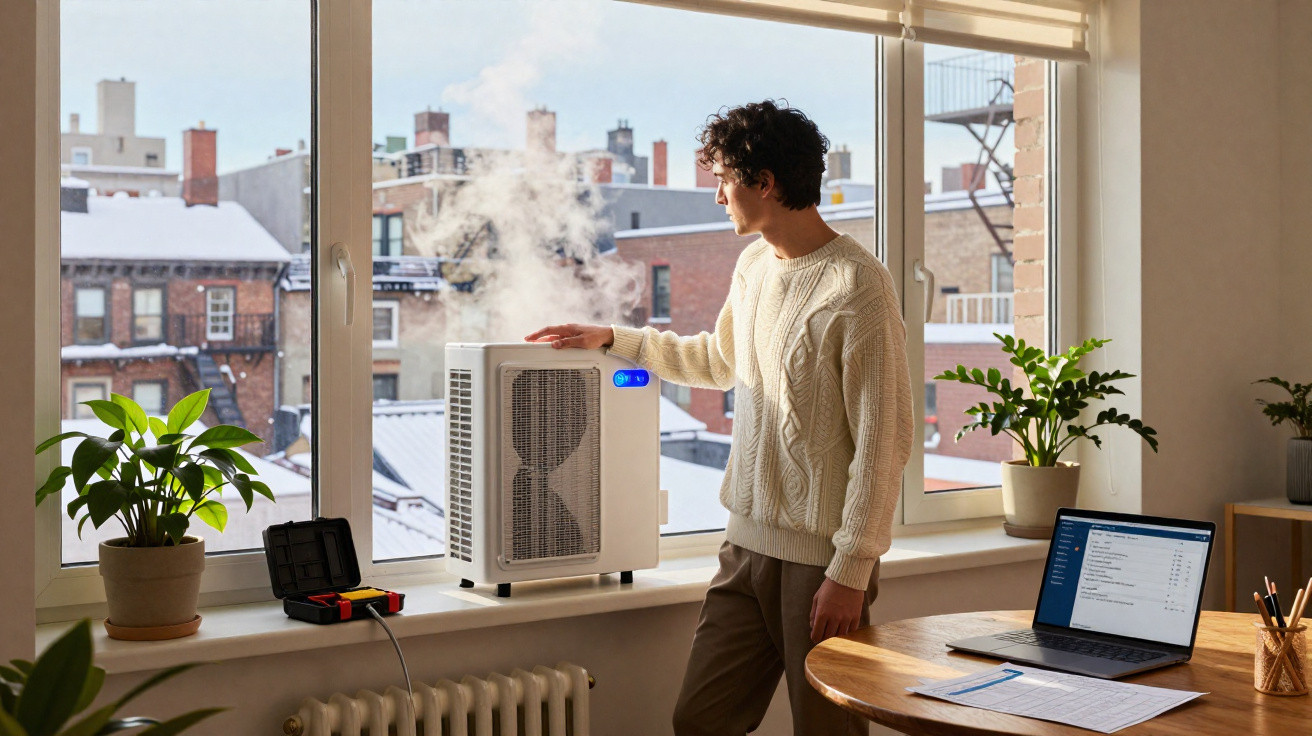
After several years of public-housing trials, a compact “window heat pump” has become the talk of the US energy sector. Resembling a bulky air-conditioning unit, it can be fitted in less than an hour and is intended to keep a room warm even when outdoor temperatures fall far below freezing.
From social housing trial to winter hit
Chinese appliance manufacturer Midea has tested its window-mounted heat pumps over several winters in social housing buildings in Queens, New York. The trials were managed by its US subsidiary, Midea America, which uses a start-up-like model centred on fast development and feedback from real-world installations.
Its aim was simple: create a heating appliance that effectively works as an air conditioner in reverse, fits into a window and operates dependably during severe North American cold snaps.
The Midea window heat pump is designed to keep heating down to around -22°C, far beyond a typical portable electric heater.
The resulting appliance combines the recognisable shape of a window AC unit with heat-pump efficiency. Its arrival is timely, as New York and other US cities face mounting pressure to reduce gas consumption in buildings.
What is a window heat pump, exactly?
Midea’s appliance initially looks like a large, box-shaped window unit. In technical terms, however, it more closely resembles a small air-source heat pump, the kind European households are increasingly being encouraged to adopt.
Rather than burning gas, the unit transfers heat from the outdoor air into the room through a refrigerant circuit and compressor. For an equivalent amount of useful warmth, it consumes considerably less electricity than a plug-in electric radiator.
Key specs of the Midea window heat pump
- Heating capacity: 9,000 BTU/h (about 2.6 kW) when it is around 8°C outside
- Extreme cold operation: down to about -25°C, with reduced output of 5,050 BTU/h
- Installation time: roughly one hour, no wall drilling required
- Noise levels: about 51 dB(A) at high speed, 43 dB(A) low, 29 dB(A) in quiet mode
- Weight: around 59 kg, so installation often needs two people
- Power supply: standard 115 V US mains electricity
- Target price late 2025: between $2,800 and $3,000 per unit
These figures clearly make it a substantial appliance rather than an inexpensive seasonal gadget. It is intended to replace or supplement existing heating, not merely remove a slight chill from the air.
Why New York landlords are paying attention
New York’s old housing stock creates a major decarbonisation challenge. Many flats depend on gas boilers and poorly performing radiators, or on loud, inefficient window AC units alongside ageing heating arrangements. Retrofitting complete central heat-pump systems can require walls to be drilled, pipework to be installed and days of disruption in each flat.
The pitch: a landlord can upgrade one flat at a time, in hours not days, with no holes in the façade and no major plumbing work.
That proposition is particularly attractive to public housing providers. Midea’s Queens pilots indicated that tenants could receive more powerful, evenly distributed heating in their main living area without removing existing infrastructure. The company is now speaking with housing authorities in cities including Boston, while a comparable Canadian pilot is getting under way.
Installation: closer to flat-pack than full refit
Straightforward fitting is one of the product’s main selling points. A journalist from US business magazine Fast Company tried the appliance at home and said it was installed in under an hour. A conventional wall-mounted heat-pump system, by comparison, may require professional installers for an entire day and involve drilling through brickwork or concrete.
The window heat pump is effectively supplied as a plug-and-play package. It fits into a suitable window opening, is sealed around its edges and connected to a standard socket. This makes it well suited to buildings in which structural alterations are costly or legally difficult.
There is an important limitation: at almost 60 kg, it is not an appliance that most people can lift casually on their own. It also covers a sizeable part of the window, resembling a large radiator with a box-like section at the rear.
How it behaves on a freezing night
In the Fast Company trial, the journalist compared the heat pump’s performance with the gas boiler normally heating her home. With temperatures outside at approximately -7°C, she increased the window heat pump’s setting and found that the living room warmed rapidly and became more comfortable than the rest of the house.
Users report a more even, less “on-off” feel compared with older gas radiator systems, thanks to a smarter compressor.
This more consistent warmth is produced by the appliance’s variable-speed compressor. Rather than operating only at full power or switching off entirely, it varies output according to data from an outdoor temperature sensor. This uses energy more carefully and limits fluctuations in room temperature.
Why it won’t heat an entire flat
The window heat pump is made to warm one principal room rather than a whole multi-room property. Its 9,000 BTU/h capacity is sufficient for a standard New York living room or studio flat, but it will find it difficult to heat several separate rooms through doors and corridors.
It therefore competes more directly with portable electric heaters and older gas heaters than with whole-home central systems. Midea says its appliance uses less electricity than an electric radiator in the same room, while providing stronger and more reliable warmth.
That market position is central to Midea’s plan: target landlords and housing providers able to install one appliance per flat for an immediate improvement in comfort, retaining existing boilers or building-wide heating as backup where necessary.
Price, subsidies and the business model
Costing up to $3,000 per unit before incentives, the window heat pump represents a substantial outlay for an individual tenant or homeowner. Midea’s first phase is consequently not focused on shop shelves. Its priority customers are professional purchasers: property developers, housing associations and public landlords.
Midea’s US operation expects prices to decline as manufacturing volumes increase. The company is not a luxury-brand producer; globally, it sits in the middle-market, high-volume appliance segment.
US tax credits and local incentives are highly significant. A federal tax credit for heat pumps is set to expire, although state programmes, including New York’s Clean Heat programme, can still sharply reduce upfront costs for major buyers. Such subsidies help explain why public-housing pilots have become so prominent.
Why Europe is watching, but not next in line
At present, the technology is genuinely compatible only with North American-style windows, in which single- or double-hung sashes move vertically. Much of Europe, France included, has different window styles that are unsuitable for a large box positioned within the opening.
Midea has not announced a consumer launch in Europe. It accepts that English-speaking markets such as Canada and the UK could be the next prospects, partly because they face similar policy pressure to move away from gas heating and have a growing appetite for heat pumps.
| Market | Main focus | Timeline |
|---|---|---|
| United States | Public housing, pilot projects, early commercial sales | Under way |
| Canada | Pilot schemes in cold-climate housing | Starting |
| UK & other anglophone markets | Potential adaptation for local housing types | Future |
For European properties with tilt-and-turn windows and thick masonry walls, later versions would probably require alternative mounting arrangements or semi-permanent frames fixed to façades.
Heat pump basics: a quick guide for tenants and owners
For anyone unfamiliar with the term, a heat pump transfers heat rather than producing it directly through combustion or electric resistance. It relies on refrigerant that evaporates and condenses in a closed circuit, taking heat from the outdoor air and releasing it indoors.
This means a heat pump can provide more heat energy than the electricity it uses. The relationship between the two is known as the coefficient of performance (COP). A COP of 3, for example, means the appliance supplies three units of heat for every unit of electricity taken from the grid.
Window heat pumps use exactly the same approach, but contain every component within one self-contained box. They can generally provide cooling as well as heating, changing mode in warmer weather to operate much like an air conditioner.
Who actually benefits from a window heat pump?
Those most likely to benefit are people with inefficient or unreliable heating in a single main space: residents of small flats, tenants in older high-rise blocks and students renting poorly insulated homes.
Consider a one-bedroom flat in a 1960s block with an ageing gas boiler and noisy radiators. Its landlord does not want to fund a complete heating upgrade. A window heat pump in the living room could offer the tenant a comfortable space throughout winter, while the existing system heats the bedroom and corridor at a lower temperature.
For landlords, this arrangement has several potential benefits: reduced overall gas use, fewer reports of cold rooms and a visible move towards climate goals without opening walls or inconveniencing tenants for days.
Risks, trade-offs and what to watch for
The concept is promising, but it involves compromises. The appliance uses window space and alters a building’s appearance, something some property managers may oppose. Although its stated noise ratings are relatively low, it could still disturb light sleepers, particularly in very small flats.
Upfront expense is another obstacle, even where incentives are available. Should energy prices decline, landlords would face a longer payback period. Furthermore, although the compressor can operate down to around -22°C, heating capacity falls during intense cold, so exceptionally exposed homes may still require additional heating.
There is a behavioural factor too. Tenants accustomed to turning up a thermostat may need advice on getting the most from a room-based system: closing doors to retain heat, selecting stable temperatures instead of repeatedly altering settings, and keeping filters maintained to support airflow.
How a reader might use this tech in future
Imagine a future UK or Canadian city in which regulations strongly discourage new gas boilers. A young couple rent a flat in an older block with limited insulation. Encouraged by local grants, their landlord installs one window heat pump in the living room. On a wet and windy January night, they work, cook and watch television there, while the bedroom radiators operate at a lower setting to save energy.
Alternatively, consider a housing association responsible for hundreds of properties. Rather than undertaking one multi-million-pound retrofit, it progressively installs window heat pumps in the coldest flats first, focusing on vulnerable residents. Sensor data from the units then informs future planning: identifying the buildings that lose the most heat, those requiring insulation next and locations where electrical capacity must be upgraded.
These examples illustrate why an apparently niche appliance fitted in a Queens window has attracted such attention. The window heat pump is not a silver bullet for the heating crisis, but it offers landlords and cities a further practical option as they seek to keep people warm while burning less gas.





Comments
No comments yet. Be the first to comment!
Leave a Comment