
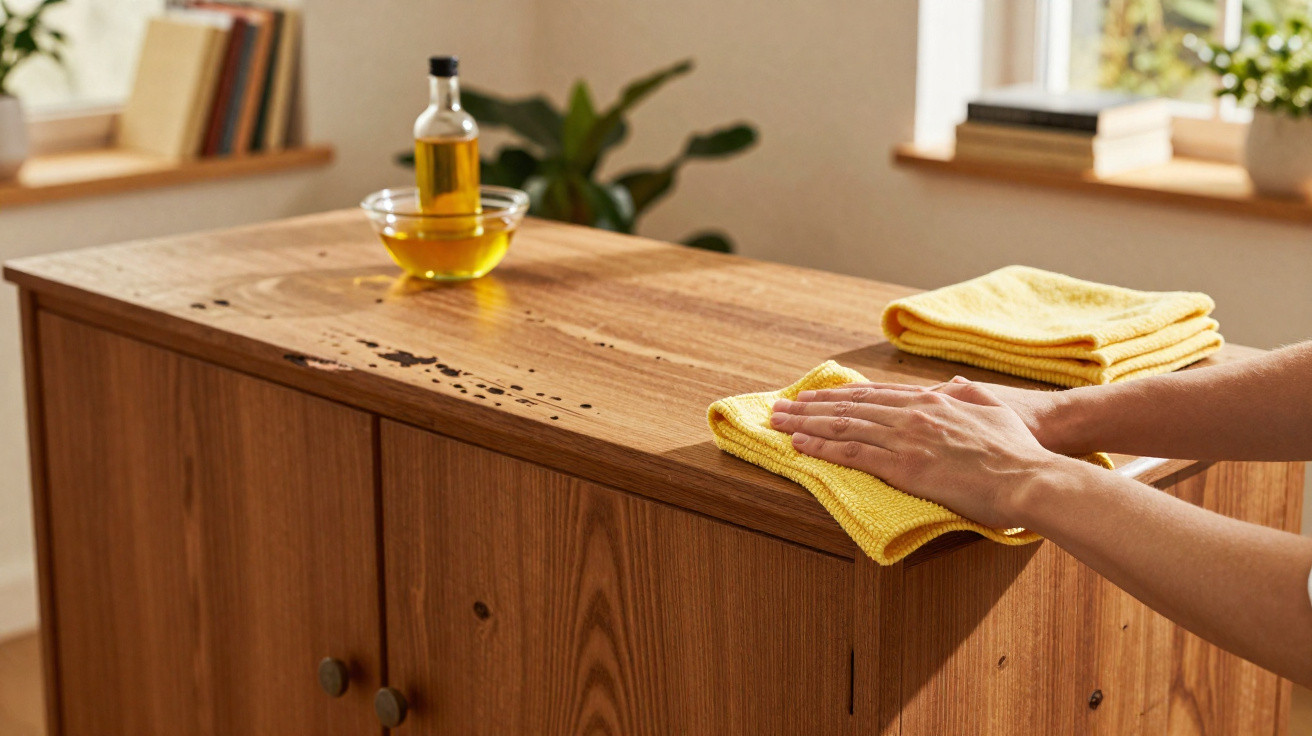
The chair seemed beyond saving: scuffed arms, a milky finish and lifeless marks left by cups that had been forgotten. It was the sort of ageing wooden furniture that gets moved from the sitting room to the garage with the thought, “I’ll deal with it one day,” before it simply fades from view. That morning, a restorer wearing faded jeans and boots dusted with sawdust traced the arm with his fingertips and grinned. “This one’s not done,” he said. “It’s just dry.” He picked up a small bowl, combined two ingredients likely already in your kitchen, and lowered a soft microfiber cloth into the liquid.
Twenty minutes on, the chair appeared to have shed ten years of use. Its scratches looked less pronounced, the timber had regained its glow and the whole room felt transformed. It was not flawless; it simply looked alive once more.
The “magic” mixture? It is almost ridiculously straightforward.
Why restoration experts rely on a kitchen-cupboard mixture
According to furniture restorers, much of the wooden furniture described as “ruined” is not ruined at all. More often, it is dehydrated. Varnish loses moisture, dust sticks to the surface, budget sprays create a lifeless coating and sunlight strips warmth from the grain. Seen from across a room, a piece may look worn out. Closer up, the wood seems to be asking for moisture. This is where a microfiber cloth and a mild homemade mixture can help. The purpose is not to strip, sand or radically alter the furniture, but to revive its surface.
The effective combination that many professionals use discreetly is remarkably basic: equal amounts of olive oil and white vinegar, whisked into a thin emulsion. Used with a soft microfiber cloth, the blend does more than remain on the top layer. It removes dirt while conditioning the timber in one step, producing a finish that can appear almost freshly polished.
A Paris-based restorer I spoke to demonstrated this with a worn walnut bedside table. It had water marks, fine scratches and a white film left by a cleaning product that had gone wrong years earlier. “Clients bring pieces like this and think it’s over,” she laughed. She dipped a fresh microfiber cloth into a bowl containing equal parts vinegar and olive oil, squeezed it until it was only damp, and worked it across the grain in slow circles.
The result looked almost cinematic. The rings became fainter, the haze turned into a warm lustre and the damaged edge, while still visible, no longer demanded attention. “That’s the point,” she said. “You don’t erase the life of the piece. You just help it look like it’s being cared for again.” After one ten-minute treatment and a swift polish with a dry cloth, the small table seemed to have been given another opportunity.
There is a straightforward reason this kitchen worktop solution works. White vinegar is a gentle cleaner that breaks down fingerprints, old polish residue and surface dirt without damaging the finish. Olive oil provides glide and a light conditioning layer that settles into microscopic pores and scratches. The microfiber cloth performs the understated hard work: its exceptionally fine fibres lift dirt without abrasion and distribute the mixture as a light, even coating.
When applied sparingly, this combination delivers much of what costly conditioning products promise without saturating the wood. This is refreshing rather than refinishing. That’s why a piece can suddenly look “almost brand-new” after one careful pass, even though nothing dramatic has actually happened to the structure of the furniture.
The precise olive oil and white vinegar method with a microfiber cloth
Professionals begin with a small amount, every time. They add one part white vinegar and one part olive oil to a small bowl or jar, then stir or shake them until they form a cloudy mixture. There is no need for specialist equipment or a row of measuring spoons worthy of a cookery programme. Approximate equal quantities are enough, mixed until they resemble a light salad dressing. The key stage follows: the furniture is not soaked; the cloth is.
A clean microfiber cloth is dipped into the solution briefly and then squeezed firmly. It should be damp rather than dripping. Restorers then treat areas roughly the size of a book cover, following the grain rather than crossing it and making slow, overlapping strokes. A few minutes later, they use a second, dry microfiber cloth solely to buff off excess liquid, leaving a satin-like finish rather than an oily one.
This is the point where many of us go wrong at home. We tip the mixture straight on to the wood, reach for an old T-shirt instead of microfiber, and hurry the process. Then we are surprised when the surface turns streaky or sticky. In truth, hardly anyone does this every day. Life takes over, dust accumulates, and a table receives attention only when visitors are coming or a fresh ring appears. This is precisely why restorers favour gentle, occasional care over forceful “deep cleans”.
They advise against scrubbing, particularly on old shellac or delicate varnish. Excess pressure combined with an unsuitable cloth may create tiny swirl marks that continue to catch the light. They also recommend testing the mixture on a concealed area first. If the finish behaves unexpectedly or the colour changes too much, stop immediately. There is no need for heroics: respect the age of the furniture and its uncertain history of treatments.
“People think wood is dead once it’s damaged,” says London-based restoration specialist Daniel Hayes. “But good hardwood is incredibly forgiving. A microfiber cloth, a gentle homemade mix, and a bit of patience will take you further than most store-bought sprays. The secret is restraint: thin layers, soft movements, and stepping back often to see what the wood is telling you.”
- Work in natural light
Early-morning or late-afternoon daylight makes it easier to see streaks, overlooked areas and lingering dirt without severe glare. - Use different cloths for cleaning and buffing
Use one lightly damp microfiber cloth to apply the mixture, and reserve a separate clean, dry one for the final polish. - Refresh, don’t drown
A thin coating is sufficient. Too much oil may attract dust and create a tacky surface. - Avoid raw, unfinished wood
This approach is most suitable for sealed, varnished or previously oiled furniture, rather than newly sanded timber. - Repeat rarely
For most furniture, treatment every few months is enough; the aim is lasting maintenance, not a weekly routine.
How restoring old wooden furniture can change your home
There is something unexpectedly personal about bringing an old wooden item back to life yourself. You begin to notice details that had escaped you: a dent caused during a move, a pale ink mark from homework, or the corner a child once secretly chewed. As the microfiber cloth moves over the surface and the colour of the timber gradually deepens, an “ugly old thing” becomes a record of your life again. We have all experienced that moment of nearly discarding something before realising it still has more to offer.
Restorers say clients often bring in furniture after trying this basic mixture and discovering that they would rather keep it. A table destined for the pavement becomes the focus of Sunday breakfasts once more. A scratched chest of drawers becomes “vintage” instead of “ruined”. This modest ritual does more than save money or prevent another click on a “must-have” item. It gently changes your perspective from consumption to care.
After seeing a dull, lifeless plank recover a warm, almost-new finish with only vinegar, oil and a cloth, it becomes difficult not to look around your home and ask what else might deserve a second look.
| Key point | Detail | Value for the reader |
|---|---|---|
| Simple homemade mixture | Equal parts olive oil and white vinegar, whisked into a light emulsion | An affordable, readily available alternative to commercial wood polishes |
| Microfiber application | A damp, not dripping, cloth used with the grain in small sections | Minimises scratches and streaks while creating a more professional-looking finish |
| Gentle, occasional care | Test a hidden area, buff with a second dry cloth and repeat every few months | Helps preserve the appearance and lifespan of old furniture without intensive restoration |
FAQ
Question 1
Can I use any type of olive oil for this solution?
Answer 1
Yes. Regular and extra-virgin olive oil both work, although many restorers choose a neutral, inexpensive oil because function rather than flavour is the objective. Do not use flavoured or infused oils, as they may leave unusual odours or residue.Question 2
Will this method repair deep scratches or gouges in the wood?
Answer 2
No. The mixture will not fill or eliminate deep damage. It can reduce the appearance of light surface scratches by darkening and conditioning them, but deeper gouges generally require filler, sanding or professional repair.Question 3
Is this safe for every type of wooden furniture?
Answer 3
It is usually safe for sealed, varnished or previously oiled furniture, but it is less appropriate for raw, unfinished wood or finishes treated only with wax. Always try it first on a small, hidden area, and stop if you see cloudiness, tackiness or colour bleeding.Question 4
How often should I use the vinegar-and-olive-oil mixture?
Answer 4
For most household furniture, once every three to six months is sufficient. Between treatments, simply dust using a dry microfiber cloth. Using the mixture too often can cause build-up that attracts dust.Question 5
Can I keep leftover solution for later?
Answer 5
A small amount can be stored in a tightly sealed jar for a short period, though restorers generally prefer to make fresh batches. The emulsion may separate or turn rancid over time, particularly when left open or kept somewhere warm.

Comments
No comments yet. Be the first to comment!
Leave a Comment