
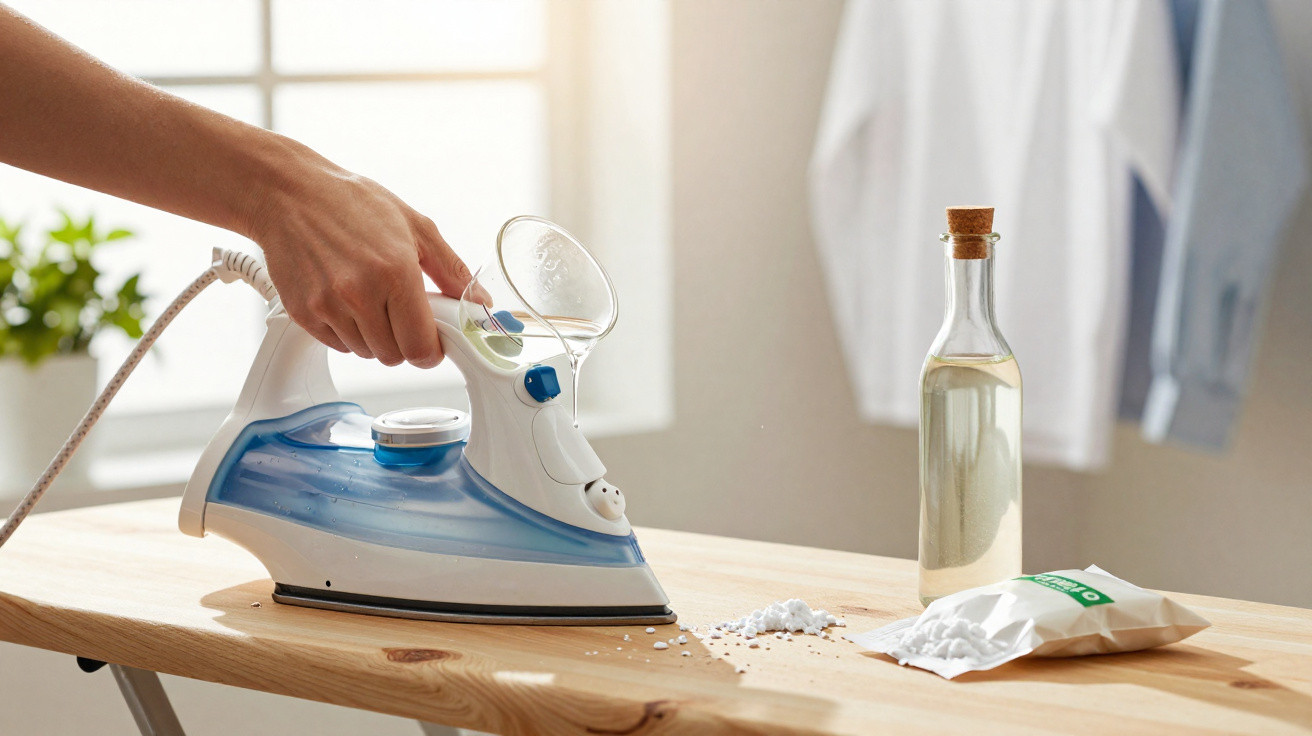
In hard-water areas, steam irons can become clogged with limescale well before they stop working altogether. Fortunately, an inexpensive, straightforward routine can restore most steam irons and prevent marks from spoiling your clothes.
When your iron starts talking: early warning signs of limescale
Limescale in a steam iron does not normally appear suddenly. It gradually accumulates in the water tank, steam chamber and slim internal channels. Usually, the appliance shows signs of trouble long before it fails entirely.
Limescale rarely kills an iron instantly; it weakens performance for months first, leaving a trail of clues on your laundry.
Reduced steam output is commonly the earliest warning. When you use the steam boost, you may get a weak burst rather than the thick plume you expect. Steam may also come and go, while unusual crackling or whistling noises can occur as water struggles through partially blocked passages.
White flecks on dark clothing are another warning sign. These pale crumbs are mineral deposits dislodging from within the iron. Their appearance indicates that hardened scale has already coated the steam chamber.
If you overlook this point, the issue can worsen. Deposits may combine with tiny fibres scorched onto the soleplate. This mixture can then come out as brown or rusty drops on shirts and blouses. On white cotton or silk, such stains may be extremely difficult to shift.
Brown drips usually mean oxidised limescale and residue have built up to a point where they’re contaminating the steam.
An iron affected by scale may also catch on fabric rather than gliding freely. You can end up applying extra pressure, increasing the chance of shiny areas on synthetics or deeply pressed creases that are hard to remove.
Why hard water quietly wrecks steam irons
Much of the UK, as well as large areas of the US, has tap water containing dissolved minerals including calcium and magnesium. When repeatedly heated in an iron, these minerals crystallise into limescale.
The resulting deposits attach themselves to heating elements and inner surfaces. Because scale acts as an insulating layer, the iron must use more energy to achieve the same temperature. This added demand can put strain on the thermostat, seals and pump.
Without intervention, blockages increase pressure on the pump and internal connections. This may lead to leaks around the base, unexpected shut-offs or lasting electronic faults. At this stage, many people decide that the iron is “finished” and throw it away, although the underlying problem often began months before with ordinary scale build-up.
The vinegar and water trick: how to descale without scrubbing
You do not usually need specialist products to remove most scale deposits. Standard white vinegar and a little time will often be enough.
A 50/50 mix of white vinegar and water can dissolve stubborn limescale inside the tank and steam channels, no dismantling required.
Step-by-step descaling with vinegar
- Unplug the iron and allow it to cool fully.
- Combine equal quantities of white vinegar and clean water in a measuring jug.
- Fill the iron’s water tank with the mixture, up to its normal maximum line.
- Keep the iron switched off for roughly 30 minutes, allowing the acid to act at room temperature.
Do not be tempted to heat vinegar inside the iron. Hot acidic vapour may irritate your eyes and throat, while repeated heated cycles can be tougher on rubber seals.
When the soaking time is up, empty the tank completely. Rinse it several times with clean water, gently shaking the iron to release loosened deposits. This step is important: missing it could leave a vinegar odour on your next wash load.
After rinsing, fill the tank with plain water and heat the iron to its highest setting. Hold it over a sink or old towel, turn on the steam function and repeatedly press the steam boost.
During this “steam purge”, you’ll often see flakes and cloudy droplets spurting out. That mess is exactly what you want to eject now, not onto your favourite shirt.
Citric acid: the odour-free alternative
For those who dislike vinegar’s smell, citric acid is a less fragrant alternative. Available as a food-grade powder, it is also produced through natural fermentation and works very effectively on mineral deposits.
How to use citric acid safely
For most household irons, use the following mixture:
- 1 tablespoon citric acid powder for about 250 ml of warm (not boiling) water
- Mix until all crystals have fully dissolved
- Add it to the cold iron, leave it for 30 minutes, then rinse several times
Once the solution has soaked, follow the same process as with vinegar: rinse thoroughly, then carry out a steam purge using plain water. Citric acid is odourless, an advantage many people value in small flats or shared homes.
The ideal maintenance schedule so your iron lasts for years
In hard-water areas, one thorough clean each year is not sufficient. Shorter, more frequent maintenance routines are more effective and gentler on the appliance.
Think of descaling as routine maintenance, not an emergency repair. Little and often keeps steam powerful and clothes stain-free.
As a general guide, households that use an iron several times weekly with hard tap water should descale it every one to two months. Where water is exceptionally hard, do it more often. In soft-water areas, or where the iron is only used occasionally, every three months may be sufficient.
| Water hardness | Iron usage | Recommended descaling |
|---|---|---|
| Very hard | Daily or near daily | Every 4–6 weeks |
| Medium | A few times a week | Every 2 months |
| Soft | Occasional | Every 3–4 months |
It is useful to keep a small maintenance kit near the ironing board. With a measuring jug, white vinegar or citric acid, and an old cotton cloth for the purge, you can complete the process alongside other household tasks. The hands-on part takes only a few minutes, while the soaking happens by itself.
Day-to-day habits that slow down scaling
As well as deep cleaning, a handful of everyday practices can greatly slow limescale formation.
- Empty the tank after every ironing session, preventing water from sitting inside and crystallising.
- In very hard-water areas, use a blend of tap water and demineralised water.
- Do not put fragrance or fabric softener directly into the tank, as they may leave sticky deposits.
- Once the soleplate has cooled, wipe it with a damp cloth, particularly after ironing synthetic materials.
Many newer irons include “anti-calc” cartridges or self-cleaning functions. These are useful, but they do not remove the need for proper descaling. Cartridges can still become blocked, while automatic programmes require manual rinsing and purging to remain effective.
What “descaling” actually does inside your iron
If you are reluctant to use acids in an appliance, it may help to know what happens during descaling. Limescale consists mainly of calcium carbonate. Mild household acids, such as the acetic acid in vinegar and citric acid powder, react with it, turning it into soluble compounds and carbon dioxide gas.
Used in low concentrations and at room temperature, household acids target mineral deposits rather than metal parts or plastic housing.
Moderation is essential. Strong acid that is heated aggressively can damage metal coatings and seals. Mild, cool soaking treatments direct the reaction towards the chalky deposits that need removing.
Real-life scenarios: when a clean iron genuinely saves the day
Imagine the morning of a job interview. You pick up the iron to give your shirt one final press, hit the steam boost and brown liquid streaks across the front. That is often when people first look into descaling - but it is already too late for that item of clothing.
Routine care changes the situation. With unobstructed steam vents, an iron reaches its selected temperature sooner and operates more efficiently. Clothing is pressed evenly, without wet areas or unexpected stains, and you are less likely to raise the temperature out of frustration and scorch delicate materials.
There is a wider advantage too: fewer supposedly “dead” irons end up in household rubbish. Once scale is kept under control, the iron’s moving parts and electronics can often last much longer than expected. For many households, this means relying on one dependable iron for years instead of replacing it every few seasons.


Comments
С помощью , Вы можете узнать точную дату выпуска автомобиля, его комплектацию, каталожные номера деталей и их стоимость, установить соответствие запчастей определенных марок, определить внешний вид и расположение запчасти, изучить конструкцию узлов определенного автомобиля, а так же выяснить размеры и вес запчастей https://zapchasti-remont.ru/shop/PATRIOT_PROFI_NOMAD/
Покупать запчасти для бытовой техники приходится в основном из-за поломки в связи с неправильной эксплуатацией прибора, из-за перепадов электроэнергии или от износа https://zapchasti-remont.ru/shop/karbyuratoryi4/
Покупать лучше детали и запчасти для техники конкретной марки и модели (не аналоги, а оригинальные детали) https://zapchasti-remont.ru/shop/glushiteli3/
Неоспоримым достоинством данного подхода является удобный формат услуги – занятия проходят в помещении детского сада, так что не нужно тратить время на дорогу от одного кружка до другого https://school-neuron.ru/katalog/nejroshkola
Но есть и недостатки – выбор уроков ограничен квалификацией воспитателя, он может преподавать лишь ряд дисциплин согласно своей специализации https://school-neuron.ru/obrazovanie
Конечно, эта проблема решается за счет приглашения дополнительного педагога, но не все родители готовы платить за его услуги, а индивидуальные занятия могут быть слишком дороги https://school-neuron.ru/o-tsentre-razvitiya-nejron
В структуру нашего центра детского образования входят: частные детские сады, частная школа с углубленным изучением отдельных предметов, подготовка к школе https://school-neuron.ru/katalog/nejrodiagnostika
Индивидуальный подход к ребенку
Английский язык – ключ к успешному обучению
Юридические услуги • Юридическая консультация •
Нафко https://yuristi.com/blog/advokat-po-st-163-uk-rf
4 https://yuristi.com/advokat-po-ugroze-ubiystvom-119-uk-rf 1) лица, желающие принять на воспитание в свою семью ребенка, оставшегося без попечения родителей, если они обращаются за оказанием бесплатной юридической помощи по вопросам, связанным с устройством ребенка на воспитание в семью;
40 отзывов https://yuristi.com/advokat-po-grabezhu-161-uk-rf
Neopravo https://yuristi.com/privacy
3 https://yuristi.com/blog/yurist-po-moshennikam-vernut-dengi 8 Юридическая компания по взысканию неустойки с застройщиков Зевс эксперт https://yuristi.com/blog/advokat-po-delam-ob-ubiystve-st-105-uk-rf
…и перевода помещения в нежилое https://yuristi.com/practice Юристы быстро и грамотно все провели, за что им большая благодарность https://yuristi.com/practice
Также Вы можете обратиться по предварительной записи в Приемную бесплатной юридической помощи Адвокатской палаты города Москвы по адресу: г https://yuristi.com/advokat-po-kontrabande-narkotikov Москва, ул https://yuristi.com/blog/advokat-po-iznasilovaniyu-st-131-uk-rf Садовая- Кудринская, д https://yuristi.com/blog/advokat-po-krazham-st-158-uk-rf 11, стр https://yuristi.com/advokat-po-narkotikam-228 1 (каб https://yuristi.com/besplatnaya-konsultatsiya-advokata 114) https://yuristi.com/advokat-po-razvratnym-dejstviyam В Приемной организовано консультирование граждан адвокатами в рамках реализации положений Федерального закона от 21 ноября 2011 г https://yuristi.com/blog/yurist-po-moshennikam-vernut-dengi № 324-ФЗ «О бесплатной юридической помощи в Российской Федерации» и других нормативных актов, регулирующих оказание бесплатной юридической помощи гражданам РФ в Москве https://yuristi.com/blog/advokat-po-ch-2-st-159-uk-rf-stoimost-zashity
В нашей команде трудятся сотни квалифицированных специалистов с большой юридической и адвокатской практикой https://yuristi.com/practice Каждый из них — профессионал в своей отрасли права, который всегда в курсе новых нормативно-правовых актов https://yuristi.com/blog/advokat-po-moshennichestvu-st-159-uk-rf Подтверждение тому — многочисленные благодарные отзывы клиентов https://yuristi.com/advokat-po-ugroze-ubiystvom-119-uk-rf
Юридические услуги https://yuristi.com/blog/advokat-po-narkotikam-st-228-uk-rf
Клиника аппаратной косметологии Проэстетик в Москве оснащена оборудованием премиум-класса, которое используется в ведущих клиниках Европы и США:
нежелательные волосы;
Биостимуляция https://mycosmi.ru/
Световые волны определенной длины способствуют ускорению клеточного обновления, заживления, а также улучшают микроциркуляцию https://mycosmi.ru/
Аппаратная эстетическая косметология – это современное направление ухода за кожей, основанное на использовании передовых технологий для решения широкого спектра эстетических задач https://mycosmi.ru/services/lazernaya-epilyatsiya
Благодаря инновационным методикам, аппаратная косметология профессиональная позволяет эффективно улучшать состояние кожи, корректировать возрастные изменения и добиваться выраженного результата без хирургического вмешательства и длительной реабилитации https://mycosmi.ru/services/lazernaya-epilyatsiya
Почему стоит выбрать эвакуатор от «АвтоКор»?
Мы предоставляем прямую услугу, без посредников: эвакуатор принадлежит нашей компании, что позволяет устанавливать разумные цены и гарантировать высокий уровень сервиса https://amt-ufa.ru/evakuator-v-rajonax/czentr.html
Сохранность груза, что исключает дополнительные расходы и риски
перевозят машины, повреждённые в ДТП;
Лидеры на рынке Уфы
Не стоит выбирать первую попавшуюся компанию, лучше сравнить цены и условия нескольких компаний и выбрать наиболее выгодный вариант https://amt-ufa.ru/blog/testovaya-statya.html
Оперативный выезд в любую точку Уфы и Башкортостана https://amt-ufa.ru/dopolnitelnyie-uslugi/vremennaya-stoyanka.html
Распространенная причина – авария, в которой автомобиль получил серьезные повреждения и не может двигаться самостоятельно https://amt-ufa.ru/stoyanki.html
Эвакуатор также незаменим при техническом сбое, если фура или автобус заглохли посреди трассы, создавая угрозу затора или аварийной ситуации https://amt-ufa.ru/kontaktyi.html
Данная спецтехника привлекается для удаления крупногабаритного транспорта, оставленного в неположенном месте https://amt-ufa.ru/evakuator-v-rajonax/sipajlovo.html
Сравнивайте цены и условия различных компаний https://amt-ufa.ru/
Другие характеристики, которые важно учитывать при выборе мотор-редуктора:
климатическое исполнение,
обороты на выходе,
Мотор-редукторы, преобразующие круговое движение в поступательное https://www.sm-privod.ru/reduktor_ekaterinburg
Состоят из ведомой прямой зубчатой рейки и ведущей цилиндрической шестерни https://www.sm-privod.ru/catalog/motor-reduktory-importnye/
Они способны развивать большое усилие, однако их движение не может быть бесконечным – амплитуда перемещения равна длине рейки https://www.sm-privod.ru/reduktori_dlja_voroneza
Поэтому в их конструкции есть концевые выключатели, которые выключают привод или реверсируют его по достижению максимального расстояния перемещения https://www.sm-privod.ru/motor-reduktor-4mts2s-63-80-100-125
Главный недостаток данныйх редукторов – тихоходность https://www.sm-privod.ru/reduktor-tsilindricheskiy-ts2u-315n
— Реечными https://www.sm-privod.ru/reduktoryi-tsilindricheskie-1tsu-160ts
ГОСТ 31591-2012 определяют базовый набор технических характеристик планетарных, червячных и других мотор-редукторов https://www.sm-privod.ru/motor-reduktor-mpo-1m-mpo-2m
Основной критерий — рабочий ресурс, гарантированный производителем https://www.sm-privod.ru/kranovoe-oborudovanie
Он определяет минимальное количество часов работы оборудования https://www.sm-privod.ru/catalog/katalog/motor-reduktory/motor-reduktory-planetarnye/page/2/
Первое, с чем необходимо определиться при выборе мотор-редуктора — его вид:
Ремонт оргтехники в Белгороде – это одна из тех услуг нашего сервисного центра, которую мы выполняем в самые короткие сроки и на высоком качественном уровне https://zapchasti-remont.ru/shop/reduktoryi_i_transmissii/
Чтобы воспользоваться помощью квалифицированного мастера для устранения неисправностей лазерной оргтехники, нужно сделать всего несколько простых шагов: связаться с менеджером подробно описать проблему оговорить удобное время для визита специалиста https://zapchasti-remont.ru/shop/detali_bloka_tsilindrov1/
В подавляющем большинстве случаев ремонт принтеров на дому выполняется уже в день обращения к менеджеру, благодаря чему вы можете сэкономить свое время и быстро получить полностью исправную технику https://zapchasti-remont.ru/shop/toplivnyie_baki/
Симптомы неисправностей принтеров Ремонт принтеров, выполняемый силами профессионалов нашего центра – это необходимая мера https://zapchasti-remont.ru/shop/mtd_YARD_MAN_CUB_CADEN_WOLF_GARTEN_BOLENS/
Пытаться самостоятельно восстановить работоспособность оборудования не рекомендуется, поэтому мы предлагаем звонить нам сразу же после выявления следующих признаков поломки: возникают проблемы с включением устройства https://zapchasti-remont.ru/shop/karteryi_i_kolenvalyi/
В этом случае наш сервис по ремонту принтеров проведет детальную диагностику, чтобы точно установить причину поломки не осуществляется подача бумаги, оборудование заминает или рвет листы качество печати сильно снижается, на документах появляются пятна, полосы, другие дефекты принтер не подключается к ноутбуку или компьютеру через USB-порт или по беспроводному каналу бумага застревает в принтере устройство захватывает сразу несколько листов https://zapchasti-remont.ru/shop/karbyuratoryi5/
В любом из этих случаев мы сделаем срочный ремонт принтера в Белгороде без каких-либо дополнительных наценок https://zapchasti-remont.ru/shop/zapchasti_motopomp1/
Преимущества профессионального ремонта Обращение в наш центр по ремонту принтеров – это отличная возможность получить целый ряд неоспоримых преимуществ: бесплатная диагностика оборудования возможность сделать ремонт принтера недорого предоставление оригинальных запасных частей для вашей оргтехники бесплатный выезд специалиста на дом или в офис гарантия на всю отремонтированную технику, выдаваемая на срок от 1 года https://zapchasti-remont.ru/shop/zapchasti_benzopil1/
Мы работаем с лазерной оргтехникой от любых производителей, оперативно и качественно восстанавливаем устройства и обеспечиваем их безупречную работу в течение длительного времени https://zapchasti-remont.ru/shop/karbyuratoryi6/
Также вы можете заказать у нас любые операции по обслуживанию и настройке принтеров https://zapchasti-remont.ru/shop/zapchasti_benzo_i_dizelnyih_generatorov/
У автомобилей КАМАЗ огромная сфера применения и множество преимуществ, начиная от повышенной прочности и износостойкости, заканчивая современным техническим оснащением и хорошей управляемостью https://zapchastikam.ru/zapchasti-kamaz/korobka-otbora-moshchnosti/vilka-vklyucheniya-kom-na-lebedku-kamaz-4310-4204126
В полной мере оценить плюсы эксплуатации грузовых авто разных модификаций можно только при условии, что все системы работают без сбоев https://zapchastikam.ru/zapchasti-kamaz/zapchasti-i-komplektuyushchie-cistemy-pitaniya-kamaz/filtr-tf-ff-5706-ztd-ff5706
При возникновении поломок или естественном износе комплектующих нужно своевременно выполнить замену деталей, и проблем с тем, где купить запчасти на Камаз Евро, 4310, 5490 на оптимальных условиях, нет https://zapchastikam.ru/zapchasti-kamaz/tormoznaya-sistema/treshchotka-evro-zadnyaya-levaya-universalnaya-ztd-79261
рамные узлы и элементы;
Сертификация и маркировка
Постоянная обратная связь с клиентами и повышение уровня обслуживания https://zapchastikam.ru/zapchasti-kamaz/sistema-vypuska-gaza-kamaz/glushitel-4310-5511-kamaz-4310-1201010-01
Наши сотрудники оказывают профессиональную поддержку на всех этапах сотрудничества https://zapchastikam.ru/zapchasti-kamaz/most-zadnij-kamaz/shesternya-poluosi-evro-20-shlic-kamaz-53205-2403050
Ориентируясь на потребности покупателей, мы предлагаем детали для автомобилей, которые адаптированы под разные евро стандарты, указывая этот момент в описаниях https://zapchastikam.ru/zapchasti-kamaz/metizy/trojnik-m18hm14hm22-861010
Приобретая у нас двигатели и другие компоненты, вы можете не сомневаться в их экологической безопасности и исправности https://zapchastikam.ru/kamaz?page=161
Leave a Comment