
The scene is nearly always the same: after several rainy days, the sun returns in full force. You step into the garden with a coffee in hand, and something catches the corner of your eye.
That timber deck which was once a source of pride is stained, with dark patches. The garden bench creaks differently when you sit down. The wooden gate, which once shut smoothly, now catches at the bottom and scrapes across the damp ground. Run your hand over the surface and you notice slight crumbling, along with the scent of old timber: partly sweet, partly musty. Moisture gets to work quietly and patiently, year after year. It can feel as though, unless you act, you will lose everything. Or almost everything.
When timber starts objecting to rain
Anyone living with timber outdoors soon learns that its biggest enemies are above and below it: harsh sunshine overhead and standing water underneath. Timber does not rot overnight. It gives subtle, almost hesitant warnings first: a stain darkening near the foot of a post, a splinter lifting from a deck board, or a door swelling and no longer closing properly. These may seem minor, but they mark the start of a serious interaction between moisture and wood fibres.
In many Brazilian homes, particularly in coastal regions and very humid cities, the same pattern occurs repeatedly. A typical example is a handsome newly installed pergola that holds up well through its first summer. By the second, the first cracks emerge. By the third, the metal fittings have begun to rust, while the timber around the bases starts to darken. If it is ignored, four or five years later the owner is seeking quotes to replace the whole structure. This is no exaggeration: maintenance firms report that more than half of call-outs involve rot beginning precisely where timber is constantly exposed to water.
There is plenty of logic behind this understated problem. Timber remains a living material even once it has been cut. It breathes, absorbs moisture, expands and contracts. When damp penetrates deep into the fibres without a route out, fungi develop and feed on the structure itself. This creates rot: a soft core that is fragile to the touch. If water arrives from above and finds poorly sealed cracks, the process speeds up. Where timber touches soil directly or sits on waterlogged paving, it acts like a wick, drawing moisture up from below. The good news is straightforward: this cycle can be stopped before it destroys your timber.
Moisture protection begins long before the rain
The most effective step in preventing rot is taken while the timber still looks immaculate, not after it has decayed. It begins with the choice of material: properly treated timber from a reputable source, clearly rated for outdoor use. It continues with cutting, sanding and the generous application of wood stain, yacht varnish or a suitable timber oil. It also depends on a detail many people overlook: allowing the wood to “breathe”, with effective ventilation beneath it and no direct contact with soil or pooled water. It may sound overly cautious, but that is exactly what can make a deck last 3 years… or 15.
Many people buy a wooden table for an outdoor entertaining area, place it on tiled flooring and assume the job is done. A few months later, the undersides of the legs begin to stain, out of sight. Moisture rises from the floor, becomes trapped there and quietly does its damage. Or a timber gate receives its first coat of varnish at installation and is never maintained again. Let us be honest: nobody does this every day. Yet a simple touch-up every year or two can completely alter the future of the item. The common mistake is not a lack of miracle products; it is assuming timber can withstand everything on its own.
“Outdoor timber does not die of old age; it dies of neglect,” a carpenter in Florianópolis once told me, lifting a piece of beam that had completely crumbled away inside.
- Use pressure-treated timber for areas close to the ground.
- Raise bases with plastic or metal spacers to keep them clear of standing water.
- Apply quality wood stain or varnish every 12–24 months, according to the climate.
- Ensure the paving slopes sufficiently so puddles do not form beneath decking or furniture.
- Remove mould and algae as soon as they appear, before they penetrate the fibres.
A minimal routine, maximum impact
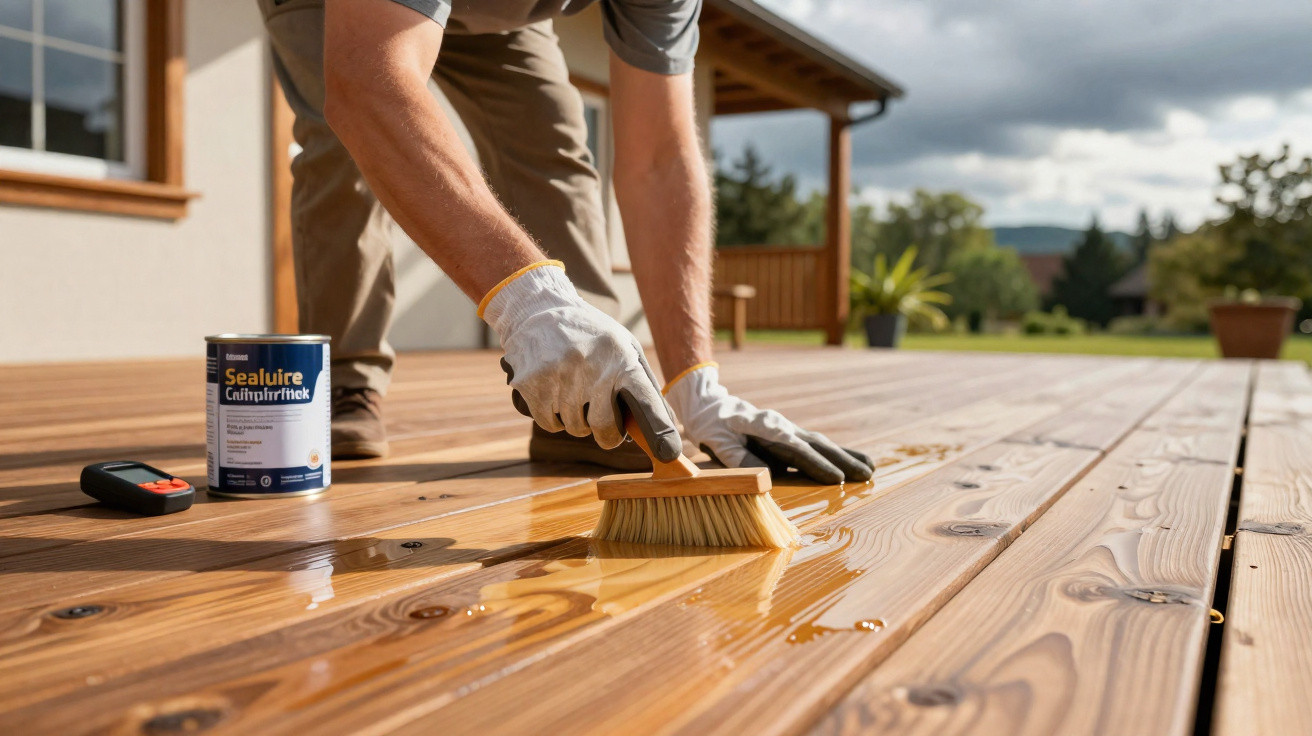
Those who look after outdoor timber properly tend to follow a simple, almost automatic ritual after rainy spells: look, touch and listen. Run a hand over surfaces, watch for darker areas, and notice whether anything has swollen or begun creaking differently. Wash gently with water and mild soap, without using excessive force from a hose, then allow everything to dry fully before applying any product. Once a year, set aside a weekend to renew the protection. This may be a wood stain, which penetrates without forming a film, or yacht varnish, which creates a more rigid layer, depending on how the timber is used.
There is a sensible balance between care and paranoia. No one has the time to become the full-time guardian of their own deck. However, a quick inspection at every change of season can reveal hidden leaks, areas where water is pooling and rusty fittings that are starting to stain the timber. A common error is attempting to make up for years of neglect by applying one thick coat of varnish over everything, without cleaning, sanding or removing already damaged material. The varnish then cracks, water enters through the splits, and the timber rots underneath, unseen.
As a street furniture restorer in São Paulo puts it: “Timber always tells you when it is suffering. We are the ones who pretend not to hear.”
- Avoid using a pressure washer too close to outdoor timber.
- Lightly sand worn sections before reapplying wood stain or varnish.
- Cut out and dispose of rotten sections immediately rather than trying to disguise the problem.
- Use breathable covers for outdoor furniture, not plastic covers that trap moisture.
- Choose lighter colours for surfaces in full sun to reduce extreme expansion.
When timber becomes a barometer for the home
Paying closer attention to outdoor timber changes how you see the space around your home. Suddenly, the leg of a bench that has started to darken is not merely an aesthetic flaw: it warns that water is collecting where it should not. A gate that swells during the rainy season indicates that side of the house is not drying properly. Timber skirting along a side passage can reveal water ingress from a neighbouring property or a poorly designed drain. Timber becomes almost a barometer for your home’s microclimate, translating everyday conditions into stains and cracks.
Once a care routine is added to the calendar, just like changing a water filter or servicing the car, the relationship with moisture changes entirely. Instead of responding to damage, you begin acting before it appears. The opening scene - the stained deck, scraping gate and smell of tired timber - can become another: firm boards, renewed colour and structures that withstand years of rain and sun with dignity. The decision is less about buying extremely expensive products and more about observing, understanding and intervening at the right moment. Perhaps it is also worth sharing this with someone else who has a piece of timber outside, quietly fighting the next cold front.
| Key point | Detail | Value to the reader |
|---|---|---|
| Choosing and preparing timber | Use treated, well-sanded timber protected with wood stain or yacht varnish | Adds years to the service life of decks, gates and outdoor furniture |
| Avoiding direct contact with water and soil | Spacers, correctly sloping paving and ventilation beneath components | Drastically reduces the risk of rot in bases and legs |
| Regular maintenance and observation | Quick checks each season and annual protective touch-ups | Makes early action possible, reducing costs and avoiding complete replacements |
FAQ:
- Question 1 How often should I reapply wood stain or varnish to outdoor timber? In most of Brazil, the usual interval is between 12 and 24 months. Areas exposed to intense sun and rain need annual touch-ups, whereas more sheltered locations can last up to two years.
- Question 2 Does washing a deck with a pressure washer damage the timber? It can do if the jet is held too close or used with excessive force. Use moderate pressure and a fan nozzle, keeping a sensible distance from the surface, solely to remove dirt and algae.
- Question 3 Will timber placed directly on the ground always rot? The risk is considerably higher. Even treated timber has a shorter lifespan when it is in constant contact with damp soil. Spacers, footings and raised bases greatly help to extend its life.
- Question 4 Can I restore an item that has already started to rot? In many cases, yes: cut away the damaged section, treat the surrounding area with fungicide and reapply protection. When the core is very soft, replacing the entire section is the safest option.
- Question 5 Is linseed oil enough on its own for outdoor use? It helps, but by itself it generally offers limited protection in conditions of heavy rain and strong sunshine. It works best when combined with products designed for external use, following the manufacturer’s recommendations.





Comments
No comments yet. Be the first to comment!
Leave a Comment