
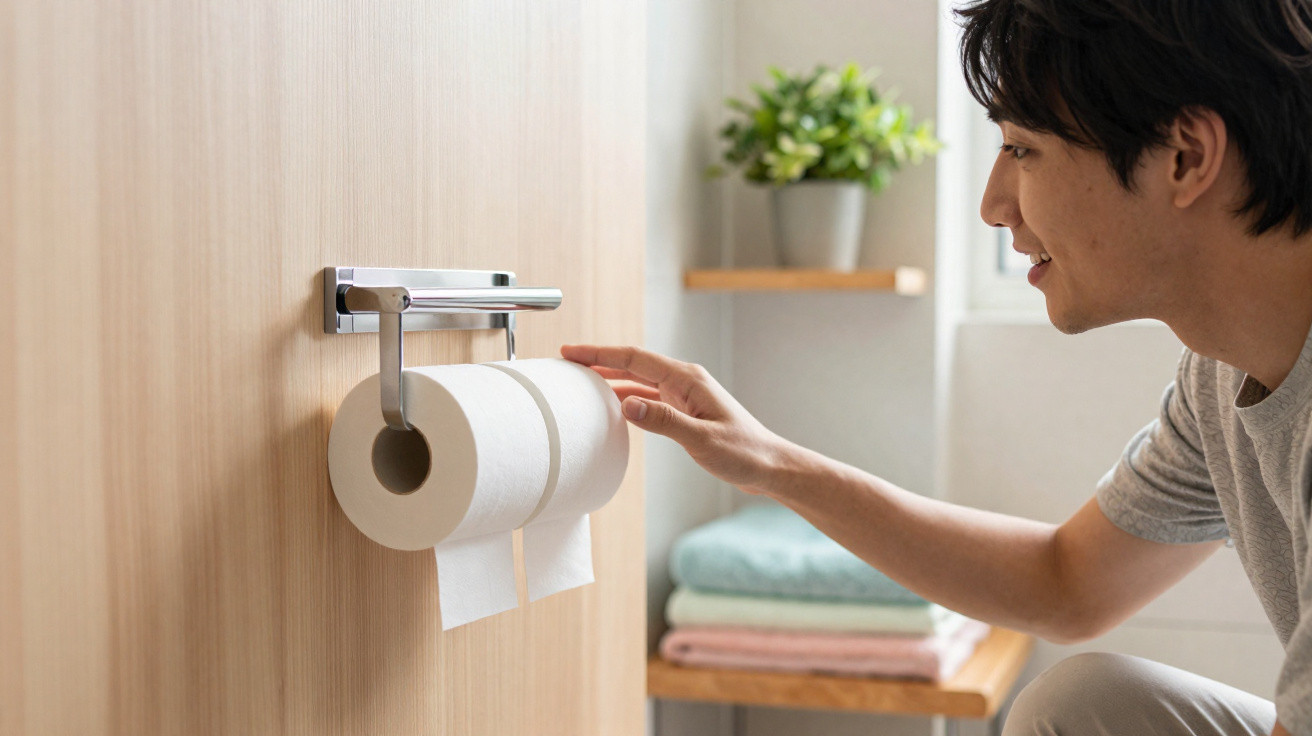
White tiles, gentle pop music and a light citrus-cleaner scent. Above the usual toilet roll, a second roll rested in a narrow transparent case, marked in bold blue lettering: “For your future self.”
A young office worker left the cubicle just ahead of me, quietly laughing as she photographed the arrangement. “Why didn’t we have this in 2020?” she said jokingly to her friend. They carried on, but her remark lingered with me like an unwritten headline.
Japan had, once again, quietly improved an object so ordinary that most of us no longer notice it, changing it just enough for it to seem almost revolutionary. It is a small adjustment to cardboard and paper, but one that reveals plenty about modern life.
And about why this idea did not occur to us earlier.
Japan’s understated toilet paper revolution
At first glance, Japan’s latest toilet paper innovation appears unremarkable: it is still a white roll hanging in its usual place. The difference lies in its design and intended use. A growing number of shops and public facilities now combine a standard roll with a “backup roll” in a compact double-holder, keeping the spare sealed, hygienic and ready to use.
The concept is almost embarrassingly straightforward. Even so, it tackles three all-too-common issues at the same time: discovering an empty roll, wasting partly used rolls in busy washrooms and panic-buying driven by memories of shortages. Instead of encountering a solitary cardboard tube, users find reassurance built directly into the wall.
At certain trial sites, the reserve is not even an ordinary roll. It is an ultra-long “mega core” model that can last up to three times longer while fitting the same holder. The space stays the same, but roll changes become less frequent and empty-roll crises are reduced. It is precisely the sort of engineering refinement Japan enjoys.
One Tokyo supermarket chain recently released internal figures after introducing double-holders and longer rolls in staff and customer washrooms. Within a month, maintenance teams said their refill rounds had fallen by nearly 40 percent. In practice, that meant fewer urgent reports of “no paper on the third floor” and less time struggling with jammed dispensers at busy times.
Customers noticed the change as well. Images of neatly arranged backup rolls behind transparent covers began appearing on Japanese social media, accompanied by remarks such as “Where was this during the toilet paper wars?” and “This is the energy I need in my life.” A brief TikTok video of a hand fitting the sealed spare roll into position attracted hundreds of thousands of views in only a few days, largely from overseas users asking, “Why don’t we have this?”
Manufacturers also highlight a less visible advantage: fewer cardboard cores, reduced packaging and many fewer partially used rolls discarded in high-traffic washrooms. A 12-pack of the new mega rolls occupies the space once required for 24 or even 30 standard rolls. In compact urban flats, that practical benefit matters more than any sustainability-report buzzword.
In practical terms, the innovation depends on three elements: capacity, backup and clarity. The mega core roll provides greater capacity without requiring a new oversized dispenser. The backup arrangement, usually placed in a slim dust-proof compartment next to or above the main roll, quietly ensures that nobody is left stranded halfway through a toilet visit. Clear instructions, often written in both Japanese and English, explain the process: “Use this one first. When empty, pull here.”
This is more than a piece of hardware. The arrangement subtly shapes behaviour. Users are less inclined to leave a nearly finished roll behind because the next action is clearly defined: use the first roll completely, then release the backup. For facilities managers, this consistency makes stock levels easier to predict and reduces those irritating “90% used but not quite empty” cases that result in needless replacements.
The psychological effect is understated but genuine. Following the worldwide toilet-paper panic of 2020, an organised and clearly visible spare answers a deep need for stability. It signals that somebody has planned ahead on your behalf. In a space as personal as a washroom, that small act of anticipation can feel unexpectedly reassuring.
How Japan’s toilet paper idea changes everyday life
For households, the Japanese model is already encouraging straightforward copycat routines. A method many families are adopting from convenience stores is to reserve a small, clearly labelled place for a “next roll” within reach of the toilet. Rather than leaving a random pile beneath the basin, they keep one clean, visible and almost ceremonial spare roll ready. It is effectively the domestic version of the double-holder.
Some households are even recreating the sealed-backup approach with transparent containers or simple wall-mounted boxes. The roll remains visible, clearly unused and, most importantly, easy to replace when the backup space is vacant. That modest visual prompt does more to maintain bathroom harmony than any passive-aggressive message taped to a door.
Japan’s mega rolls point to a wider change in attitude too: shop a little more intelligently, store things a little more effectively and plan only one step ahead. This is not about filling a doomsday bunker with paper; it is about creating a small margin of comfort that eases frantic mornings and late-night emergencies for everyone sharing a home.
That is where the emotional dimension becomes clear. On a difficult day, finding an empty roll can feel like the final insult after everything else has gone wrong. In a television segment, one person in Osaka described how their elderly mother had once become fearful of public toilets after being left without paper at a railway station. When stations introduced the backup system, that anxiety diminished. “She still checks, but she doesn’t panic,” the daughter said.
More mundanely, the innovation addresses the low-level household disputes familiar to many couples and flatmates: who “never” replaces the roll, and who leaves the last few pathetic sheets for somebody else. The Japanese approach reframes the task. Instead of constantly changing rolls, people maintain a dependable reserve. That slight change takes some of the emotional heat out of an absurdly minor object.
There is a sustainability element as well. Longer-lasting rolls that work with existing holders can mean fewer plastic-wrapped multipacks, fewer delivery journeys and less storage needed in cramped homes. One Japanese brand estimates that its extended rolls reduce cardboard-core use by roughly a third over a year for a typical family. Those figures will not save the planet on their own, but they encourage better habits without requiring anyone to give up comfort.
“We realized people weren’t just buying toilet paper,” explained a product manager from a major Japanese brand in a local interview. “They were buying the feeling of not running out.”
Viewed in that way, useful everyday measures become more obvious:
- Keep exactly one visible backup roll in each bathroom instead of a disorganised pile.
- Select higher-capacity rolls that still fit your holders, particularly in small flats.
- Replace arguments about who changed the roll with a shared rule: finish the first, prepare the second.
Let’s be honest: nobody truly does this every day. No one checks bathroom storage with military precision. But small, visible cues lessen the need for discipline in the first place. That is the hidden brilliance of the Japanese arrangement: it makes the simplest action the most sensible one too.
Why the world is taking notice
The product itself is not the only thing attracting international interest; so is its message about preparedness. Memories of empty supermarket shelves remain fresh in many countries. When images of Japanese washrooms with calm, orderly backup rolls began to spread, they resonated far beyond hygiene-design enthusiasts and retail managers.
People recognised something broader: a culture quietly learning from a frightening experience and then adapting an everyday object so that the same anxiety is less likely to intensify next time. It is the reverse of a flashy gadget launch. There is no app, subscription or QR code-only a wall, a roll and a spare.
The idea is particularly easy to share because it travels so well. You do not need to import a Japanese toilet to follow the same principle. Set aside a clear space for a spare, choose a better-fitting roll and establish a simple household rotation rule, and you can create the same gentle sense of security. It is the sort of small improvement people enjoy posting with a “Why did we wait so long for this?” caption.
The innovation also prompts a quiet question about other parts of daily life that we treat as unchangeable. If toilet paper, an old and unexciting necessity, can receive a worthwhile upgrade in 2026, what else is sitting in plain view while waiting for somebody to ask: “What if we just make this a little kinder to live with?” Kitchens, bin bags, light bulbs and even the way waiting rooms provide tissues could all be reconsidered.
At a deeper level, Japan’s toilet-paper change speaks to a collective desire for gentler infrastructure: systems that do not demand attention or scold us, but support us a little more effectively when something goes wrong. That may be why the story continues to circulate through social feeds and group chats. It is not truly about paper; it is about the comfort of feeling that the world has, for once, planned one step ahead.
| Key point | Detail | Benefit for the reader |
|---|---|---|
| Backup roll system | A visible, clean second roll built into the holder | Reduces no-paper emergencies and household tension |
| Mega core design | Longer-lasting rolls that fit standard fittings | Fewer refills, less storage space and reduced waste over time |
| Behavioural nudge | Clear prompts that lead users to finish one roll before releasing the next | Makes good habits effortless and more dependable |
FAQ
- What exactly is Japan’s new toilet paper innovation? It combines higher-capacity “mega” rolls with smart double-holders that display a sealed backup roll ready for use, making a spare an integrated feature rather than an afterthought.
- Can I get the same setup outside Japan? The exact hardware may not yet be widely available, but the principle can be copied with a wall-mounted spare-roll holder, a simple box or a visible shelf reserved for one backup roll.
- Is the new system really more eco-friendly? Brands say that longer-lasting rolls require fewer cardboard cores and less packaging per use, while significantly reducing waste from partially used rolls in public places.
- Does this require special Japanese toilets to work? No. The idea concerns the roll format and holder design, not high-tech bidet seats or plumbing.
- Why are people online so excited about something so basic? It solves a universal problem-running out at the worst possible time-with a straightforward, elegant answer that anyone can grasp at a glance.
Comments
No comments yet. Be the first to comment!
Leave a Comment