
Grease splashes, scorched crumbs and dark marks can quickly accumulate on baking trays, while ordinary washing-up liquid often makes little difference. Although many homes immediately turn to strong cleaning sprays, a quieter kitchen trend is gaining ground: inexpensive everyday ingredients that can restore a tray’s shine without using harsh chemicals.
Why baking trays look worn out before their time
Whenever food meets heated metal, small amounts of fat, sugar and protein are left behind. At 180–220°C, this residue caramelises, burns and eventually carbonises. Gradually, it creates the stubborn brown-black coating that can appear permanently stuck to the tray.
Most “ruined” baking trays are not actually damaged; they are just coated in layers of burnt grease and food residue.
Oil can spit, marinades can run, and cheese can spill over the sides of pizzas. Unless this debris is thoroughly removed, each subsequent use bakes it further into the surface. Powerful oven cleaners may remove part of the build-up, but frequent use can produce harsh fumes and discolour some coatings.
The potato trick: a surprisingly useful baking tray cleaning hack
Of the milder cleaning approaches becoming popular in European kitchens, one of the simplest relies on an ordinary raw potato. There is no need for a specialist product or extra chemicals: just use a standard potato from the vegetable drawer.
How the potato method works
The method starts by loosening the grime before using the potato with a mild abrasive to tackle it. It only takes a few minutes and requires much less pressure than scrubbing a dry tray with a metal scourer.
- Potato starch can help lift greasy layers and bind to them.
- Its cut side acts somewhat like a soft eraser against metal.
- Used with salt, it creates a gentle scrub for more persistent marks.
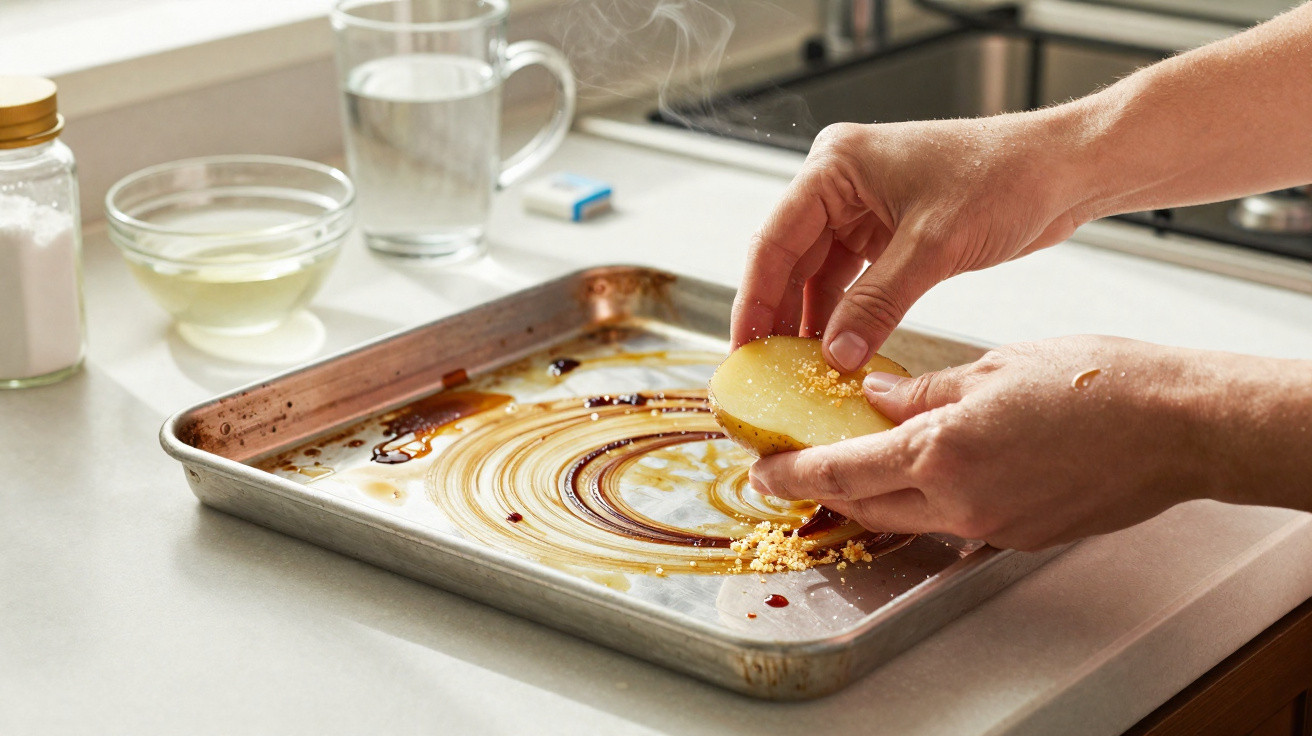
A raw potato, sliced in half, can behave like a natural cleaning pad when rubbed across a warm, wet tray.
Step-by-step: cleaning an oven tray with a potato
This is a straightforward technique to try at home.
- Boil water in a kettle or pan.
- Put the empty baking tray in the sink or over the hob.
- Pour the boiling water carefully over the tray until the base is covered.
- Let it stand for roughly five minutes to loosen the baked-on residue.
- Pour away most of the water, keeping the tray damp and warm.
- Cut a raw potato in half.
- Hold the potato by its skin and rub the cut side firmly over dirty sections in circular movements.
- If the grime is particularly heavy, add a tablespoon of ordinary table salt to the tray before rubbing.
- Rinse the tray under running water.
- Give it a final quick wash with a sponge and washing-up liquid.
A tray that has gone untreated for years may not become perfectly reflective straight away. However, many people notice an obvious improvement after one clean and a nearly new appearance after repeating the method several times.
Other cupboard staples that can make trays shine
The potato trick is one of several affordable methods that use familiar household ingredients instead of specialist cleaning products.
Vinegar soak for baked-on grease
Ordinary kitchen vinegar combined with water can help break up oily coatings and release older stains.
Equal parts vinegar and water, left to soak on the tray, often lift a surprising amount of grease with minimal scrubbing.
Add equal quantities of vinegar and water to the tray, using enough liquid to cover the worst affected sections. Allow it to soak for at least 20–30 minutes. Its acidity helps dissolve mineral deposits and weaken the bond between grease and metal. Once soaked, use a non-scratch sponge to scrub the tray, then rinse it well to eliminate the vinegar smell.
Dishwasher tablet in boiling water
Dishwasher tablets contain powerful detergents and enzymes formulated to deal with precisely this type of dirt.
To clean a tray with one:
- Set the tray in the sink.
- Add one dishwasher tablet.
- Pour in enough boiling water to cover the base.
- Wait for the tablet to dissolve completely, then move the liquid around the tray.
- Leave it for several minutes before lightly scrubbing and rinsing.
This approach is especially effective for trays without sensitive non-stick coatings. The concentrated detergents may be too harsh for lower-cost non-stick layers when used repeatedly.
Cornmeal as a mild abrasive
Cornmeal, commonly used in baking and breading, can also serve as a gentle polish for metal baking trays. It offers texture without the harsh abrasiveness of steel wool.
A light scatter of cornmeal on a damp tray can act like very fine sandpaper, lifting residue without gouging the surface.
Dust the tray with a light layer of cornmeal, then use a damp sponge to spread it around the surface. The grains help release stuck-on residue, while the sponge gathers the loosened dirt. Rinse thoroughly afterwards to ensure no grains are left behind before the tray is used for cooking.
Choosing the best method for your baking tray
Baking trays vary considerably. They may be made from solid stainless steel, aluminium, enamel or non-stick-coated metal. Selecting a suitable cleaning technique helps protect both the tray’s condition and its lifespan.
| Tray type | Safe methods | Methods to avoid |
|---|---|---|
| Stainless steel | Potato + salt, vinegar soak, dishwasher tablet, cornmeal | Heavy use of steel wool that can scratch |
| Enamel-coated | Potato + salt, vinegar, cornmeal | Very abrasive powders or sharp metal scrapers |
| Non-stick (Teflon-style) | Potato (without much salt), mild detergent, short vinegar soak | Dishwasher tablet soaks, harsh abrasives, long hot soaks |
| Aluminium (uncoated) | Potato, cornmeal, gentle detergent | Strong vinegar soaks that can dull or pit the metal |
Why households are moving away from harsh oven sprays
Strong oven cleaners can work quickly, but they can also create unpleasant fumes and irritate the skin, particularly in small flats with poor ventilation. Parents and pet owners may also be concerned about cleaning residues on surfaces that will later hold food.
Using potatoes, salt, vinegar or cornmeal can reduce chemical exposure as well as plastic packaging. These ingredients are low-cost, easy to find and frequently already available in the kitchen, which is particularly relevant as grocery costs rise.
Keeping baking trays cleaner for longer
After restoring a tray to a respectable shine, several small habits can help prevent grime from building up as fast.
- Use baking paper or a reusable silicone mat for fatty or sticky foods.
- Clean the tray while it is still slightly warm rather than once it has cooled, before the grease fully hardens.
- Remove larger food pieces before washing instead of allowing them to dry on the surface.
- Do not stack trays while they remain greasy, as residue can transfer between them.
Regular light cleaning beats the occasional heavy scrub, both for your hands and for the tray surface.
When marks will not come off: realistic expectations
Certain marks are not grime at all, but genuine heat- and age-related discolouration in the metal. Rainbow shades, faint golden patches and slight darkening may stay behind even if the tray is completely clean. In most cases, these marks do not affect safety or performance.
A helpful guide is to run your fingers across the surface: if it feels smooth, the visible mark is likely staining rather than residue. Concentrate cleaning efforts on areas that feel rough, raised or sticky, as these are where food particles are still attached.
Practical risks and simple precautions
Natural cleaning methods still involve a few small hazards. Carelessly handled boiling water can cause scalds, and trays can stay hot for longer than expected. Use heatproof gloves or a thick towel at all times, and keep children away from the sink while cleaning.
Use salt and other granular abrasives gently on non-stick finishes because repeated vigorous scrubbing may gradually wear away their coating. If you are unsure, test the technique on one small corner first and look for scratching or dullness.
Beyond trays: applying the same kitchen cleaning tricks
These methods can also be used on other cookware. Potato and salt can clean cast-iron griddles, cornmeal can refresh roasting tins, and diluted vinegar can remove greasy haze from glass oven doors. The same principle applies throughout: soften the residue, loosen it, and lift it away rather than using brute force.
Viewed this way, the neglected bag of potatoes at the back of the cupboard is more than a source of food. Alongside salt, vinegar or a basic dishwasher tablet, it becomes a modest cleaning kit that can revive tired ovenware without costly sprays or complicated gadgets.



Comments
No comments yet. Be the first to comment!
Leave a Comment