
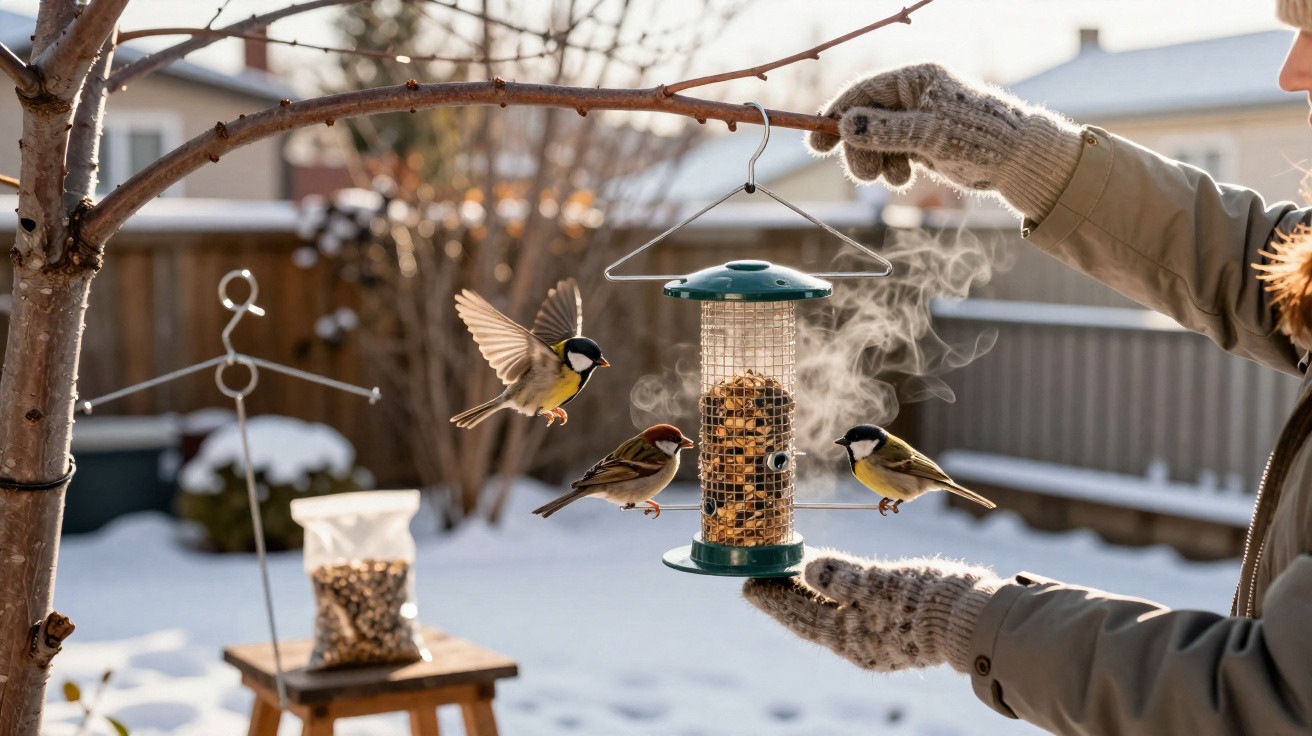
A frost-covered garden may look deserted, yet a simple household trick is quietly making a difference to the lives of urban and garden birds.
As frost blankets the ground and conceals seeds and insects, every small detail can affect birds’ survival. One inexpensive, slightly unexpected solution is being rediscovered at the back of wardrobes: the old metal coat hanger. Once destined for the bin, it can take on a useful new role during the cold season.
Metal coat hanger: from the back of the wardrobe to a garden support
When temperatures fall, small birds such as sparrows, tanagers, great kiskadees, bananaquits and rufous-collared sparrows use considerable energy simply to stay warm. They need to eat more at precisely the time when natural food sources are scarcer.
Many households have started putting feeders in their gardens and on balconies. However, a poorly placed feeder can become a hazard: it may blow over in the wind, tip easily, collect dirt, or remain within reach of cats and other predators.
A metal coat hanger, when properly adapted, acts as a rigid, raised arm that keeps food away from the ground and from predators.
This reuse fits with a zero-waste approach, cuts costs and creates a safer feeding point at the same time. Rather than buying an expensive bracket, many birdwatchers are making use of items they already have at home.
Why a metal coat hanger genuinely helps birds in winter
An ordinary coat hanger has three qualities that are particularly useful for anyone wanting to support local wildlife:
- it is rigid enough to hold a feeder filled with seeds;
- it is pliable enough to shape using pliers;
- it already has a hook that can be adapted to different fixing points.
Once straightened and reshaped, the coat hanger can become a support rod that keeps the feeder suspended around 1.5 m to 1.8 m above the ground. This height greatly reduces access for cats, dogs and even more agile rodents.
Lateral clearance is another essential consideration: positioning the support roughly 2 metres from walls, thick tree trunks, roofs and fences makes it harder for predators to leap towards it. Birds can arrive in flight, whereas a cat needs both a launching point and support to attack. Without that “bridge”, the danger is substantially lower.
A badly positioned feeder can become bait for predators. A coat-hanger support helps balance good intentions with genuine safety for birds.
Wind, snow and rain: the daily test for this improvised solution
In winter, gusts and heavy rain can knock over feeders resting on unstable surfaces. When securely fixed, the hanger’s metal withstands this movement more effectively. It will still move, but in a controlled way. Birds soon adapt to it, unlike a dish simply placed on a window ledge, which can fall in the first strong gust.
How to turn a coat hanger into a secure feeder support
Adapting it takes only a few minutes and requires no advanced DIY skills. Here is a simplified guide.
Basic step-by-step guide
| Stage | What to do |
|---|---|
| 1. Choosing the hanger | Select a sturdy metal coat hanger with no severe rust or broken welds. |
| 2. Straightening it | Using pliers, gradually unbend the hanger until it forms an almost straight rod of around 35–40 cm, or longer if the available space allows. |
| 3. Creating the feeder hook | At one end, form a tightly closed loop to hold the feeder securely. |
| 4. Making the fixing hook | Shape the other end into a hook suited to the chosen location: a branch, beam, wall bracket or balcony railing. |
| 5. Balancing it | Hang the empty feeder and adjust the curve until it sits level without tipping to either side. |
It is best to avoid very thin hangers, as they bend too easily, as well as pieces with deep rust. The metal needs to support the weight of the seeds even on wet days.
Easier hygiene thanks to the coat hanger’s practicality
One often-overlooked benefit is easier cleaning. Because the feeder is simply slotted onto or attached to the coat hanger hook, it can be removed for washing in one movement.
Conservation organisations recommend cleaning the feeder once or twice a week to reduce the risk of fungi and disease spreading among birds.
This straightforward routine limits bacterial growth and helps prevent leftover food from fermenting. Without a practical support, many people stop cleaning feeders regularly, which harms the very birds they intend to protect.
Where to place the feeder to protect birds and respect neighbours
Once the coat hanger has been shaped, the most strategic step remains: selecting the right place to hang the feeder.
Gardens and back gardens
In open spaces, it is advisable to choose a fairly central area with good visibility for both the birds and anyone watching from indoors. Nearby trees can provide shelter, but the feeder should not be placed right against them.
- Height: between 1.5 m and 1.8 m above ground level;
- Horizontal distance: around 2 m from trunks, walls and fences;
- Setting: a spot with some protection from the wind but no obstructions along the flight path.
This position gives birds a quick escape route while making it more difficult for cats and mustelids, such as weasels found in some areas, to approach unnoticed.
Balconies and terraces
In flats, the coat hanger can be hooked onto a balcony railing, a wall-mounted hook or a protective beam. In this setting, consideration for neighbours also matters.
It is sensible to:
- keep a clear flight corridor, with no wires or decorations blocking entry and exit;
- prevent seeds and droppings from falling directly onto the balcony below;
- place the feeder away from large panes of glass, which increase the risk of bird strikes.
What to put in the feeder: food that helps and food that harms
A secure support is only worthwhile if the food offered is suitable as well. Certain choices are much more useful in winter.
Good options for cold weather
- sunflower seeds, preferably black ones, which provide more energy;
- seed mixes made for wild garden birds;
- plant-based fat balls, with no plastic netting around them;
- chopped fruit, including apple and banana, plus small portions of raisins.
On the other hand, some everyday foods can cause digestive problems for birds:
- excessive amounts of bread and flour-based products;
- biscuits and foods that are very salty or sugary;
- seasoned table scraps;
- animal fat and milk.
The wrong foods can make birds feel “full” without providing the nutrients they need to cope with cold nights.
The most suitable period for this concentrated support generally runs from mid-November to the end of March, adjusted according to local weather conditions. During extreme cold, snow or prolonged frost, extra food can make a real difference to the survival of many birds.
When an improvised support becomes part of a conservation routine
Using a metal coat hanger in this way is more than a charming improvised idea. It reinforces a principle gaining ground in urban and peri-urban areas: every small change in a garden or on a balcony affects the lives of dozens of wild animals.
For beginners, a useful approach is to watch how birds behave around the new feeder for one or two weeks: which species visit, at what times, whether there are disputes between them, and whether a predator appears frequently. These signs can guide adjustments to the height, position and type of food.
Some people set up more than one feeding point, using two or three recycled coat hangers. One can hold seeds only, another fruit, and another plant-based fat balls. This reduces competition between species with differing habits and spreads bird activity more evenly around the garden.
For children, this type of installation can become an informal scientific observation activity. They can record the species they see, dates, days with greater activity, and behaviour on rainy or sunny days. Gradually, the old bent coat hanger that once took up space in the wardrobe becomes a symbol of a small winter refuge for tired birds, offering the quick calories they need to get through another freezing night.




Comments
No comments yet. Be the first to comment!
Leave a Comment