
The microwave once stood for modern-day convenience, transforming frozen leftovers into hot meals within minutes. Now, however, that familiar symbol can seem outdated as newer technology offers cooking that is quicker, tastier and more energy-conscious. One rival, in particular, is shifting from a specialist gadget to a credible replacement.
The microwave’s unusual place in 2025 kitchens
For many decades, the microwave oven has been as essential a purchase as the fridge. It warms coffee, defrosts mince, melts butter and helps keep busy weeknights on schedule. Most homes in Europe and North America still have one, while sales continue to hold steady.
Still, the relationship is not entirely straightforward. Plenty of people use a microwave every day yet confess they do not completely trust it. Claims about radiation, nutrients being “killed” and chemicals escaping from plastic containers persist, despite years of fact-checking.
Microwaves are not about to give you cancer, but the way you use them can still affect your health and the quality of your meals.
Meanwhile, compact new ovens are beginning to equal or surpass microwaves in the areas they once owned: convenience and speed. This is increasingly influencing purchasing choices, particularly in small city homes where each plug socket counts.
What science really says about microwave safety
One question repeatedly returns: can radiation from a microwave cause cancer? Major health bodies, including the US National Cancer Institute and the World Health Organization, give a short answer: no.
Microwave ovens operate with non-ionising electromagnetic waves. Their energy makes water molecules move, creating heat, but it is insufficient to break DNA strands-the process that can result in cancer.
Modern microwave ovens are also enclosed in a metal casing that works like a cage. The door's mesh allows light through so that you can watch the food, while preventing the microwaves themselves from escaping. Provided the door shuts correctly and its seal remains undamaged, leakage stays well under safety limits.
The more practical health concerns are found elsewhere: in the containers selected, the foods being heated and the consistency of the cooking.
The real weakness: plastics and ultra-processed meals
A large number of “microwave-ready” meals are supplied in plastic trays. Heating food in plastic can allow tiny amounts of chemicals to transfer into the meal, particularly if the container is thin, scratched or unsuitable for high temperatures.
Certain substances used in plastics and coatings-including some plasticisers and residues from inks and dyes-cause concern because they could interfere with hormones or accumulate in the body over time. Regulators impose limits, and manufacturers have removed some of the most problematic substances, although research is ongoing.
The risk does not come from the microwaves themselves, but from heating food in the wrong type of container at high power, day after day.
Nutrition presents another consideration. The issue with many microwave meals is not microwave heating itself, but their ultra-processed nature: they are often high in salt, sugar and refined fats. Their nutritional profile remains the same whether they are heated in a frying pan, air fryer or microwave.
The quiet growth of the convection oven
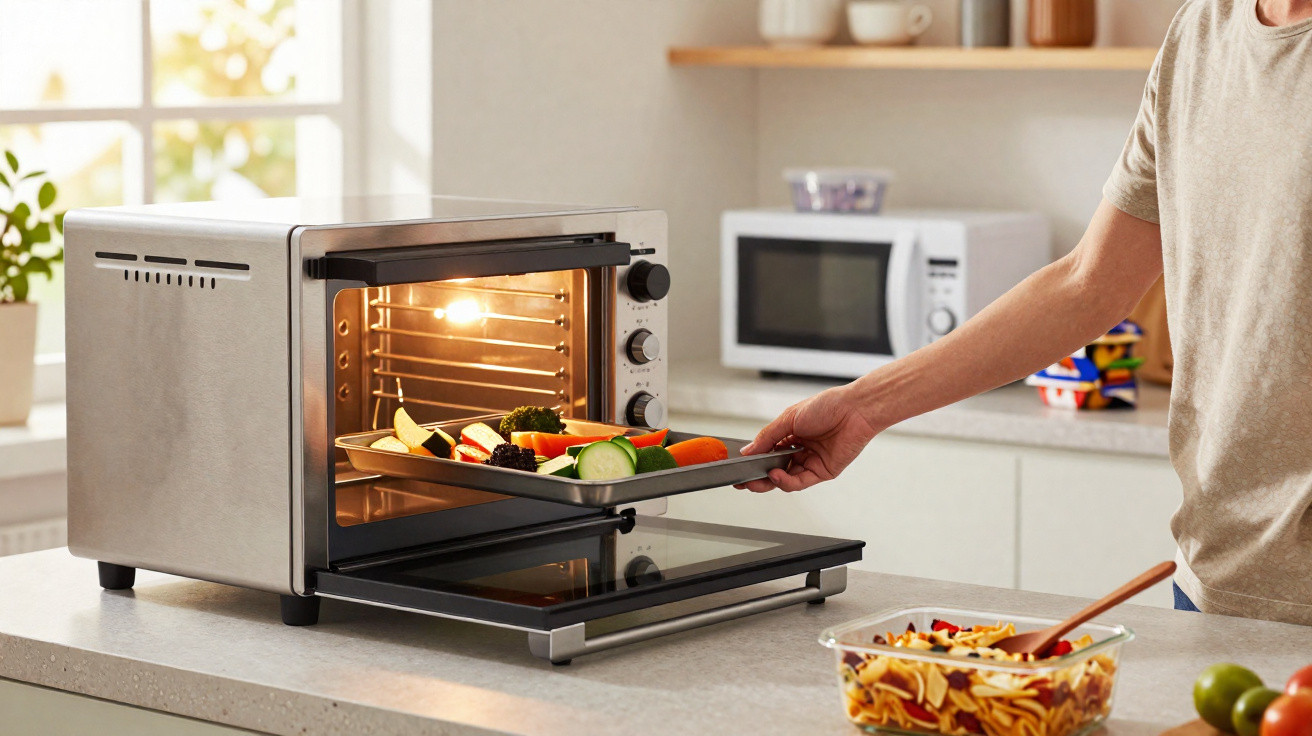
As discussion around microwaves continues, another technology is steadily gaining popularity: the countertop convection oven, frequently marketed as a multi-function air fryer oven.
Rather than relying chiefly on still air and metal surfaces, as a conventional oven does, a convection oven uses a fan to move hot air around the food. This continuous circulation shortens cooking times and produces a more consistent temperature throughout the cavity.
Manufacturers state that these appliances can save up to 80 per cent of the energy needed to preheat and operate a full-size conventional oven for small servings. Results from independent tests differ, but the general conclusion remains: for a tray of vegetables or one chicken breast, a compact convection appliance will usually consume less energy than a large built-in oven.
The core promise of convection ovens: microwave-like speed, but with the texture and browning of a conventional bake.
Why some homes now go without a microwave
For an increasing number of people, a small convection oven manages nearly every everyday job for which a microwave once seemed essential. It can:
- Reheat leftovers with crisp edges rather than soggy areas.
- Cook frozen food without heating up a large oven first.
- Toast bread and bake small quantities of pastries.
- Roast vegetables and fish evenly, with greater control over texture.
The eating experience is significant. Leftover pizza from a convection oven tastes markedly different from pizza heated in a microwave. Chips revive instead of turning into a soft heap. Thanks to the airflow, even ordinary toast browns more evenly.
For tenants and students, a single compact oven can take the place of a toaster as well as much of a microwave’s role, while occupying a similar amount of worktop space. It can therefore be an attractive first appliance, especially in flats where energy prices are increasing and built-in ovens may be ageing or unreliable.
Microwave vs convection oven: the real comparison
| Feature | Microwave oven | Convection oven |
|---|---|---|
| Primary heating method | Microwaves excite water molecules inside food | A fan circulates hot air around food |
| Speed for reheating | Extremely quick for liquids and soft dishes | Quicker than a traditional oven, but slower than a microwave |
| Texture | Soft, occasionally rubbery, with no browning | Crisp, browned exteriors, better for roasting |
| Energy use for small portions | Low to moderate, depending on power and duration | Low to moderate, often lower than a full oven |
| Best suited for | Soups, drinks, quick reheating, defrosting | Full meals, frozen foods, baking, crisp reheating |
Many households now use both appliances. But when people need to select only one, the trend is increasingly towards convection, particularly in newer and more compact homes.
Getting the best from the microwave you already have
Even if a new convection oven is appealing, the microwave you own still has a place. When used carefully, it can be energy-efficient, fairly healthy and remarkably precise.
Improve reheating with a few straightforward changes
When warming leftovers, pause halfway through to stir or turn the food. This redistributes cooler and hotter areas, lowering the likelihood of bacteria remaining in cold spots-particularly in dense foods such as rice or casseroles.
For food that tends to dry out, add a little water or place a microwave-safe lid over the dish. The resulting steam helps retain a texture closer to that of the original meal.
Where the food sits also makes a difference. The middle of the turntable can heat less consistently than its outer edge because microwave energy is not spread perfectly evenly inside the cavity. Positioning the plate nearer the rim lets it move through more hot zones as the turntable spins.
A small shift of the plate towards the edge of the turntable can lead to more even heating than adding a full extra minute.
Selecting the right container every time
Metal is still an obvious no, since it may create sparks. Some newer microwaves can use particular metal racks, but these are made to reflect energy in controlled ways. For ordinary use, glass and ceramic usually provide the greatest safety margin and the best heat distribution.
When using plastic, ensure it is labelled microwave-safe, and throw away containers that are old, warped or scratched. Do not heat particularly fatty or oily foods in thin plastic, as high heat can put the material under stress.
What the change could mean for future kitchens
The discussion around microwaves and convection ovens points to a wider change in home cooking. Rather than having one “main” oven with a microwave acting as its assistant, kitchens in the 2030s could revolve around smaller, quicker and smarter devices designed for particular jobs.
Manufacturers are already trialling hybrid appliances that bring together microwave, convection and even steam functions in one unit. They offer microwave speed, hot-air browning and the delicate results of steam cooking. Compact in size, they sit somewhere between a conventional oven and a professional combi-oven.
For homes concerned about energy bills, the issue becomes a practical one: which appliance can complete the greatest number of tasks using the fewest watt-hours? A convection oven capable of roasting, baking and reheating may warrant its initial price more than a basic microwave used chiefly for warming coffee and leftovers.
A useful way to choose is to record appliance use for a week. Write down every occasion when you use the microwave, main oven, toaster or any air fryer. The findings often catch people out. If most of your hot food needs baking, roasting or crisping, a quality convection oven may be more useful than replacing your microwave. If you mainly warm soups, porridge and baby bottles, the traditional microwave remains suited to your routine.
Food safety should be part of the decision as well. Dense, higher-risk foods-including reheated rice, large portions of poultry and meal-prep containers-must be heated evenly through their centres. A convection oven, or a microwave-convection combination appliance, may give more uniform results for these foods and reduce the likelihood of cold areas where bacteria can survive.



Comments
No comments yet. Be the first to comment!
Leave a Comment