
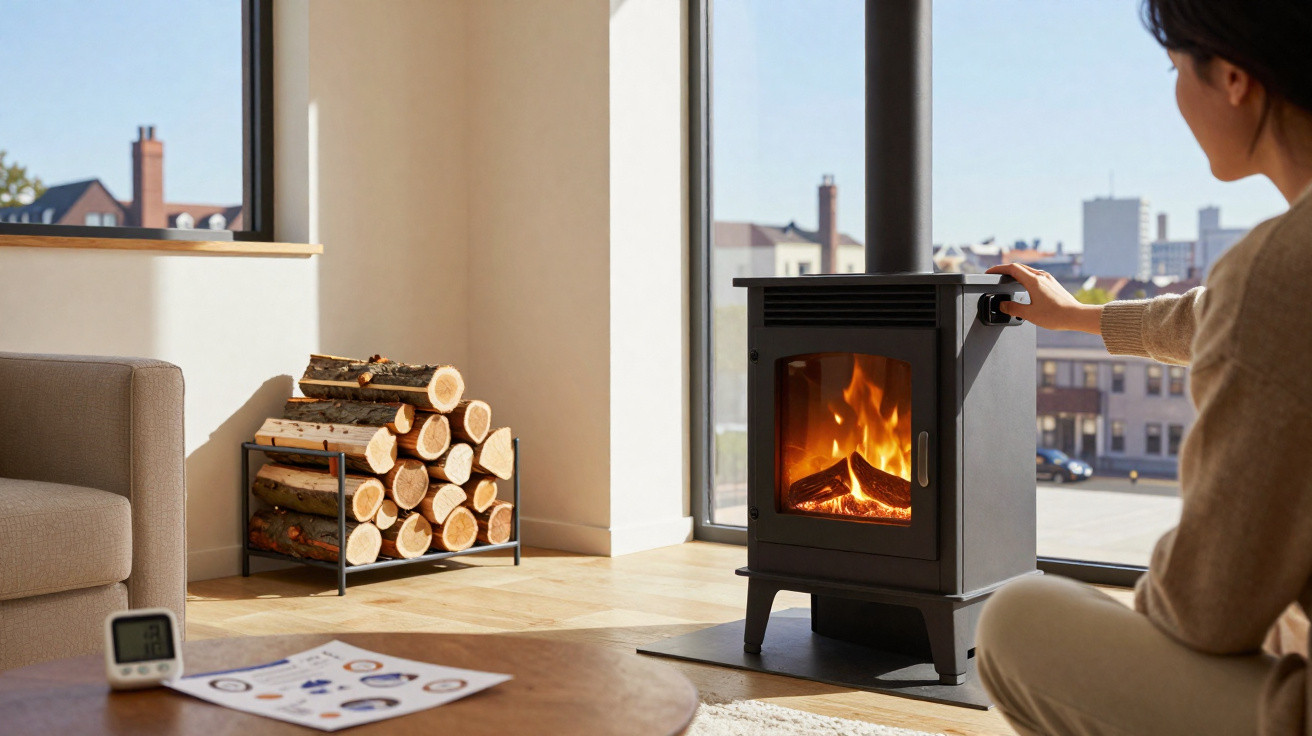
Today, that same scent can signal a council letter, a fine or an uncomfortable knock at the door. Across the UK, regulations governing wood burners and fireplaces are changing rapidly, and plenty of households are only beginning to understand the scale of the change.
Fresh restrictions on permitted fuels, tighter smoke limits, new inspections and fines: the cosy living-room fire has quietly turned into a legal minefield. Families who believed heating with logs was the “green” choice are now being labelled polluters. Stove retailers are revising their sales messages, while chimney sweeps are increasingly acting as unofficial legal guides.
Some people are frustrated, others bewildered, and many simply want to know whether their cherished stove is about to become a very costly ornament. The rules are different now. But has everyone really caught on?
What the new ban on wood burners really changes
On an overcast Tuesday in an ordinary terraced street, the difference is visible without opening a single piece of legislation. Fewer chimneys are smoking. Those that still send up a noticeable plume attract looks that would have been unlikely a few years ago. Even when people cannot cite the rules, they sense that something has shifted.
The latest change is not a total ban on wood burners. Instead, it tightens the rules on what may be burned, where it can be burned and how it should be burned. New stoves must comply with more demanding “Ecodesign” standards. In many urban smoke control areas, wet wood and house coal can no longer be burned. Councils may fine households where chimneys emit dark smoke for more than a brief period. The romantic notion of “just throwing anything on the fire” is now running into a growing body of air-quality regulation.
Conversations in stove shops reveal the concern. A retired Leeds couple ask whether their 15-year-old burner has become unlawful. In Croydon, a young family search for DEFRA-approved models on their phones as they try to establish whether they can use the second-hand stove bought online. Many learn that the real focus is not the metal appliance itself, but its fuel and the smoke it creates. The change is understated: your fireplace is not banned; your old habits are.
A stark figure sits behind these measures: wood burning is now among the UK’s largest sources of small-particle pollution (PM2.5), particularly during winter. These particles are sufficiently small to travel deep into the lungs and bloodstream. Public Health England and local councils have faced growing calls to intervene, especially in crowded cities where one person’s “cosy fire” can trigger another person’s asthma. The new ban therefore targets the dirtiest fuels and the most polluting practices, even though headlines can suggest that stoves have been banned altogether.
How to live with a wood burner under the new rules
For existing wood burner owners, the first practical measure is uncompromisingly straightforward: examine the fuel you burn rather than only the appliance you burn it in. Kiln-dried or properly seasoned wood with moisture below 20% is now the basic expectation in many places. Wetter fuel produces much more smoke and soot, along with the fine particles councils are seeking to reduce.
As a result, bags labelled “wet wood” are being withdrawn or relabelled, while many retailers now supply only clearly marked “Ready to Burn” certified fuel. A low-cost moisture meter, cheaper than a takeaway, can show whether your log store is compliant or a potential problem. Brief, hot fires with sufficient airflow burn more cleanly than a prolonged, damp smoulder. It is a modest adjustment to everyday practice, but it separates a welcoming flame from a smoky nuisance.
The emotional jolt often arrives later, when households recognise that their established winter routines are now being examined. On a freezing January evening, the urge to burn offcuts, painted timber or whatever is stored in the shed now brings a genuine risk. In some smoke control areas, using prohibited fuels can result in fines of up to £300, with greater penalties for repeat offenders. Many households find this out only after a warning letter arrives, complete with a blurred photograph of their chimney.
On a personal level, it can feel intrusive. The familiar orange light of a fireplace, once associated with independence, now carries an unseen checklist of requirements. And honestly, nobody reads every government PDF before lighting a fire at 6 pm after a tiring day.
The reasoning behind the tougher approach is quite direct. Policy makers are not attempting to spoil anyone’s Sunday evening; they want to reduce hospital admissions and long-term respiratory harm. Monitoring stations in major cities have recorded winter pollution spikes that correspond with domestic wood burning rather than heavy industry. The new rules consequently encourage cleaner-burning stoves, improved fuel and better practices, while progressively pushing out the dirtiest arrangements. This is regulation through gradual pressure, not overnight confiscation.
Staying on the right side of the fireplace rules
The most useful action you can take is to assess your own circumstances, much like carrying out a small home audit. Do you live within a smoke control area or beyond one? A quick postcode search on your council website should provide the answer. Which stove model do you have, and does it appear on the list of DEFRA-exempt or Ecodesign-ready appliances? It may sound unexciting, but five minutes of research can prevent months of lingering concern.
Once you understand your position, you can establish a simple routine. Burn certified dry wood or authorised smokeless fuel. Have the chimney swept at least annually, and more often if you use the stove heavily. Leave the air vents open so that the fire burns hot and clean rather than restricting it in an attempt to make a few embers last longer. These small practices bring you quietly into line with the new rules without making your living room feel like a laboratory.
More personally, the greatest mistake is to act as if nothing has altered. Many people continue burning exactly as before, then feel caught out when a neighbour complains or a fine arrives. There is a narrow divide between enjoying a log fire and creating tension along the street. In a tightly packed terraced row, smoke does not simply vanish into the sky; it can drift through somebody else’s bedroom window.
Communication can make a difference. Telling neighbours that you have moved to low-smoke fuel or upgraded your stove can gently reset expectations. It demonstrates that you are not “that” neighbour who is unconcerned. Equally, if smoke from next door is troubling you, a calm discussion may achieve more than immediately contacting the council. On a cold evening, everyone is sharing and negotiating the same air.
Let’s be honest: no one really does this every day. Nobody checks stove specification sheets over their morning coffee. Experts therefore often advise concentrating on three essential habits: clean fuel, clean burning and a clean flue. Get these right most of the time and you are far removed from the headline-making nightmare scenarios.
As one air quality researcher told me:
“The goal isn’t to ban warmth or comfort. It’s to stop the small number of very dirty fires doing a large share of the damage.”
That distinction seldom appears in viral social-media posts, yet it is where the real transformation takes place. For many households, the decision is not “wood burner or no wood burner”. It is whether they will alter their habits enough to keep the fire going without suffocating their neighbours.
For a practical approach, here is what many experienced wood-burner owners now recommend:
- Burn only dry, certified wood or approved smokeless fuels.
- Operate the stove hot when lighting and refuelling, and avoid extended smoky smouldering.
- Arrange for a qualified professional to sweep your chimney at least once each year.
- Find out whether your area has particular smoke control rules or fuel restrictions.
- Replace your old stove with an Ecodesign / DEFRA-approved model when it reaches the end of its working life.
What this shift says about how we heat our homes
There is something quietly revealing in the way this new ban and the evolving fireplace rules have been received. For some, the impact is a minor inconvenience: change the fuel, adjust the routine and carry on. For others, it seems like an assault on a lifestyle or a hard-earned sense of self-sufficiency. A log burner is not merely a heater; it represents preparedness and freedom from complete dependence on a fragile energy grid.
Meanwhile, more renters and younger city residents primarily view wood smoke as a problem: irritated throats, wheezing children and the odour of burning caught in curtains. They do not see crackling logs on Instagram; they see air-quality reports and inhalers. Both perspectives are real, and the new rules seek to bring them into a shared discussion, however uncomfortable that may be.
We have all experienced the first genuinely cold autumn evening, when the instinct is to light something and create warmth that can be seen. The law now enters that personal moment, occupying the space between match and log. It poses a question: can you heat your own home without making the shared air worse, in another sense, for everyone else?
There is not yet a definitive answer. Some people will abandon stoves completely in favour of heat pumps or infrared panels. Others will commit to highly efficient, low-emission burners and careful fuel storage. A small number will disregard the rules until enforcement reaches them. The only certainty is that the age of the carefree, unregulated wood fire is passing into memory.
New bans and stricter fireplace rules do not extinguish the human attachment to flame. They simply give it a different form, with figures, penalties and air monitors present in the background. Whether this is seen as a loss or an essential development may reveal more about our relationship with home, comfort and responsibility than it does about the stoves themselves.
| Key point | Detail | Why it matters to the reader |
|---|---|---|
| Type of ban | Targeted at polluting fuels and excessive emissions, rather than a complete ban on stoves | Understand whether your appliance remains permitted |
| Smoke control area | Stricter requirements apply in smoke control areas, with possible fines | Know whether your address is subject to specific limits |
| Good practice | Certified dry wood, a hot fire, regular chimney sweeping and Ecodesign models | Reduce the risk of penalties while keeping the comfort of a fire |
FAQ:
- Can I still use my existing wood burner under the new rules? In most instances, yes. Existing stoves can generally still be used if you burn authorised fuel and avoid excessive smoke, particularly in smoke control areas.
- What exactly is banned now for fireplaces and stoves? Many areas now prohibit or severely limit wet wood and traditional house coal, concentrating on fuels that generate higher levels of smoke and fine particles.
- How do I know if my area has special wood-burning rules? Visit your local council website and search for “smoke control area” or “domestic burning”. A postcode checker is frequently available.
- Do I have to replace my old stove immediately? No legal obligation requires an immediate replacement in most areas, but moving to a DEFRA-approved or Ecodesign stove greatly cuts emissions and future risk.
- Can neighbours report me for smoke from my chimney? Yes. If your fire produces persistent visible smoke, especially within a smoke control zone, neighbours can make a complaint and the council may investigate, issue warnings or impose fines.




Comments
No comments yet. Be the first to comment!
Leave a Comment