
The steam had only just dispersed and the mirror remained misted when she spotted it: a pale grey shadow inching along the grout, spreading like a bad mood in slow motion.
The tiles had seemed spotless and bright yesterday. Now the shower corners looked suddenly aged and slightly uncared for, as though the room had concealed something overnight. She picked at the fine mark with her fingernail, aware it would achieve nothing. Once mould gets into grout, it embeds itself like a stain in your memory.
She opened the window, propped the door open and flapped her towel through the air like a flag. It seemed faintly absurd. Who has the time to look after bathroom walls after every shower? Even so, the thought stayed with her as she picked up her coffee and hurried out. Perhaps there was one easy action that would not feel like a task but could make all the difference.
The answer lies in the five quiet minutes after you switch off the water.
The hidden life of your shower walls
As soon as you leave a hot shower, the bathroom may look clean, but it is actually at its most exposed. Every bead of water left on the tiles can help mould grow. Slightly porous grout behaves like a sponge that never asked to do the job. Steam rises, water flows downwards, and gravity draws that moisture directly into the joints.
We usually notice the obvious mess: soap scum, hair and leftover shampoo. Yet the bigger issue is often the water you cannot be bothered to remove. Tiles can cope with it; grout cannot. It takes in moisture, expands and gradually deteriorates. That is when those hazy grey and black speckles begin appearing, seemingly from nowhere. Of course, they have not appeared from nowhere at all.
What seems like a sudden outbreak is normally the result of weeks of unnoticed activity. Mould spores are already present in the air in tiny quantities almost everywhere. By themselves, they are not the problem. They cause trouble when they find a surface that remains wet for long enough. A shower that does not properly dry between uses is effectively an open invitation. Once mould establishes itself in grout, cleaning turns into a fight you rarely win in one attempt.
In a survey circulated among homeowners on a US renovation forum, more than half said they had “gave up” on one bathroom because of persistent mould in the grout. Some changed to darker grout simply so it would be less visible. Others removed perfectly sound tiles sooner than they had intended. That is how much frustration a few millimetres of discoloured lines can create. And it all begins because the water has nowhere to go.
One homeowner said he had recorded a time-lapse of his shower wall. Two hours after showering, the tiles were dry while the grout lines still shone. At four hours, the surface appeared matt, but a moisture meter showed that the grout was still damp internally. Entire nights and working days went by in this half-wet, half-dry state. It is ideal weather for mould, repeated every day. It is hardly surprising that “deep cleaning weekends” became a ritual nobody enjoys.
Practically speaking, mouldy grout is a matter of physics rather than dirt. Grout is seldom fully sealed, even if you assume it is. Its microscopic pores retain water. When enough of those pores stay wet, mould spores attach themselves, feed on soap residue and skin cells, and spread across the surface. Strong chemicals may bleach the marks, but they do not always reach the roots embedded in the grout. You scrub, the stains lighten, and then they silently come back.
The real solution is not another miracle spray. It is disrupting the cycle that leaves grout damp long after you have left the bathroom. That is where a remarkably straightforward shower habit comes in-one that seems almost too basic to make a difference, but changes the entire picture.
The simple “60-second” shower trick that stops mould before it starts
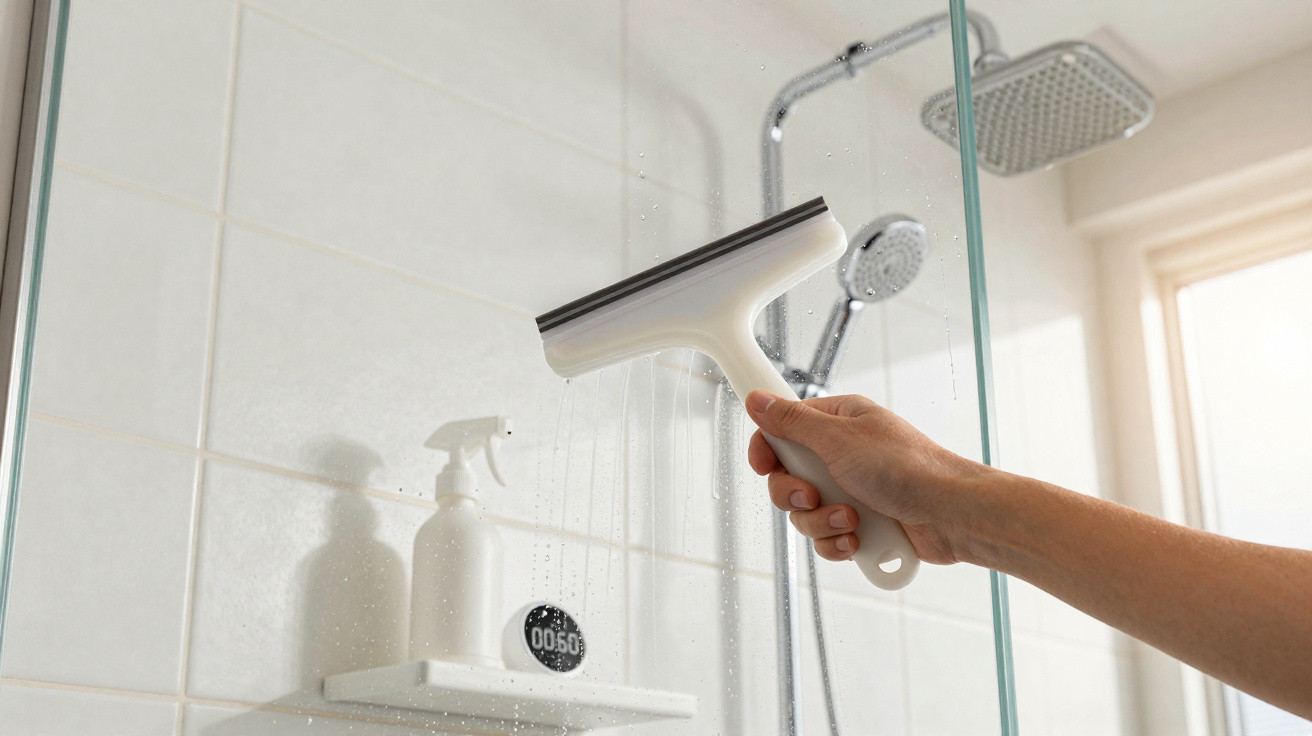
The method could hardly be simpler: after each shower, clear water from the tiles and grout before it can soak in. Rather than patting them dry with a towel, use an inexpensive flexible squeegee or a small microfibre mop to “shave” the water from every wall within reach. Work from top to bottom, finishing with the corners. It takes around a minute, and sometimes even less.
This is not deep cleaning; it is prevention through interruption. You are closing off the crucial period when grout is wet and welcoming. Pulling the blade down a tile does more than make it look tidy: it removes most of the moisture mould needs to settle in. If done properly, a few passes take the walls from glossy and wet to nearly dry. The small amount that remains evaporates fast rather than hanging around for hours.
Those who take up this easy ritual often notice a subtle change. Weeks go by, and the grout lines remain as light as they were just after cleaning. There are no fresh black spots creeping into corners or fluffy edges around the soap dish. It can feel almost unfair that such a minor action beats something as persistent as bathroom mould. Still, the reasoning is brutally simple: no lingering damp means no party for mould.
Let’s be honest: hardly anyone really does this every day. Or at least, that is what many people assume when they first hear about using a squeegee after showering. It sounds like yet another job added to already frantic mornings. In practice, it is more nuanced. Once the tool is hanging inside the shower, with its handle easy to reach, using it becomes almost instinctive. You are already standing there, dripping, waiting for the last water to run off you.
The main mistake is seeing it as an optional extra to do when you happen to remember, rather than making it part of the end of your shower routine. If the trick remains an “I’ll try it sometimes” task, it will not last. When you shower, you wash, rinse and squeegee. That is three steps in one sequence, without any fuss. Missing one day will not undo everything, but missing three weeks will. Another frequent mistake is stopping too early: wiping only the tiles at eye level while overlooking corners, recessed shelves and the lower third of the wall, where water quietly collects.
Here is the sympathetic truth: people do not abandon this trick because it is difficult. They stop because there is no visible reminder. That is why where you put the squeegee matters nearly as much as whether you use it. Hang it where your hand naturally reaches, rather than behind the shampoo or beneath the sink. Create a small moment of accountability: you see it, so you either use it or know you have chosen not to. That tiny bit of friction keeps the habit going better than good intentions ever could.
“I used to think mold was just part of having a shower,” confided a London renter in a small flat share. “I’d bleach the grout every month and hate how the bathroom smelled. Then my partner bought a £4 squeegee and made it a game: ‘Last one out of the shower has to dry the walls.’ Three months later the grout looked exactly the same as the day we moved in. I felt slightly cheated no one had told me this earlier.”
This small daily step also works well with a handful of low-effort supporting measures:
- Keep a dedicated shower squeegee inside the enclosure at eye level.
- End by going over grout in the corners and along the floor edge.
- Open the window slightly or leave the door ajar immediately after using the squeegee.
- Leave the extractor fan running for at least 15–20 minutes after hot showers.
- Lightly reseal grout once or twice each year to reduce how much moisture it absorbs.
These modest adjustments do not eliminate the need for cleaning, but they can greatly extend the period between serious scrubbing sessions. The emotional benefit is understated but genuine: the bathroom begins to feel less like a losing fight and more like a space that quietly does its part. Less guilt, less scrubbing and fewer thoughts of “I should really sort out that grout this weekend.” That is a good return for one minute with a squeegee.
A small shower habit that changes how your bathroom feels
In practical terms, this trick keeps grout lighter and mould under control. On a personal level, it changes your connection with a room you enter half-awake and leave in a hurry. Clean grout makes the entire shower seem fresher, even when the rest of the home looks as if a small storm has passed through it. There is something reassuring about stepping into a space that quietly stays on your side.
More deeply, the 60-second wipe shows that prevention rarely appears heroic. It looks ordinary, perhaps even a little silly. A few measured strokes over the tiles, a soft scraping sound, and it is finished. There is no drama, no bleach catching in your nose and no rubber gloves. It is one of those minor, slightly dull actions that prevents future overwhelm. In a life where so many problems feel too large to manage, taking control of this small patch of humidity is oddly satisfying.
People who start doing it often become understated advocates. Not in a “you must do this” way, but in an “I used to hate my bathroom, now it just…stays clean” way. They post before-and-after photographs in group chats, encourage partners and teenagers to use the squeegee “just this once”, and the habit gradually catches on. Then one day you visit a friend, notice their grout looks suspiciously flawless, and there it is-hanging from a hook and waiting to be used.
The next time you turn off the tap and hear water still dripping from the walls, a small decision awaits. You can leave and let the grout deal with the consequences, or pause for a minute and alter the ending. Not with a miracle product, but with a straightforward, almost old-fashioned action that many of our grandparents would probably consider obvious. It is the sort of trick you wish somebody had shared when you moved into your first home.
| Key point | Detail | Benefit for the reader |
|---|---|---|
| Remove water immediately | Use a squeegee or a microfibre mop after every shower | Dramatically reduces the moisture left in tile grout |
| Make it a ritual | Make drying the walls the automatic final stage of your shower | Turns a potential chore into a simple 60-second reflex |
| Support the routine | Ventilate, use the extractor fan and reseal grout 1–2 times a year | Keeps tiles cleaner for longer and limits the need for harsh products |
FAQ:
- Do I really need to squeegee after every single shower? Ideally, yes: mould thrives on regular moisture. Skipping it now and then will not ruin everything, but being consistent on most days is what produces the visible change.
- Will this trick work if I already have mould in my grout? You will first need to clean it properly or regrout, then the daily squeegee habit will stop the issue returning as quickly.
- Is a towel as effective as a squeegee on the tiles? A towel does help, but a squeegee removes water more quickly and evenly, meaning less effort and more moisture actually removed.
- How long before I notice a change in my shower? Most people notice fewer marks and fresher-looking grout within two to four weeks, depending on how bad the starting point was.
- What if my kids or partner refuse to do it? Begin by making the squeegee easy to see and use, demonstrate the difference over time, and present it as a way for everyone to avoid weekend scrubbing rather than as a new rule.



Comments
No comments yet. Be the first to comment!
Leave a Comment