
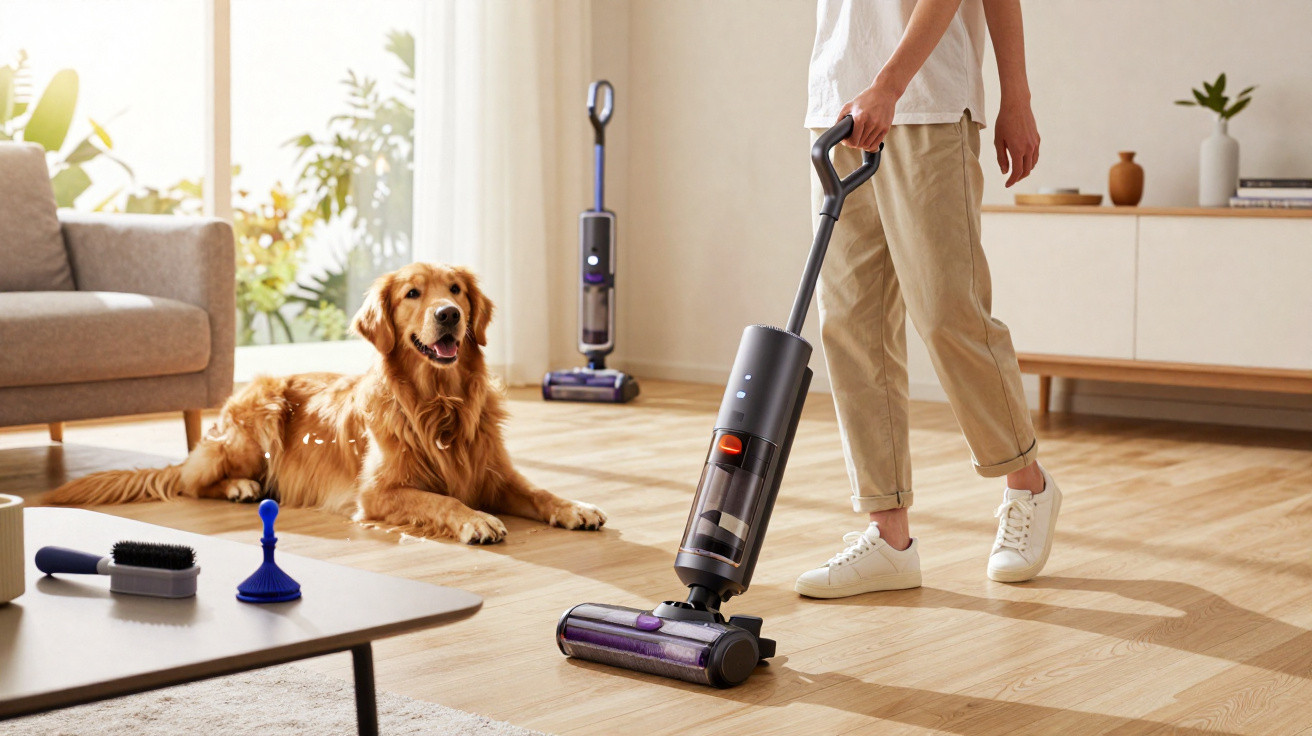
Xiaomi, best known for competitively priced smartphones, is steadily developing a substantial home-appliance range. With the new Vacuum Cleaner G30 Max, the Chinese brand steps squarely into Dyson’s market, relying on strong suction, extended battery life and a generous bundle of accessories rather than high-profile promotion.
A cordless cleaner designed to rival Dyson
The Vacuum Cleaner G30 Max succeeds Xiaomi’s G20 Max and delivers a major increase in suction power. Xiaomi gives it a rating of 280 air watts, a measurement combining airflow with suction pressure. That is a significant rise from the G20 Max’s 180 air watts, particularly for deep-pile carpets and ingrained debris.
This is more than an impressive specification on paper. Dyson’s V12 Origin delivers roughly 120 air watts, while the V15 Detect Absolute reaches around 240 air watts. Only Dyson’s newest V16 Piston Animal, launched in September, exceeds Xiaomi’s latest model with 315 air watts.
The G30 Max positions itself in the same performance band as higher-end Dyson models, while aiming to keep a mid-range price.
For anyone trying to make sense of vacuum marketing, air watts should not be mistaken for motor wattage. Greater motor wattage does not automatically mean more effective cleaning. Air watts indicate how much power is delivered to the floor through airflow and suction, making them much more relevant in normal use.
Three cleaning modes and an intelligent dust sensor
Xiaomi bases the G30 Max’s cleaning performance on three modes. Turbo mode runs at maximum intensity for intensive work on rugs, car mats and entrance areas. Although it uses battery power faster, it is suited to short, focused tasks where each pass matters.
For longer and quieter cleaning sessions, eco mode considerably lowers the power output. As hard floors generally require less suction, this setting cuts noise and energy use while still dealing with visible dust.
The most notable improvement over earlier Xiaomi cordless models is the new automatic mode. An integrated dust sensor assesses the level of dirt on a surface and adjusts suction power instantly. Still relatively uncommon among mid-range cordless cleaners, this feature is intended to remove the need to repeatedly change power settings manually.
The dust sensor lets the G30 Max save battery when surfaces are light to clean, and ramp up only where dirt actually accumulates.
For instance, the vacuum may operate at lower power in a hallway before briefly boosting suction over crumbs in the kitchen or a pet’s favourite spot on a rug. This adaptive approach is useful in both small flats and larger homes because it reduces unnecessary battery use.
Battery life, filtration and dust bin in everyday use
Inside the G30 Max is a 4,000 mAh battery. Xiaomi states that runtime is 51% higher than on the earlier G11, offering up to 70 minutes in eco mode with the primary motorised brush. Against the G20 Max’s 45 minutes, the additional half-hour could mean completing a flat in one session rather than pausing halfway through.
In real-world use, the stated 70 minutes will be lower in automatic or turbo mode, but it still points to sufficient battery life for an average two- or three-bedroom home when power is adjusted intelligently.
Filtration has also been improved. The G30 Max features a five-stage filtration system, which Xiaomi says is 99.98% effective against fine particles. This suggests that it is designed to collect more than crumbs and dust bunnies, retaining smaller particles including pollen and some allergens rather than returning them to the air.
A five-stage filtration chain helps retain very fine dust, an issue that often concerns allergy sufferers and pet owners.
The dust bin capacity rises to 800 ml from 600 ml on the G20 Max. Making fewer trips to the rubbish bin is useful in homes with pets or children, where hair and debris build up quickly. The main brush also includes a practical white LED light to expose dust and hair on hard floors. Once people become accustomed to cleaning with an illuminated brush, they often spot what an ordinary vacuum misses in dark corners.
A comprehensive accessory kit with pet owners in mind
Xiaomi supplies the G30 Max with an extensive selection of tools for broad floor areas and difficult corners alike. The main package contains:
- Main electric floor brush with integrated LED light
- Small electric brush for mattresses, stairs and upholstery
- Dedicated nozzle for sofas and cushions
- Wide 2-in-1 brush for shelves and furniture
- Narrow 2-in-1 brush for tight spaces and car interiors
- Pet grooming brush for collecting hair directly on the animal
- Wall-mounted charging dock and accessory holder
The grooming brush is particularly distinctive. It attaches to the vacuum, enabling owners to groom cats or dogs while suction captures loose hair before it spreads around the home. Naturally, this depends on the animal accepting the noise and sensation of a brush connected to a vacuum tube.
For households without pets, the small electric brush is likely to become the second most frequently used attachment. It is suitable for mattresses, car seats, stair treads and fabric headboards, where crumbs and dust mites commonly collect. The two 2-in-1 tools handle skirting boards, window frames, keyboards and other routine trouble spots.
How it compares with Dyson on price and position
Xiaomi has not yet announced a final price or release date for the G30 Max. However, the previous generation provides a useful indication of its approach. The G20 Max currently sells for 299.99 euros in Europe. By comparison, Dyson’s V15 Detect Absolute launched at about 799 euros, while the new V16 Piston Animal launched at 849 euros.
| Model | Approx. suction (air watts) | Launch price (Europe) |
|---|---|---|
| Xiaomi G20 Max | 180 | 299.99 € |
| Xiaomi G30 Max | 280 | To be confirmed |
| Dyson V15 Detect Absolute | 240 | 799 € |
| Dyson V16 Piston Animal | 315 | 849 € |
Should Xiaomi keep the price close to that of the G20 Max, the G30 Max would cost around one-third as much as Dyson’s leading models while delivering suction figures similar to the V15 and nearing those of the V16. Even a modest price rise would leave Xiaomi able to undercut Dyson by a considerable margin.
Aggressive pricing combined with high air-watt figures puts strong pressure on Dyson in the mid- to high-end cordless segment.
For prospective buyers, the key considerations will be build quality, durability and after-sales support. Dyson has built brand confidence in these areas over many years. Xiaomi has experience in consumer electronics, but it must still show that its cordless vacuums can withstand several years of frequent use, especially in homes with pets and children where they face heavier treatment.
What “airflow” and “autonomy” mean at home
Airflow and suction: more than specification-sheet language
Vacuum cleaner marketing often combines several technical descriptions. Airflow, measured in litres per second or cubic metres per hour, is the volume of air a machine can move. Suction pressure, normally measured in kilopascals, describes how strongly the vacuum draws in air. Air watts bring these elements together to provide a more realistic measure of practical cleaning power.
In everyday cleaning, greater airflow helps collect lighter debris, including dust, hair and crumbs, over a broader area. Higher suction pressure is better at removing heavier particles trapped deeply in carpets. Products such as the G30 Max, with higher air-watt ratings, generally manage both jobs more effectively, assuming the floor head is designed to direct that power efficiently.
Battery autonomy: why the advertised figure can be misleading
In cordless vacuum terminology, “autonomy” means the time a machine can operate on one charge, although the headline figure normally applies to the lowest power setting. A claim of 70 minutes would usually assume eco mode on a hard floor with a non-motorised attachment.
In practice, users switch between modes. A more realistic G30 Max scenario could involve 40 to 50 minutes using a blend of automatic and eco modes for routine cleaning, with far shorter use in turbo mode for carpets and spot cleaning. This is where Xiaomi’s dust sensor offers its main benefit: it aims to extend that autonomy dynamically, rather than requiring the user to decide which setting is appropriate for every room.
How the G30 Max fits a changing home-appliance market
Xiaomi’s G30 Max reveals something about the current cordless vacuum market. Several years ago, Dyson occupied the high-performance end largely alone, while rivals concentrated mainly on lower-cost, less powerful alternatives. Today, brands with significant electronics expertise, particularly Chinese manufacturers, are bringing advanced sensors, efficient motors and larger batteries to the category.
For consumers, this change brings more options but also requires more research. Functions such as dust detection, multi-stage filtration and pet grooming tools serve particular requirements. Before purchasing, households can consider their priorities: allergy concerns, number of pets, floor types, available storage space and noise tolerance. Xiaomi’s latest cleaner is aimed at people seeking Dyson-level suction without Dyson pricing, and who are willing to place their trust in a brand still establishing its home-care credentials.
A wider trend is also emerging: smart gadgets and conventional appliances are converging. The company that sells connected phones and wearables now provides a data-led vacuum that regulates its power according to dust levels. Possible next steps could include smart-home platform integration, usage data or prompts to clean filters and brushes, helping preserve performance over time.
At present, the G30 Max remains a promising, aggressively positioned cordless vacuum awaiting an official launch date and final price. Its mix of high air watts, lengthy claimed autonomy and an extensive accessory kit puts established brands under clear pressure, while giving shoppers another reason to reconsider which brand should take care of the weekly clean.




Comments
No comments yet. Be the first to comment!
Leave a Comment