
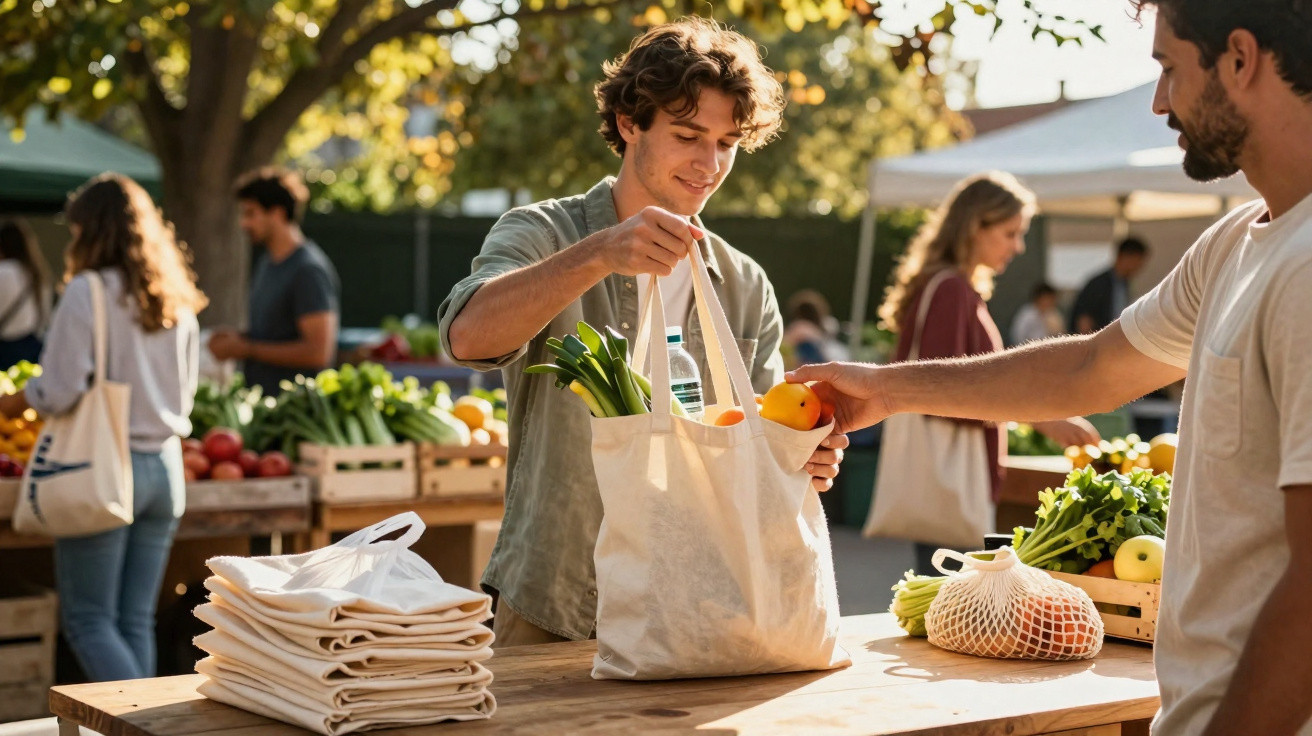
Cities may steer us with charges and restrictions, but the biggest change comes from the everyday routines we perform automatically. Fabric tote bags fit neatly into the point where practicality and conscience overlap. They can hold heavy milk and delicate berries. They fold away, endure repeated use, and steadily replace the heap of rustling waste we no longer want.
Last Saturday at the farmers’ market, I saw a dad trying to manage a toddler, strawberries and a baguette determined to point skywards. He opened a soft canvas tote and the situation suddenly became calmer. The bag stayed wide open, simple to load and with plenty of room. The child placed a lemon inside like a miniature moon landing. There was no fuss. No plastic. The vendor leaned over and said, “I wish everyone brought those.”
Beyond the stall, people were performing their own small tote-bag choreography: shifting a strap between shoulders, folding a bag quickly, tying one-handed to bicycle handlebars. A chaotic morning became more efficient in a modest, recognisably human way. That was when it clicked.
Everyday convenience: why fabric totes work
Because a fabric tote has a broad opening and remains open while you pack, your hands can move easily between the cashier, trolley and bag. That one feature removes the clumsy struggle with thin plastic bags that stick to themselves. You can see the contents immediately. A decent tote changes a juggling act into an easy flow. Its long handles rest on your shoulder rather than digging into your fingers. A flat bottom keeps bread level beside tomatoes without creating a scene.
Consider a typical midweek food shop. In ten minutes, most people use two or three plastic bags. Picture instead a robust tote carrying that same amount, with room left for a newspaper and a box of eggs. If you use it twice each week, you avoid roughly 300 plastic bags over a year. This is not a theory: it is one person adopting one habit, with a gentle packing ritual that begins to feel like portable capability.
The principle is straightforward: fewer containers make for a smoother process. With its flexible sides, a tote behaves like a portable basket. It accommodates awkward items, such as a bunch of dill or a jar of sauce, without turning into an impossible tangle. The load is distributed over your shoulder and hip, so a longer walk does not punish your hands. At the till, everything can return to the same open space it came from. There is less faffing about, less delay and less exasperation at the car boot.
Selecting and using the right fabric tote
Choose a tote for your actual routine rather than an imagined one. Canvas weighing 340–450 g is hard-wearing enough for groceries. Recycled cotton is lighter and can be folded into a jacket pocket. Jute holds its shape well and suits a farmers’ market. A gusseted bottom helps prevent bottles from falling over. An internal pocket separates your keys and phone from the apples. Easy adjustments build on one another. Hang one tote near the door and keep another rolled up in your backpack.
We have all experienced the moment when a cashier asks, “Do you need a bag?” and your mind replies, “Yes, because mine is at home.” The answer is not to purchase another five totes. Instead, position one wherever your day begins: beside the front door, in the pushchair basket or tucked beneath the car seat. Honestly, no one manages this every single day. Most days is a worthwhile target. Put your totes through a gentle wash when they become gritty or after they have carried raw meat. Alternate between two bags so that one has time to dry.
Habits spread when retailers and shoppers do their part together. Some markets provide a borrow-a-bag box for those occasions when people forget. Others offer durable totes at cost beside the till, without pressure, simply as a prompt. This is how routines take hold: discreetly, in public and without judgement.
“We stopped offering free plastic bags last spring. Within a month, seven out of ten regulars walked in with a tote. The line moved faster, and the store felt calmer,” said a corner-grocery manager in Brighton.
- Attach a tote to your keys with a small carabiner to make it harder to forget.
- If stains concern you, select a dark fabric; it gives you longer between washes.
- Mark one bag “produce only” to keep herbs and leafy greens separate.
- Carry a foldable spare in your coat for unexpected errands.
Reducing single-use plastic waste without guilt
Plastic bags may be used for only minutes but can remain for lifetimes. The imbalance is obvious when you pass a tree with a pale, ghost-like snarl caught among its branches. Reusable totes make a meaningful difference only when they are genuinely used again and again. Cotton requires resources to grow and weave, so repeated use is what delivers the benefit. The ideal bag is the one you will take with you every week without a second thought. Reusing always beats buying new. Use what you already have, even if it is imperfect, and allow the habit to do the hard work.
A fabric tote is not a moral symbol. It is simply a practical item designed to carry heavy things repeatedly without giving up. Begin with one bag and a pattern that suits your routine. Leave it in sight. Think of it as you do your wallet: you take it because it is part of leaving the house. Pass spare totes to a neighbour or set up a swap box in your building’s lobby. Single-use waste falls when the convenient option becomes the normal one. The best bag is the one you already own.
| Key point | Detail | Benefit for the reader |
|---|---|---|
| Totes simplify checkout | Wide opening, stable base and shoulder-friendly handles | Quicker packing and fewer awkward spills |
| One habit is more effective than many products | Use a tote twice a week to avoid ~300 plastic bags/year | Tangible progress without changing your whole lifestyle |
| Match the material to the job | Canvas for heavy loads, recycled cotton for portability and jute for structure | Longer-lasting bags and greater carrying comfort |
FAQ:
- How many totes do I actually need? Two or three suits most people: one in daily use, one spare while washing, and one foldable backup.
- Which fabric is best for groceries? Strong canvas weighing 340–450 g handles heavy loads well; recycled cotton folds down small; jute stays upright and allows airflow.
- Do I need to wash totes often? Wash them when they feel gritty or after carrying raw meat or leaking containers. A gentle cycle followed by air-drying will help them last.
- Are paper bags a better option? Paper avoids plastic, but it tears when wet and takes up more room. When used consistently, a reusable tote performs better than paper.
- What if I keep forgetting my tote? Keep one at the starting point of your journey: on a door hook, in the car boot or in a backpack. A small carabiner on your keys can help more than you might expect.


Comments
No comments yet. Be the first to comment!
Leave a Comment