
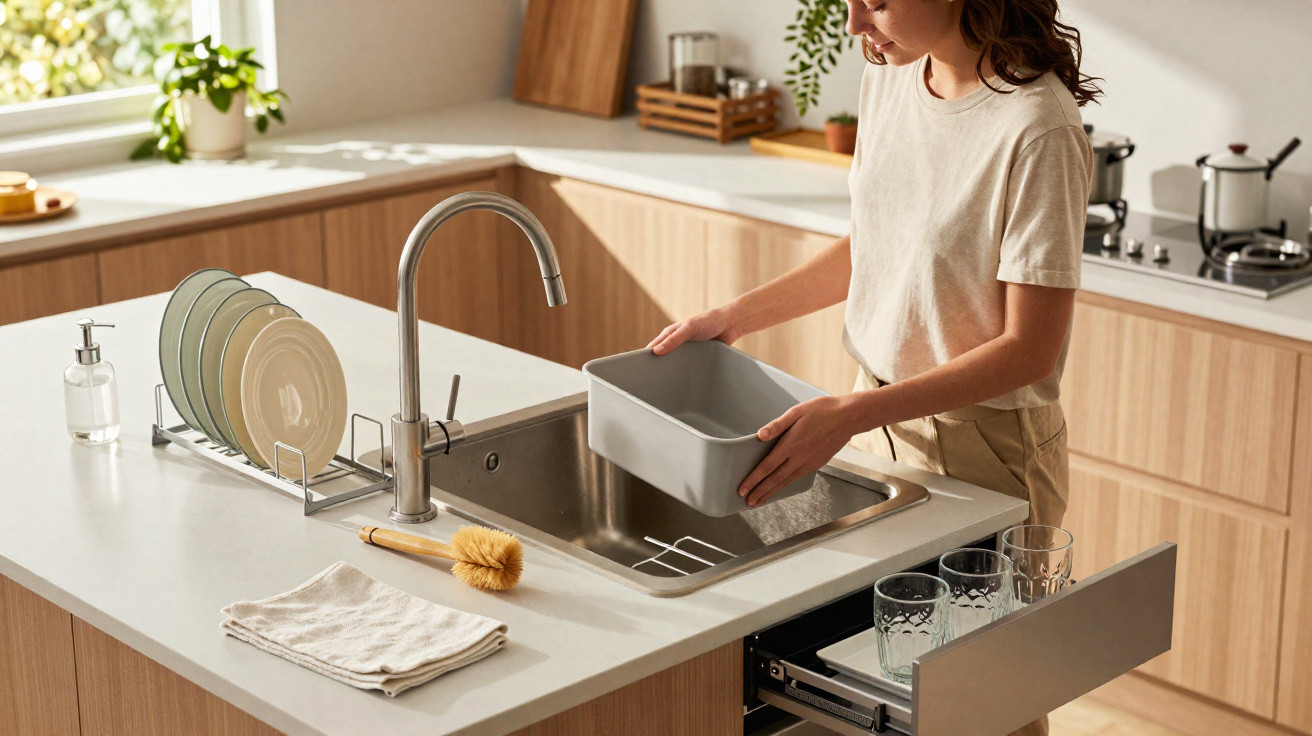
The sink is overflowing again: plates piled into a precarious tower, glasses perched on forks, and a wet dish rack consuming the whole corner like a plastic octopus. You arrive home planning to make an easy meal, yet the view of that untidy metal structure immediately drains your enthusiasm. Instead, you rearrange everything, balance a damp chopping board over yesterday’s mugs and promise yourself you will “deal with it later”.
Most of us know that feeling, when the kitchen somehow seems more cramped than the sink itself.
A fresh trend, quietly appearing in Instagram kitchens and compact city flats, takes a radical approach. Rather than offering a more attractive dish rack, it gets rid of one altogether.
Why the old dish rack is quietly killing your kitchen space
In almost every conventional kitchen, the same item catches your eye: a large dish rack that has taken up permanent residence beside the sink. It occupies the room’s most valuable space - the worktop - and transforms it into an exhibition of drying plates. Eventually, it becomes invisible. Like a loud fridge or a persistent mark, it simply blends into the background.
Yet that background affects the atmosphere. A constant heap of partly dried crockery tells your brain that the kitchen is permanently in the middle of a job and never fully complete. However thoroughly you clean the worktops, the room continues to feel untidy.
The impact is even more severe in small flats and studio kitchens. Consider Marie, who lives in a 27 m² flat with one shallow sink and a run of worktop narrower than a laptop. Her wire dish rack remained there for years, leaving room for little more than a chopping board. Preparing food became a carefully timed routine: move the rack, push it over the sink, then move it back again.
One day, she took the rack away “just to clean properly”. It stayed off the worktop for a week, then a month. In its place, she used a foldable over-the-sink drying mat and a concealed rail beneath a cupboard. “I thought my landlord had enlarged the kitchen overnight,” she laughs. The only real difference was the item she had removed.
There is a clear reason this space-saving trend is taking off across social media. It responds to a basic need: visual calm. A fixed dish rack keeps crockery visibly suspended in a half-completed state. Rather than functioning as a workspace, the area around your sink becomes a car park. Remove the rack and the surface lines flow again, the eye moves more freely and the kitchen immediately appears larger.
There is no trick involved. Clutter is seldom only about how much you own. It is also about what stays on display throughout the day, taking up attention as well as worktop space.
The new way to dry dishes without sacrificing your sink
The principle behind the trend is straightforward: stop keeping a permanent, cumbersome rack fixed beside the sink. In its place, people are choosing flexible, stowable drying systems that can be put away once the job is finished. Options include roll-up silicone-and-steel mats placed directly over the sink, narrow wall-mounted rails fitted with hooks, and compact vertical racks stored in a cupboard until required.
Wash the items, allow them to drip dry briefly, then put them away and roll, fold or slide the drying system out of view. The sink corner returns to its intended purpose as a work area rather than a storage spot. In effect, you suddenly reclaim an extra half-metre of worktop.
Adjusting how you dry dishes often changes other small routines as well. People following this trend commonly begin washing up in shorter, more regular sessions. Cleaning as you cook feels simpler because the space around the sink remains clear and welcoming. There is no permanent metal obstacle course to work around.
The main error, however, is swapping an old dish rack for a stylish new version while still leaving it out all the time. The underlying clutter problem remains unchanged. The sink still appears crowded, dishes still build up and the same visual noise persists, only in more appealing colours. A space-saving tool only works if it actually frees space when you’re not using it.
What does a more practical drying arrangement look like day to day? Interior stylist Lena explained it this way after reworking her own compact kitchen:
“Removing the dish rack was more impactful than repainting the walls. It sounds ridiculous, but clearing that one object made my kitchen feel like a grown-up space instead of a student rental.”
She brought together three understated features that are now central to the trend:
- A roll-up drying mat placed over the sink and kept in a drawer when unused
- A slim rail with hooks below the upper cupboard for mugs and everyday utensils
- A narrow two-tier rack concealed inside a cupboard to air-dry larger pans
Individually, none of these elements is revolutionary. Together, though, they achieve what her former rack could not: making the kitchen appear finished between meals.
A calmer kitchen without the sink-side chaos
Taking the traditional dish rack out of the equation brings another change. Tidying the kitchen in the evening no longer feels like a punishment; it becomes a reset. The mental end point shifts from “I’ve washed everything” to “the sink area is clear and empty.”
That visible clear space can have an unexpected effect the following morning. You enter a kitchen that feels open, calm and prepared for the day. You can place a coffee mug in the sink without starting a chain reaction of tumbling plates. You can make breakfast where the unattractive rack once stood. The room begins to support you rather than work against you.
| Key point | Detail | Value for the reader |
|---|---|---|
| Replace fixed rack | Choose roll-up mats, concealed rails or stowable racks | Creates visual and practical space around the sink |
| Think “temporary” drying | Dry items, then store the equipment out of sight after use | Keeps the kitchen looking complete between meals |
| Optimise small habits | Use shorter washing-up sessions and clean as you cook | Reduces overwhelm and makes daily upkeep easier |
FAQ:
What can I use instead of a classic dish rack?
Try a roll-up drying mat over the sink, a slim foldable rack stored vertically or a wall-mounted rail with hooks for lightweight items. Use two or three together rather than depending on one large, bulky item.Will my dishes dry properly without a big rack?
Yes. Leave them to drip on the mat or compact rack for a short while, then use a tea towel to finish if necessary. Let’s be honest: nobody really does this every single day, but even doing it most days keeps the sink clear.Is this trend only for small kitchens?
No. Bigger kitchens benefit from a more open, uncluttered sink area too. Even people with ample worktop space often feel they “have no space” because one corner is permanently occupied by a full rack.What about families with lots of dishes?
Choose a larger foldable rack for use after substantial meals, alongside a permanent but unobtrusive rail or over-the-sink mat for daily items. The important point is that the larger arrangement is not left out 24/7.Is wall-mounting worth the effort?
Renters can use removable adhesive rails or magnetic strips instead. Homeowners who fit a strong rail or shelf often say it is the one change that made their kitchen feel organised and truly intentional.




Comments
No comments yet. Be the first to comment!
Leave a Comment