
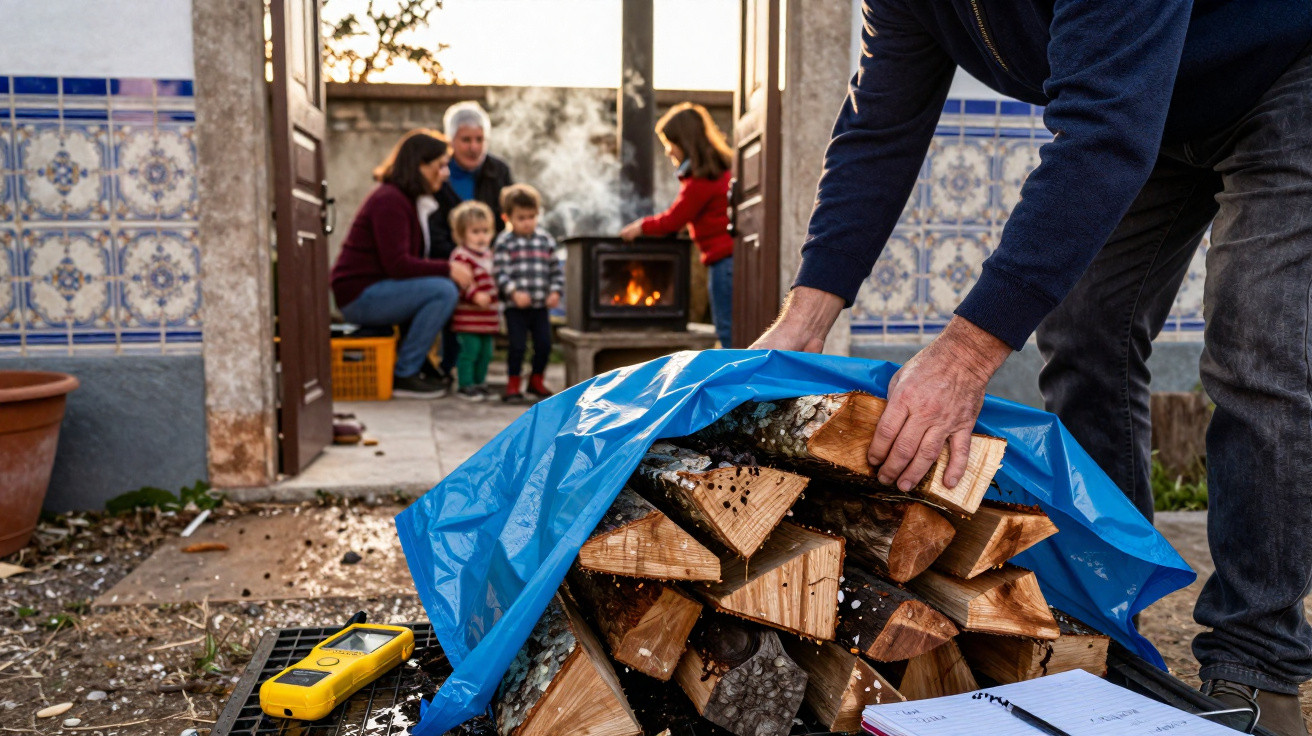
For many households, that belief unravelled this year.
Across Europe and North America, a growing number of families are using wood stoves to reduce their energy bills. Many believed they were fully prepared, having stacked enough firewood to last for months. But when the first chilly evenings came, they discovered that their logs would barely burn, gave off dense smoke and did little to warm the room.
“No one explained how to do it”: when a winter plan falls apart
As energy costs continue to climb, wood heating has returned in a major way. Social media is packed with advice to buy lower-cost logs early in the year, and many new users acted on it. They ordered large quantities, piled the wood in a garden corner, covered it thoroughly and expected the passing months to handle the rest.
Households thought they had a season’s worth of heat. What they really had was a season’s worth of wet, underperforming fuel.
Consumer organisations in France and Germany have reported the same recurring experience. Families who moved from gas or electric heating to wood believed they had made a sensible choice. Instead, their stoves produced smoke, the stove glass rapidly turned black and their sitting rooms remained persistently cold.
The shared cause of these complaints is seldom a defective stove or an unsuitable wood species. More often, it stems from one straightforward yet expensive error: the firewood was stored without ever drying properly.
The hidden problem: wood that looks ready but isn’t
Usable firewood should have a moisture content of less than roughly 20%. When it exceeds that level, the log contains so much water that much of the combustion energy is spent converting water into steam rather than heating the home.
Why “seasoned” wood can still be useless
Many suppliers market logs as “seasoned”, although the description is imprecise. Some countries have no strict legal definition for the term. Wood may have been cut several months before sale, but kept in conditions that almost completely prevent it from drying.
Customers notice split ends and a grey-toned exterior, then conclude the logs are ready to use. They may stack them against a wall, tightly drape the pile with a plastic sheet and wait for winter. Although the wood may have been stored for six to eight months, moisture can remain locked inside.
The problem often isn’t how long the wood has been stored, but where and how it has been allowed to dry.
Once those logs are placed in a stove, several problems occur at the same time:
- The fire is difficult to light and requires repeated relighting.
- Steam visibly comes out from the log ends.
- Flames remain weak and orange, rather than bright and active.
- More smoke is produced, leaving tar and soot in the flue.
To the user, the wood simply “doesn’t heat”. It is burning, but its energy is lost through the chimney or consumed by evaporating water.
How to tell if your firewood is truly dry
Seasoned users do not depend on appearance alone. To prevent an unpleasant surprise in January, they use a combination of simple practical checks and basic equipment.
Four quick checks you can do at home
- Sound test: Strike two logs together. Dry wood makes a clear, almost ringing sound, while damp wood produces a dull thump.
- Weight: Two comparable logs can feel remarkably different if one is dry and the other wet. A dry log is noticeably lighter.
- Appearance: Dry split logs have cracks at their ends and a paler, greyer finish. Newly cut or damp wood appears darker and more “oily”.
- Moisture meter: A low-cost handheld meter provides a percentage reading. The target is below 20% when tested on a freshly split surface.
Moisture meters were once used largely by professionals, but can now be bought for about the cost of a takeaway meal. Some energy advisers explicitly suggest that households regard them as a basic safety item, alongside smoke alarms and carbon monoxide detectors.
| Moisture level | What you can expect |
|---|---|
| Above 30% | Extremely difficult to light, lots of smoke and almost no useful heat |
| 20–30% | It burns, but wastes energy and blocks the chimney more quickly |
| Below 20% | A clean, efficient fire with strong heat output |
The storage mistake many new users keep repeating
Most households left with unusable logs made comparable and foreseeable errors when storing their deliveries.
Wood stacked straight on the ground
Putting logs directly on soil or concrete is among the most harmful storage methods. Moisture rises from below, while the bottom row behaves like a sponge. The top of the stack may dry, but the base can remain wet for months.
Lifting the stack only 10–15 cm above ground level with pallets, bricks or basic timber beams makes a major difference. Air is then able to move beneath the logs, and rainwater runs away rather than gradually soaking into the wood.
Covering the pile like a swimming pool
Fully wrapping a log pile in a plastic sheet is another common mistake. The thinking seems sound-exclude rain-but it traps humidity instead. On sunny days, condensation develops beneath the cover, falls back onto the logs and delays drying.
Firewood needs protection from direct rain, but it also needs constant air movement. Shelter and ventilation must work together.
Specialists generally recommend one straightforward approach: protect the top of the stack only. Keep the sides uncovered and, where practical, orient them towards the prevailing wind. A lean-to roof, carport or a plain sheet of corrugated metal above the pile can work better than tightly sealed plastic sheeting.
Stacking too tight, too early, in the wrong place
People living with small urban gardens often place their woodpile against a wall or fence, sometimes beneath a balcony. While this conserves space, it prevents airflow along at least one side.
Stacks packed tightly with no spaces between individual logs also take longer to dry. A secure pile still needs some “free space” around the pieces. Some wood professionals deliberately cross-stack the ends, alternating the direction of logs, to make the pile stable while forming small channels for air.
Moving substantial quantities of wood indoors too soon creates a further problem. Damp logs can add moisture to the house, increasing indoor humidity and encouraging mould. Wood stored beside the stove for the short term should already have passed the moisture test.
Health, safety and the environmental angle
This issue goes beyond household comfort. Burning wet wood produces more fine-particle emissions, directly worsening air quality. Cities where wood heating increases sharply during cold weather already record peaks in pollution.
Incomplete combustion also leaves creosote and soot inside the flue. As these deposits accumulate, the risk of a chimney fire rises. Fire brigades in several European regions associate part of their winter call-out workload with badly maintained wood-burning systems supplied with damp logs.
Wet wood doesn’t just waste fuel money. It also adds to local pollution and raises the chances of a dangerous chimney fire.
For first-time stove owners, the connection can be surprising. They may have changed from gas to wood for environmental reasons, only to find that their habits can drive emissions in the opposite direction.
How to set up a storage system that actually works
A dependable firewood supply needs to be planned months before the first frost. Effective storage is based on a small number of clear principles.
Think in years, not weeks
Energy advisers commonly recommend planning at least six to twelve months ahead. Purchasing green or partly seasoned wood in spring and drying it correctly until the following heating season generally offers more control over quality than trusting a “ready-to-burn” label in October.
Householders with sufficient space sometimes operate a two-year cycle: one stack dries while another is burned. Moving through clearly labelled sections avoids uncertainty over which batch is genuinely ready.
Simple rules that avoid cold surprises
- Raise the stack above the ground on pallets or beams.
- Keep at least a few centimetres between the woodpile and any wall or fence.
- Cover the top only; never close off the sides.
- Where possible, point the open side of the stack towards the prevailing wind.
- Split large logs early, as smaller pieces dry more quickly and consistently.
- Test several randomly selected logs with a moisture meter before the heating season starts.
What this means for households switching to wood heat
Many countries are actively encouraging wood stoves and biomass boilers to help stabilise energy costs and reduce dependence on imported gas. However, the actual performance of these systems relies greatly on how they are used.
Even a modern, highly efficient stove will perform poorly with damp fuel. The gap between advertised efficiency and everyday results often begins with the woodpile rather than the appliance. A relatively small spend on storage-basic pallets, a simple roof and a small meter-can deliver the performance buyers expected when they invested in a stove.
For tenants and those without a garden, community-based options are beginning to appear. Some towns are trialling shared covered storage spaces or local depots that guarantee moisture content. Others promote compressed wood briquettes, which are dried in the factory and easier to store, although they generally cost more per kilowatt-hour.
Anyone considering wood as their main heat source over winter can carry out a simple home “simulation”: rely solely on the stove for a whole weekend in early autumn using existing supplies. Track how many logs are used, how the home feels, how often the fire needs topping up, and inspect the chimney draw and smoke. A system that struggles in October will not suddenly work better in January. This brief trial can prevent months of frustration-and many cold evenings-later in the season.






Comments
No comments yet. Be the first to comment!
Leave a Comment