
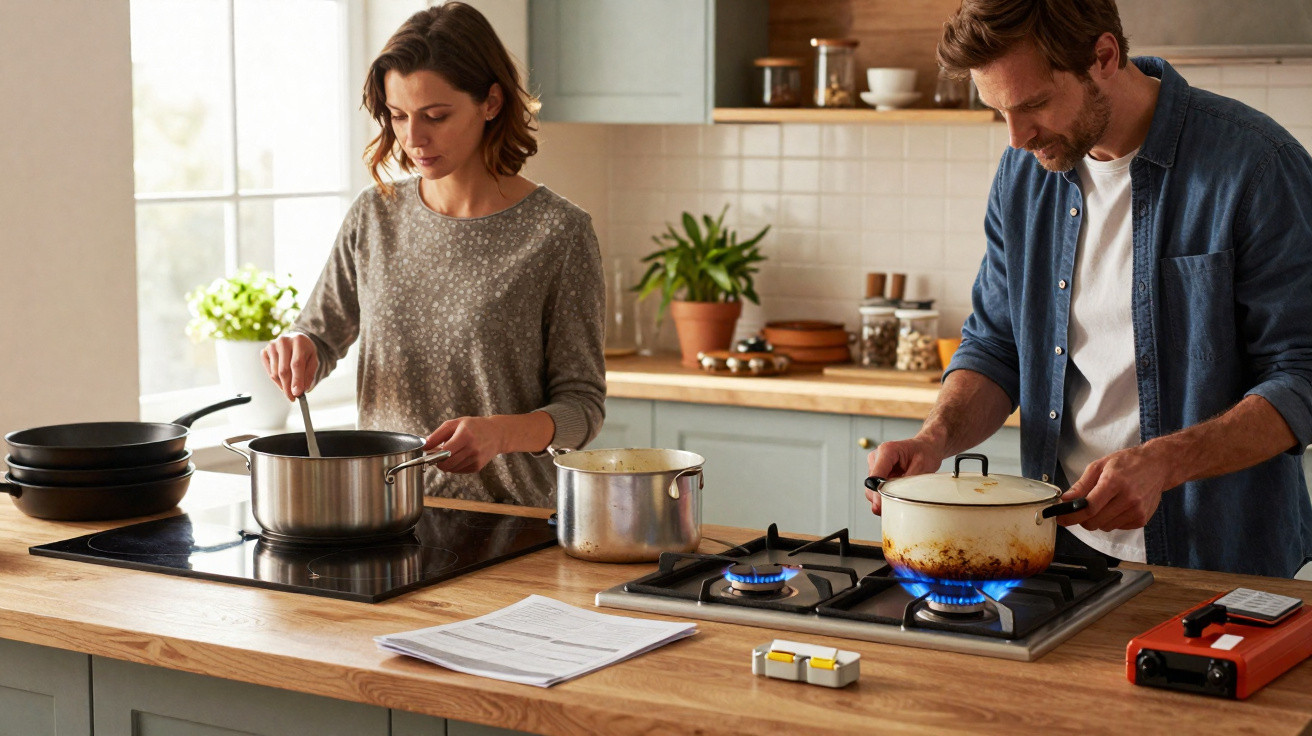
The first thing that stands out is the quiet. No electrical hum, no digital bleeps, no self-satisfied little “bip” to confirm the pan has been recognised. There is only the soft “tchick” as a gas control turns, followed by a sudden blue ring of flame. In a small Lyon flat, Marta is arguing with her teenage daughter, who stands with her arms folded in front of the new gas hob fitted where induction had once taken pride of place.
The voices are heated in every sense.
Marta insists she “has control again”. Her daughter replies that the whole arrangement smells of the past - and perhaps of danger too.
The same scene is unfolding across Europe, from Berlin lofts to family kitchens in Lisbon. At first it happens quietly, then the exchanges become more pointed, with climbing energy bills looming in the background.
One question sits at the heart of it all: Are we really about to say goodbye to induction?
The 2026 twist: gas returns to the kitchen
The tale begins with something that appears purely technical: regulations, energy mixes and the 2026 target dates attached to several European programmes that had previously encouraged households to adopt induction.
With public grants becoming less generous and fresh electricity-pricing rules taking shape, many families are looking once more at the old gas pipes running through their walls.
Retailers are seeing an unusual two-part trend. Sales of premium induction hobs surged during the 2020–2023 energy-transition drive before starting to level off, while interest in modern gas hobs with better safety features has been slowly increasing.
On paper, this resembles a sensible adjustment. In everyday life, it feels more like a handbrake turn.
Italy offers a clear example, where attachment to cooking over a flame never truly vanished.
In Milan, 42-year-old Claudio proudly swapped his gas cooker for a glossy black induction hob in 2021 to “match the kitchen on Instagram”.
Then the energy crisis arrived, and his bill doubled over one winter.
He began measuring how long water took to boil. During leisurely Sunday ragù cooking, he watched his smart meter tick over. At first, he worked out the figures poorly; then he became obsessive. The induction hob, once a badge of status, started to seem like a financial snare.
Last autumn, he hired a plumber to reconnect his gas supply. The installer, mildly amused, said he had carried out three “reverse conversions” in the same week.
Behind these small household conflicts is a combination of unforgiving maths and personal identity.
Induction offers control, speed and a clean, minimalist way of living. Gas offers heat, heritage and the emotional reassurance of a visible flame.
As European energy strategies change, electricity is not always as inexpensive or as “green” as households expected, particularly in nations that remain dependent on fossil-fuel power stations. Some families are deciding that gas cooking, alongside efficient boilers or biogas, could be less costly for their particular circumstances.
Let’s be honest: almost nobody studies every energy-policy paper before buying a hob. People make their choices through bills, routines and anxieties. And at the moment, the flame is tapping into those emotions very effectively.
Safety, cost and the persistent blue flame: how families handle the revival
Ask installers and they tend to report the same opening line: “I’m scared of gas, but…” That “but” is generally followed by three words - bills, control and taste.
One practical solution gaining ground in European homes is the hybrid kitchen. It retains one or two gas burners for high-heat cooking and power cuts, alongside a small induction zone for speedy breakfasts or occasions when children cook on their own.
From a technical perspective, this is straightforward. It involves planning the worktop, selecting a mixed hob, or matching a slim domino gas burner with a compact induction plate. It also requires one decidedly unglamorous task that is often overlooked: asking a professional to inspect the ventilation and gas supply before celebrating the “return of real cooking”.
Safety is where the emotional conflict lies.
Parents raised with gas remember partly treated burns and the faint odour of butane on winter nights. Their teenagers have grown up hearing about indoor air pollution, asthma and carbon monoxide.
Disputes commonly begin with statistics: “Gas leaks are rare”, “induction can also break”, “you’re overreacting”. They generally end with something more personal: “I don’t feel safe lighting this”, “I don’t want my kids to breathe that”.
We have all experienced that moment when a seemingly simple dinner suddenly sparks a family referendum on what “safe” and “modern” are supposed to mean. That is why discussing rules for use, rather than bills alone, can change the conversation.
Kitchen designers around Europe hear the same comments every week.
Some are nearly weary of the swing between “all gas” and “all induction”. But they also recognise a middle ground that is remarkably calm.
“People arrive saying, ‘Gas is back, induction is over,’” says Léa, a kitchen planner in Brussels. “I tell them: your life is not a trend. Your habits, your kids, your building… that’s your real rulebook.”
To get beyond the noise, they often give customers a straightforward checklist:
- Check your building: are gas lines allowed, updated, and properly ventilated?
- Compare real tariffs: electricity vs gas, not just headlines.
- Think about who cooks: children, elderly relatives, renters, guests.
- Decide your priorities: speed, safety, taste, bills, or sustainability.
- Plan for outages: a single gas burner can feel like gold during blackouts.
Plain-truth moment: your “best” hob is the one that fits your messy, imperfect everyday life, not the one that scores highest in a lab test.
Beyond 2026: a divided, flickering future for Europe’s kitchens
As 2026 approaches, there will be no neat point at which induction vanishes and gas wins. Instead, a more complicated and compelling picture is emerging: a patchwork Europe in which a Berlin start-up founder cooks by induction beneath solar panels, while a Portuguese grandmother proudly returns to a triple-ring gas burner that sounds like a jet engine.
Energy policy will continue to move, as will prices. Cities could impose stricter limits on new gas connections, while rural households may rely more heavily on bottled gas or locally produced biogas. Manufacturers, aware of the uncertainty, are already promoting smarter gas hobs with better sensors and auto-shutoff systems, as well as highly efficient induction plates that use power sparingly.
Families are caught between these forces, wooden spoon in hand, trying to forecast a decade of costs and regulations simply to fry an egg in peace.
What the “goodbye to induction” story truly exposes is not so much about appliances as it is about trust.
Trust that governments can create energy transitions without penalising low-income households. Trust that manufacturers will be candid about durability, repair costs and actual energy use. Trust in our own routines, which seldom resemble the showroom ideal.
Some people will stick with induction because of its uncluttered appearance and surfaces that are safer around children. Others will embrace the hiss of gas again, certain that they are recovering both flavour and financial common sense. Many will remain uneasily between the two, browsing forums late at night as they try to decide before their next refurbishment.
The kitchen, once a quiet backdrop to daily life, is becoming a stage for Europe’s fears about climate, money and security to appear at the dinner table. People will continue to discuss it. And each time you hear that “tchick” and see a flame return, you will still feel a small jolt.
| Key point | Detail | Value for the reader |
|---|---|---|
| Cost vs. energy mix | Gas may cost less in certain countries, while electricity tariffs rise as policies change | Helps you judge whether returning to gas could genuinely reduce your bills |
| Hybrid kitchen setups | Combining one or two gas burners with a small induction plate | Provides flexibility for safety, power cuts and different cooking styles within one home |
| Safety and ventilation | Modern gas hobs include sensors and auto-shutoff, but still depend on sound installation and airflow | Explains what to assess before welcoming the “return of the flame” |
FAQ:
Are induction hobs really disappearing from 2026 in Europe?
No, they are not being banned. The policy and financial setting is what is changing: support for induction is declining in some places, while gas is again becoming more appealing to certain households, creating the impression of a “farewell” trend.Is cooking with gas more dangerous than induction?
Gas involves particular risks: leaks, an open flame and indoor air pollution where ventilation is inadequate. Induction lowers burn and fire risks, but it can crack or suffer electronic faults. In practice, the safest choice is the one that is properly installed, maintained and used according to realistic daily routines.Which is cheaper to run, gas or induction?
This depends on local tariffs, appliance efficiency and the amount you cook. Gas remains cheaper per kilowatt-hour in some countries; elsewhere, where electricity is cheap or generated at home, induction can come out ahead. Reviewing the bills from your previous 12 months will tell you more than any broad rule.What about the environmental impact of gas vs. induction?
Induction can be cleaner where the electricity grid relies strongly on renewable energy. When electricity is produced mainly by coal- or gas-fired power stations, its climate advantage becomes smaller. Gas hobs burn fossil fuels directly, although biogas can be used alongside them in some areas. The greenest option is closely connected to where you live.How do I future-proof my next hob choice?
Allow physical space and suitable cabling or gas connections for future changes. Many households now opt for mixed or modular arrangements so that, if prices or regulations shift again, they can rely more heavily on one technology without refurbishing the entire kitchen.



Comments
No comments yet. Be the first to comment!
Leave a Comment