
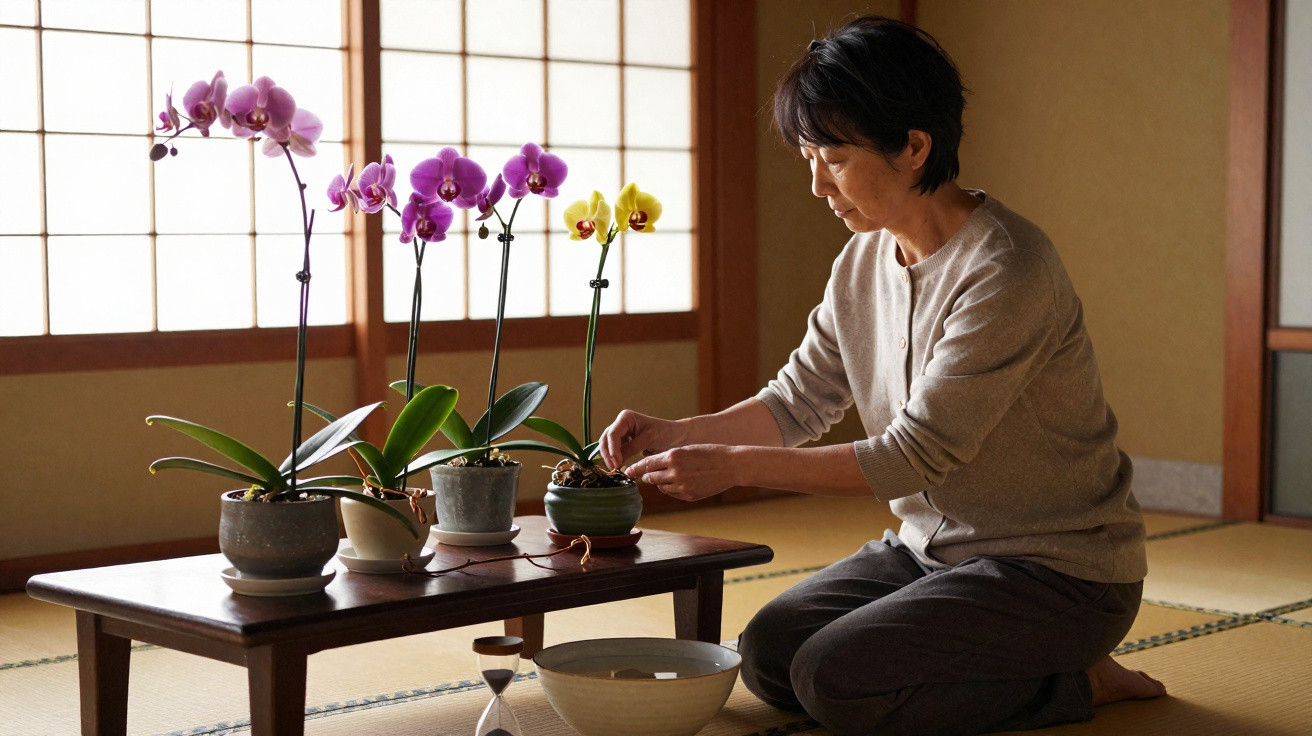
Throughout Japan, growers’ clubs and small florists quietly talk about a particular practice. Orchids that seem exhausted and reluctant can unexpectedly return to bloom - with no heat lamps and no fertiliser. Just touch. Just timing. Supporters describe it as knowledge handed down through caring hands; critics see stress wrapped in tradition.
There was no hum from a heater and no fertiliser bottle anywhere. Mopeds spluttered into life outside, while the shop inside was filled with breathing and the buzz of neon. She counted under her breath - one, two, three - before rotating the pot by a quarter turn and misting the air rather than the foliage. The orchid appeared to be paying attention. It felt as though the method could only succeed when nobody was watching. When I eventually asked what she was doing, she smiled. She named it the Silence.
Japan’s quiet orchid reset
When growers are asked why the flowers come back, they tend to give the same simple answer: early light, cool evenings, pure water and a consistent hand. There is nothing mystical about it. The practice follows a beat - a short dry spell, followed by a faint touch of moisture in the morning, then contact along dormant nodes. No heat. No feed. Only touch and timing. What remains is patience, alongside the belief that plants sense the world through their surfaces.
In Osaka, an older enthusiast called Nakata let me see his record book. Each page marked “seven dawns” with pencilled ticks, and an occasional smiley face beside a swelling spike. He withheld water for ten days, then misted at 5 am for a week, stroking every node for half a minute. Across three winters, 86 of the 127 Phalaenopsis he recorded produced fresh spikes within eight weeks. That figure belongs to his club rather than a laboratory, but the older men around him nodded as though the result rang true.
The explanation may be physiological rather than magical. Orchids take their flowering signals from shifting daylight and the difference between daytime and night-time temperatures. Physical contact can also alter growth; stroked plants may become firmer or change direction, a botanical response grouped under thigmomorphogenesis. Mild drought pushes hormones in one direction, while a cool and damp dawn shifts them back, and the pass of a fingertip might prompt nodes into activity. It is a prompt, not pressure. It relies on rhythm rather than force.
Try the orchid touch and timing routine at home
This is the process as I have watched it practised. Allow a healthy Phalaenopsis to remain dry for longer than normal - ten to twelve days - until its pot is noticeably lighter. Place it in bright but indirect light, with cooler nights near an open window but away from draughts. For seven mornings, ideally before sunrise, spray cool water into the air surrounding the plant and, using clean fingers or a soft cotton glove, lightly trace each dormant node for 30–45 seconds. Rotate the pot by a quarter turn daily. Do not water between those dawn mists.
This is not hard rubbing; it is more like tracing braille. Avoid any tissue that feels soft or looks bruised. Should the leaves lose excessive turgour, water the orchid once before continuing the dry period. Do not repot it, feed it or shift it between rooms. We all recognise the point at which a “quick fix” becomes a month spent putting things right. It’s just you and the plant, at dawn. Honestly, hardly anyone manages this every day.
“The hand is only a metronome,” a Tokyo grower told me. “The plant keeps the music.” His point was that your role is to provide timing, not pressure. With that in mind, this is the tidy framework the Kansai club gives to newcomers:
- Seven dawns, rather than seven randomly chosen days.
- Touch the nodes, not the stem.
- Mist the surrounding air, not the crown.
- Give the pot a quarter turn, then leave it alone.
- Maintain cooler nights and brighter mornings, with no feed.
Where ritual becomes roughness
This is the complicated part. Some purists look at the dry period, the encouraging touch and the cold morning mist, and argue that stress can still look appealing. Stress remains stress. For others, the technique recalls their grandmother: dusting leaves before market day, or watering before school rather than afterwards. Care carries culture within it. And, despite all their apparent drama, orchids continue quietly when offered a pattern they understand.
If attempting this routine makes your shoulders tense, something is not right. Stop and revisit the fundamentals: light, temperature variation, a freely draining pot and roots that are not waterlogged. If it feels like harm, stop. Everything else is a dialogue with time. Pass it on to a neighbour who believes their orchid is finished, then observe it together. The first sign is a small green horn emerging from a dormant node, and it invariably resembles a tiny, determined miracle.
| Key point | Detail | Benefit for the reader |
|---|---|---|
| Touch and timing, not gadgets | Seven dawn mists, gentle fingertip traces, quarter-turns | A repeatable ritual that costs nothing |
| Physiology, not folklore | Temperature changes, drought signals, thigmomorphogenesis | Reassurance that the method has a rationale |
| Respect the plant’s limits | Start with healthy roots, avoid unhealthy tissue, stop if it is stressed | Fewer losses and more long-lasting blooms |
FAQ
- Does touching the spike hurt the orchid? Gentle, clean and brief contact will not damage a healthy plant. Pressing, bending or vigorous rubbing may injure tissue and encourage rot.
- Which orchids respond best to this routine? Phalaenopsis are the most common choice. Certain Dendrobiums and Oncidiums also respond well, but beginners should start with phals.
- How long until I see new colour? Many growers notice nodes swelling within two to four weeks, with flowers following four to ten weeks later, depending on light and temperature.
- Can I do this in winter in a cold flat? Yes, provided the plant is not freezing. Seek cool nights and brighter mornings rather than cold conditions. Keep the mist fine and the crown dry.
- What if nothing happens after seven dawns? Give it time. Resume normal watering and lighting, then try again in a month or once nights become naturally cooler. Some orchids simply skip a season.





Comments
No comments yet. Be the first to comment!
Leave a Comment