
Mornings move quickly: the alarm goes off too early, the towel is waiting on the radiator and the shower often ends in a cloud of steam. You pull back the curtain, grab your clothes, then shut the door without noticing the marks already drying on the screen. Three days later, they look like a grey film. After two weeks, you promise yourself that you will “get round to it this weekend”.
We all know that slightly disheartening moment when the shower enclosure, although cleaned not long ago, already looks dull. Limescale, soap residue and moisture trapped in the seals can quickly make the bathroom feel as though it is demanding another chore. Yet the habit that genuinely makes a difference needs neither a miracle product nor a major clean: it takes ten seconds, immediately after you have rinsed off.
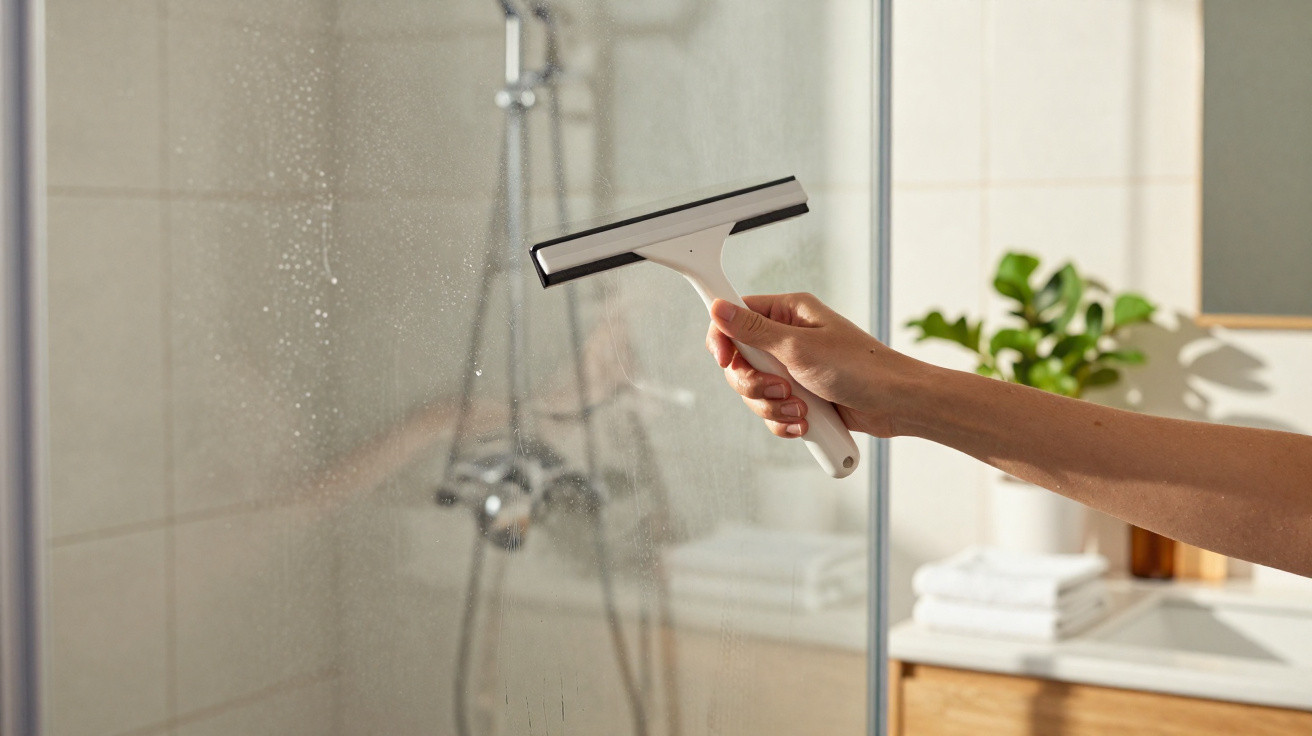
The idea is almost obvious, which is probably why it is so easily forgotten: simply run a shower squeegee over the shower walls before stepping out. This small action removes water left on glass, tiles or resin panels, precisely where limescale quietly begins to build up. It is a tiny routine, but a remarkably effective one.
It is worth understanding why a shower squeegee, so often left at the back of a cupboard, can prevent so much tiresome scrubbing. A clean shower is not maintained only on deep-cleaning day. It is protected, drop by drop.
The marks that build up when no one is looking
After a hot shower, water does not truly disappear: fine droplets cling to the walls, particularly in the corners and around the taps. As they dry, they leave behind the minerals they contain, especially calcium and magnesium. These create the small white marks, followed by the dull coating that can sometimes seem impossible to remove.
In a household of four, a shower screen can be splashed with several litres of water every day, even if nobody measures it with a jug. One reader said that she replaced her intensive Saturday clean with a quick squeegee after every shower: within three weeks, she barely needed vinegar on the glass any more. Her son, meanwhile, had turned the habit into a game.
The key is not to scrub harder, but to stop deposits from settling in the first place. Water alone does not necessarily make a shower dirty, but it carries soap, shampoo, skin cells and, in some areas, a great deal of limescale. When the surface stays damp for a long time, this whole mixture has time to cling to it. The squeegee simply interrupts the cycle before it becomes visible.
The ten-second shower squeegee habit that makes a real difference
Keep a small squeegee within easy reach, ideally hanging inside the shower on a hook or sturdy suction cup. Once you have rinsed off, begin at the top of the wall and work down in even strips, without aiming for perfection. Two passes over the glass and one over the most exposed tiles are enough to deal with the essentials: most of the droplets will no longer dry where they land.
Many people wait until their shower is spotless before starting this routine, even though it also works on a screen that is already marked. All it takes is one proper clean at the outset, followed by maintaining the result with this daily action. Let us be honest: hardly anyone manages it every single day at first. It can take a week before using the squeegee becomes as automatic as turning off the tap.
The easiest approach is to link it to a particular cue: just before reaching for your towel, for instance. That stops you from thinking, “I’ll do it later”, a phrase that often ends up meaning “never”.
“A shower stays clean for much longer when you remove the water before it decides to stay.”
- Choose a flexible squeegee that will not scratch glass or acrylic.
- Rinse it quickly once a week to prevent soap residue from building up.
- Open the door or window for a few minutes after showering.
- Dry the bottom of the shower wall too, as it is often overlooked despite being particularly exposed.
A small routine that also transforms the feel of the bathroom
A shower with less build-up is not only about appearances. It also means fewer harsh products, less time spent scrubbing seals and less discouragement when faced with glass that has turned cloudy. When the enclosure stays bright, the entire room looks cleaner, even on days when laundry is piling up and the mirror still bears fingerprints.
This reflex does not remove every cleaning requirement: the plughole, seals and taps still need some attention. However, it makes the job considerably easier, particularly in areas with hard water. Once a week, running a slightly damp microfibre cloth over the taps works very well alongside this habit. There is no need to turn the bathroom into a domestic cleaning laboratory.
There is something rather satisfying about these ten quiet seconds, almost unnoticed in a busy day. You do not do it merely to tick off a task, but to spare yourself the big clean waiting around the corner at the weekend. The next time steam fills your bathroom, the squeegee sitting there may become the small reflex that changes everything.
| Key point | Detail | Added benefit for the reader |
|---|---|---|
| Use a squeegee | Remove droplets from the shower walls after every shower | Limit limescale marks before they dry |
| Keep it visible | Position the squeegee in the enclosure or near the exit | Turn the action into an everyday automatic habit |
| Air the room for a few minutes | Open the door or window after use | Reduce lingering moisture and protect the seals |



Comments
No comments yet. Be the first to comment!
Leave a Comment