
Do we genuinely know which chemicals are present in the personal care and cleaning products we use every day?
A new study published in Environment & Health indicates that we may not.
Earlier research has suggested that manufacturers and product labels do not always provide the complete picture of what everyday items contain. That led researchers from several institutions across the US to investigate further.
Chemicals in personal care and cleaning products
The researchers examined the chemical makeup of 113 personal care and cleaning products across 12 categories, including laundry products, sun cream, baby lotions, shampoo, deodorant, and toothpaste.
The products tested were not identified by name, although they were available from Target, Amazon, Walmart, and Dollar Tree.
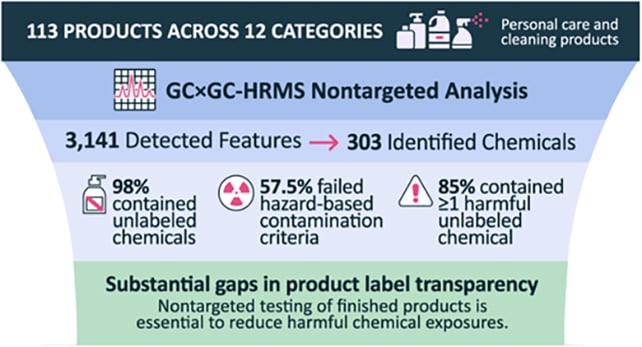
Almost all products contained unlabelled chemicals. (Schultz et al., Environ. Health, 2026)
An overwhelming 98 percent of the products included at least one chemical absent from the label. Meanwhile, 85 percent contained at least one unlabelled chemical known or suspected to be hazardous to human health.
"We found undisclosed harmful chemicals in products claiming to be free of them," says environmental health scientist Jenna Hua, of the Million Marker Research Institute in the US.
"That means someone can carefully read ingredient lists, choose 'clean' products, and still end up exposed to the very chemicals they were trying to avoid.
"The label can't protect you when it doesn't show what's really in the bottle."
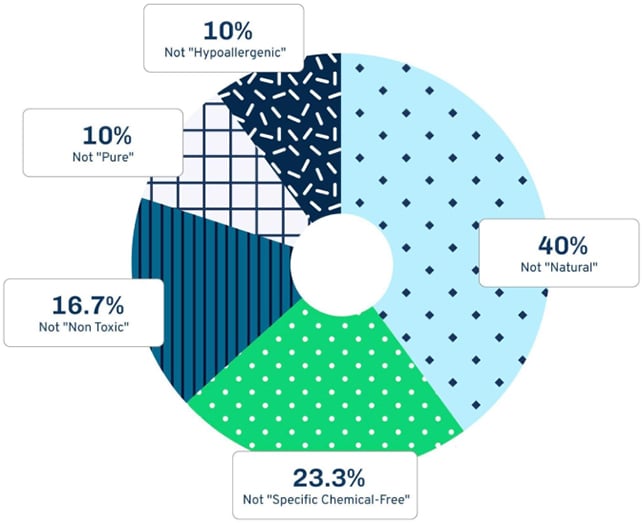
More than 1 in 4 products had chemicals that contradicted selling points. (Schultz et al., Environ. Health, 2026)
Endocrine-disrupting chemicals and unlabelled ingredients
Among the substances specifically assessed by the team were endocrine-disrupting chemicals (EDCs), which can either imitate or block the body's natural hormones. Hormones serve as vital biological messengers, and EDCs disrupt their function.
EDCs have been associated with numerous health problems, ranging from breast cancer to obesity.
The study suggests that, even for people who understand the risks of EDCs and attempt to avoid them, exposure could still occur without their knowledge.
"The label can't protect you when it doesn't show what's really in the bottle." – Environmental health scientist Jenna Hua
"People shouldn't need a chemistry lab to know what they're bringing into their homes or putting on their skin," says Hua.
"The next generation of product safety must look beyond the label and test what is actually there."
To search for chemicals, the team used a technique known as non-targeted analysis. As its name implies, this method does not begin with a particular chemical name and then look for it; instead, it produces a complete inventory of the substances present.
More than one quarter of the products contained chemicals inconsistent with marketing or label claims such as '100 percent natural' or 'hypoallergenic'.
The researchers emphasise that they do not necessarily believe these additional chemicals were deliberately added.
For instance, they could arise through contamination during manufacturing or storage, or from unforeseen chemical reactions among ingredients.
Calls for stronger product regulation
Nevertheless, the research team is urging stricter regulation and independent testing of products on shop shelves.

"For certain chemical categories, such as fragrances or botanicals, companies do not legally have to disclose all chemicals in the product," write the researchers.
"In the case of 'fragrance', many chemicals can be umbrellaed under the term and are not disclosed due to 'trade secrets'… In the case of botanicals, plant products can contain hundreds of individual chemicals that, although they may be 'naturally-derived', can still be harmful and should be disclosed."
It is important to note that the study did not assess any health effects caused by these chemicals; it identified only which chemicals were present. Establishing the specific harm these substances may cause, and at which doses, is a possible next stage of research.
Even so, consumers clearly need better information about what is in the products we buy, in the interests of public health.
Related: FDA Finds Bacteria in a Third of 'Sterile' Tattoo Inks, And That's a Problem
"Future research should focus on expanding non-targeted analytical approaches to additional product categories and improving identification confidence for unknown chemical features," write the researchers.
"Testing should be done on the finished, packaged product, and improved methods for tracing sources of contamination across supply chains may help clarify the origins of unlabeled compounds detected in consumer products."
The research was published in Environment & Health.
This article was fact-checked by Rachel Garner and edited by Fiona MacDonald. Although we take pride in our process, we are only human. If you spot an error, please let us know.

Comments
No comments yet. Be the first to comment!
Leave a Comment