
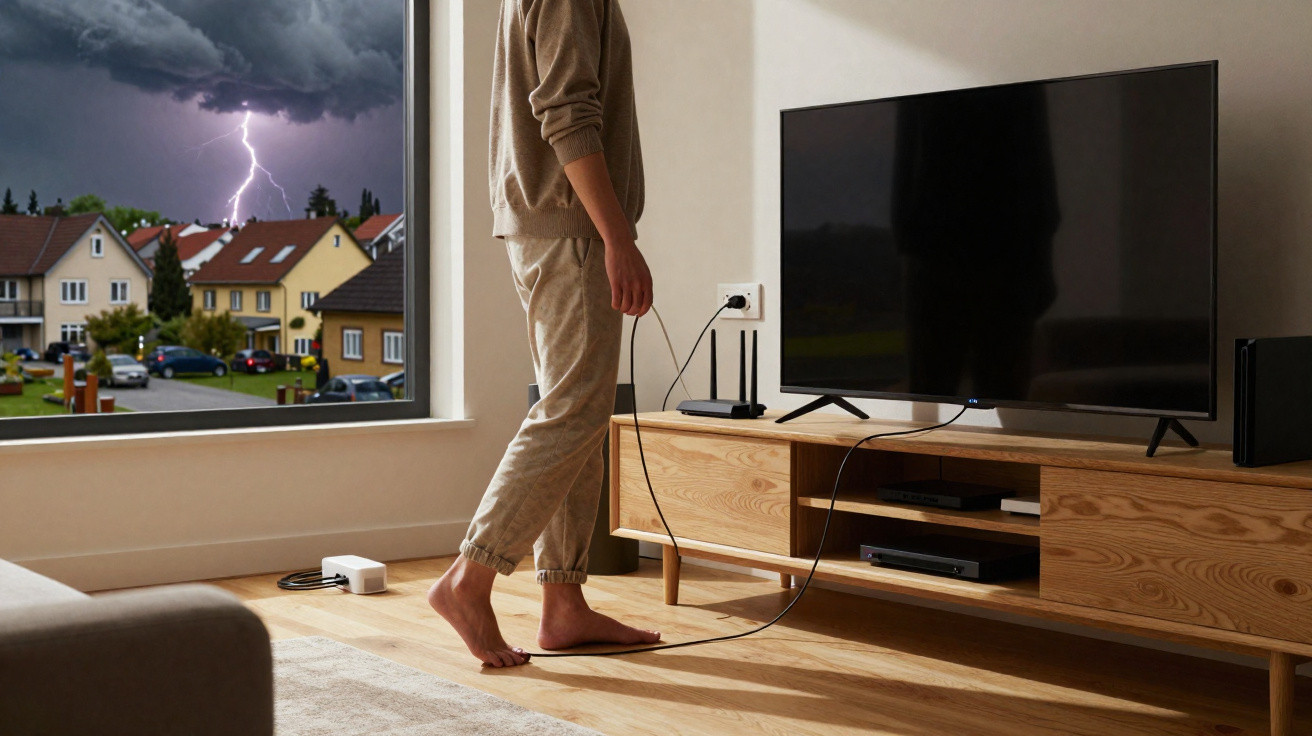
When a thunderstorm is on the way, it is easy to focus on the obvious risks: open windows, flooded gutters or water coming through the roof.
What often goes unnoticed is the threat running through your home’s cables. Even without a direct lightning strike, a storm can cause severe voltage surges that damage everyday electronics.
The hidden danger storms bring into your living room
Thunderstorms bring more than dramatic thunderclaps. They can drive powerful electrical surges through mains lines, telephone lines and TV cables. These surges can then enter homes and reach devices that were never built to withstand that level of force.
Engineers generally identify three main effects during major electrical storms: sudden voltage spikes, brief supply drops and rapid, repeated micro-outages. All of them put strain on the sensitive parts inside modern electronics.
Durante uma tempestade forte, um único pico alto pode matar um aparelho em segundos – mesmo que o raio caia a quarteirões de distância.
People often focus on the wrong appliances. Microwaves, lamps and small kitchen devices can seem most at risk because they are so visible. In practice, the most exposed item in many homes is quietly sitting in the living room.
The appliance you really should unplug first
Technicians who handle storm-related damage regularly say the biggest risk is not usually the microwave or lighting. It is the television.
Modern TVs – LED, QLED, OLED and other flat-screen models – are slim units full of sensitive electronics. Their power supplies and control boards depend on stable, predictable voltage. A sudden surge forces abnormal voltage through tiny components with little capacity to absorb it.
When lightning strikes near a neighbourhood, the electricity network can be hit by impulses of thousands of volts. The strike does not have to hit your home directly. A surge moving through the network may be enough to burn out the main board, damage capacitors or destroy the internal power supply immediately.
One severe surge during a storm can turn a perfectly working TV into a black rectangle that will not switch on again.
Repair shops say fixing a television damaged by a surge often costs between 40% and 70% of the price of a replacement set. For many households, that makes repair poor value and leads to the TV being replaced instead.
After televisions, the devices most likely to fail following thunderstorms are modems, Wi-Fi routers and TV set-top boxes. They combine mains power, network connections and aerial inputs in one unit, creating several possible routes for a surge.
Why “off” isn’t enough: what technicians actually recommend
Many people assume their TV is protected once they press the remote’s power button. Unfortunately, that is not the case. A television in standby is still connected to the mains and to other devices through its cables.
Electricians and electronics repair technicians give the same advice: when a strong thunderstorm approaches, the only dependable protection is complete disconnection.
- Unplug the TV from the wall socket.
- Remove HDMI cables connected to consoles or set-top boxes.
- Disconnect the aerial or cable TV lead.
- Unplug the modem and router from both the mains and telephone/fibre/cable lines.
HDMI leads, aerial wires and broadband cables can all provide a route for overvoltage. Even with the TV switched off, a surge can travel through a connected console or decoder and reach the internal circuit boards.
If you can see lightning and hear nearby thunder, technicians advise treating every cable connected to your TV or router as a possible path for a surge.
This may seem excessive if you live in a city flat and rarely give lightning much thought. But repair-service records show a familiar pattern: one strong strike near the local distribution network can damage several TVs along the same street.
Can stabilisers or UPS units save your devices?
Many homes use voltage stabilisers or basic surge strips as a safety net. They can help with small day-to-day fluctuations, but powerful thunderstorms can exceed what they are designed to handle.
Standard stabilisers contain components intended for moderate voltage changes. Surges caused by lightning can be far beyond those limits. In that situation, the stabiliser may fail before the connected device, or allow part of the spike through.
Uninterruptible power supplies (UPS) – battery-backed units commonly used with PCs – offer better protection, particularly higher-quality models with proper surge protection. Certified surge protectors using metal-oxide varistors provide another layer by clamping sharp peaks and sacrificing themselves in the process.
| Device | Helps against everyday fluctuations | Helps against nearby lightning |
|---|---|---|
| Basic stabiliser | Yes | Limited, often insufficient |
| Standard surge strip | Yes | Only for mild surges |
| Quality UPS with surge protection | Yes | Reduces risk, not absolute protection |
| Physical disconnection | N/A | Blocks surge paths completely |
These devices remain useful for everyday reliability, especially in areas with unstable electricity supplies. They help protect against micro-outages, electrical noise and routine voltage changes that can gradually shorten the life of electronics.
However, when it comes to powerful lightning strikes nearby, specialists largely agree: no commercial stabiliser can promise complete protection. Unplugging equipment remains the only way to fully break every electrical path.
The other devices that storms quietly destroy
Televisions get the most attention because they are costly and highly visible. But storm damage often appears first in the less exciting equipment sitting beside them.
Modems, routers and your internet connection
Broadband routers sit at the meeting point of several connections: mains sockets, telephone lines, fibre or coaxial cables, and often Ethernet cables running to other rooms. Any of these routes can carry a surge.
After a serious storm, telecom providers regularly hear from customers whose lights and fridges still work but whose internet has disappeared. The broadband box may not power up at all, or its ports may remain dead. The surge could have arrived through the mains or the network line from the street cabinet.
For households dependent on video calls, remote work and smart-home systems, losing the router can affect far more than an evening of streaming.
Consoles, audio gear and hidden weak points
Games consoles and home cinema amplifiers contain compact, densely packed circuit boards. They are built for performance rather than repeated exposure to violent electrical surges.
A sharp spike can destroy the internal power unit or harm storage and processing chips. Sometimes a device will still turn on once or twice, only to fail days later when weakened components finally stop working.
Set-top boxes and soundbars introduce another less obvious risk. They link several devices through HDMI and optical cables. A surge entering at one end can exit at the other, spreading damage across the whole setup.
Building a practical storm routine for your home
Homes in areas prone to storms often adopt simple habits that greatly reduce the risk with very little effort. A quick checklist is useful when thunder begins.
- Switch off and unplug the main TV, along with any consoles or boxes connected to it.
- Remove the aerial or satellite cable from the back of the television.
- Switch off and unplug the modem and router, including telephone or fibre leads.
- Unplug desktop PCs and external hard drives containing irreplaceable data.
- Use quality surge protectors or a UPS for sensitive equipment in everyday use.
Um minuto para desligar e tirar da tomada pode evitar dias sem internet, sem televisão e uma despesa pesada de conserto.
For many people, the simplest approach is to centralise connections: keep the TV, consoles and boxes on one power strip with an easy-to-see switch, and leave aerial or cable connectors accessible enough to remove quickly.
Why storm damage will matter more in the next decade
Homes continue to fill with connected technology: smart speakers, networked security cameras, streaming sticks and connected thermostats. Every device adds small circuit boards and power adapters that are vulnerable to voltage changes.
Climate data from several areas, including parts of the US and Europe, suggests longer warm seasons and more frequent intense storms. Together, these trends increase the number of hours each year in which powerful surges can affect local electricity networks.
Insurance policies may cover lightning damage, but claims often need proof, photographs, reports and time. Even when a payout comes through, it rarely makes up for lost data or the inconvenience of replacing essential equipment at short notice.
Knowing how storms can travel through cables makes it easier to act quickly. Unplugging a few leads before a storm reaches its peak may briefly interrupt your comfort, but it can protect hundreds or thousands of pounds’ worth of electronics that many households rely on every day.





Comments
No comments yet. Be the first to comment!
Leave a Comment