
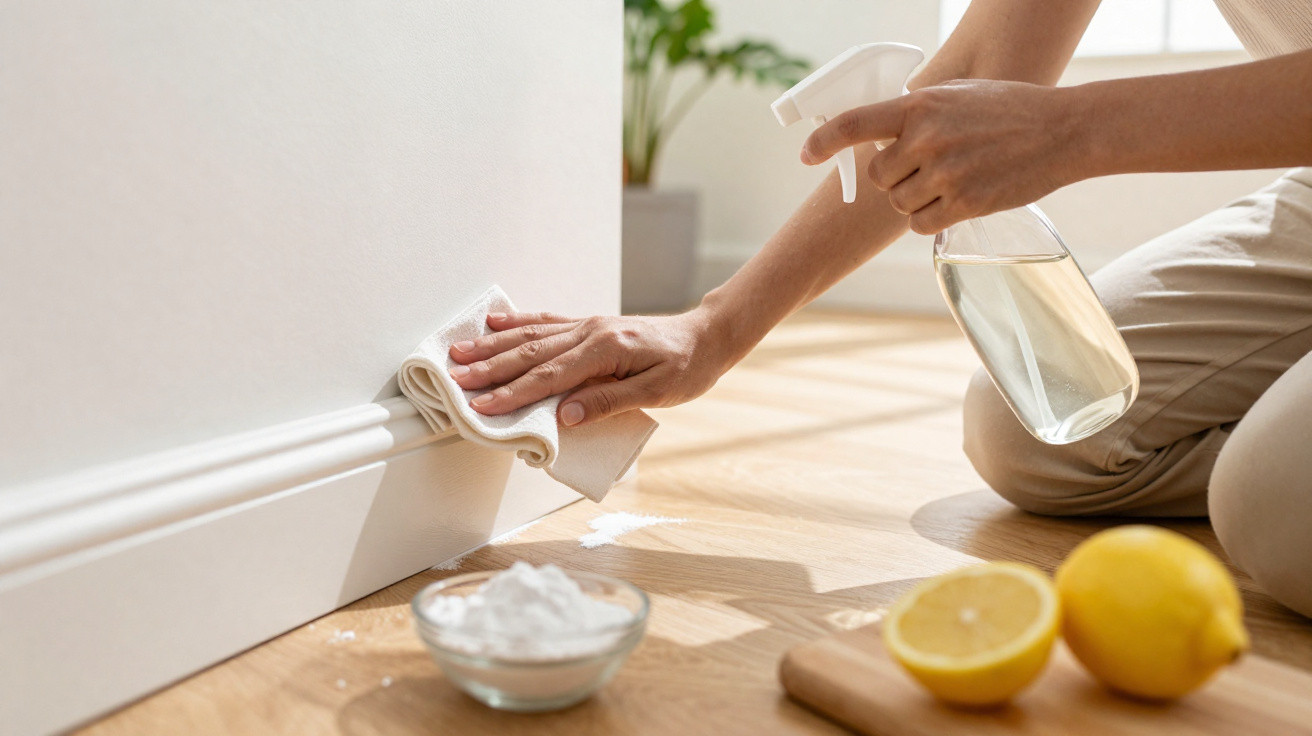
A straightforward household ingredient can transform the result completely.
Many homes have the same issue: the floor has just been mopped and everything looks gleaming, until daylight reveals a dusty line running along the skirting boards. If you are unlucky, you may be reaching for a cloth or vacuum cleaner again every few days. Yet one small adjustment to your cleaning routine can keep skirting boards noticeably cleaner for much longer.
Why skirting boards become dusty again so quickly
Skirting boards are generally made from painted wood or plastic, which is precisely why this issue can be so persistent. Friction causes their surfaces to build up an electrical charge, much like a balloon rubbed against a jumper. That static charge attracts dust and hair.
Whenever someone walks through a room, the heating is on or a window is opened, tiny particles are stirred into the air. Rather than simply settling on the floor, they cling to charged surfaces - including the skirting boards.
This grey dust line develops particularly quickly in homes with:
- radiators positioned beneath windows
- carpeted floors that shed plenty of fibres
- children, pets and lots of activity
Many people unknowingly make matters worse by wiping the boards with a dry cloth. Although this removes the dust, it also recharges the surface. The result is that everything can look grey again within a day.
The anti-static approach: keeping skirting boards cleaner for longer
The key is not the cleaning itself, but the treatment applied afterwards. Reducing static charge and lightly smoothing the surface makes it much harder for dust to stick. Two useful options are often already available in the home:
- tumble dryer sheets from the laundry cupboard
- a natural kitchen staple diluted in water and used as a spray or wiping solution
“If you clean skirting boards thoroughly first and then treat them with an anti-static layer, you can often leave them alone for three weeks or longer.”
Dryer sheets are intended to prevent clothes becoming statically charged in the tumble dryer while keeping fibres soft. Painted skirting boards benefit from the same effect: an extremely thin film settles on the surface and reduces its dust-attracting charge.
The natural kitchen solution: gentle, inexpensive and effective
Anyone wishing to avoid fragrance and added laundry-care chemicals can use a simple product from the kitchen. Mildly acidic natural household remedies, diluted with warm water, are common choices and can create a fine protective coating. This means dust does not adhere as easily and is simpler to remove during the next wipe-down.
According to user experiences, these natural solutions can leave skirting boards relatively dust-free for two to four weeks, depending on how heavily the room is used and how much air moves through it.
How to make a simple natural solution
For a gentle, everyday household mixture, you will usually need:
- a bowl of lukewarm water
- a splash of a natural kitchen ingredient, such as a little vinegar or a mild oil, depending on the surface
- a soft cloth or a small spray bottle
If you are unsure, try the mixture on an inconspicuous spot first, such as behind a piece of furniture. This will show whether the paintwork tolerates the treatment without developing marks.
Step by step: clean and protect skirting boards
1. Vacuum away loose dirt
Before using any product, remove loose dirt first. Fit the narrow nozzle to your vacuum cleaner and move slowly along the skirting boards once. Take particular care beneath radiators and in corners, where most dust collects.
2. Clean with a damp cloth
Next comes an ordinary wet clean:
- Fill a bucket with warm water.
- Add a small squirt of washing-up liquid to loosen grease and everyday grime.
- Wipe the boards with a microfibre cloth, including edges and moulded sections.
If you prefer a stronger scent, you can add a small amount of liquid laundry detergent or fabric conditioner. This is purely a matter of preference; the cleaning performance remains the same.
3. Allow the surface to dry
The cleaned areas must be completely dry before the protective layer is applied. Either leave them to air-dry briefly or go over them with a dry cloth. Any damp patches would dilute the protective film.
4. Apply an anti-static layer
This is where the main trick comes in:
- Using a dryer sheet: Hold the sheet along its long edge and run it along the skirting board using gentle pressure - once at the top, once through the middle and once at the bottom. Go into the corners a second time if needed.
- Using the kitchen solution: Pour the solution into a spray bottle, or soak a cloth in it and wring it out well. Wipe the boards with a thin layer. A light coating is enough; the surface should not look wet or glossy.
“Those who repeat this treatment every three to four weeks often find that, instead of a thick ridge of dust, only a fine film develops that can be wiped away in seconds.”
How long do skirting boards really stay clean?
Practical tests in typical homes show that skirting boards which would otherwise look dull again after one or two days can often remain clean for up to three weeks with an anti-static treatment. The result depends on several factors:
- How frequently is the room used?
- Are there radiators directly above the skirting boards?
- Are there pets in the household?
- Is there carpet that sheds fibres?
In busy hallways or children’s bedrooms, the effect will naturally last for less time. Even so, a quick wipe with some leftover solution or a fresh dryer sheet is often enough, without needing to carry out a full deep clean.
Everyday safety and material advice
Although these methods are simple, a few points are worth bearing in mind:
- Check the paint finish: With very old or delicate paintwork, test first in a hidden area to make sure the surface does not discolour.
- Pets and children: In children’s rooms and places where toddlers crawl frequently or pets chew, it is better to avoid heavily perfumed or highly chemical products.
- Slip risk: Wipe up any excess solution from the floor immediately so that nobody slips.
If you are particularly sensitive to fragrances or have allergies, choose a neutral kitchen ingredient instead and avoid strongly scented dryer sheets. The anti-static benefit matters more than the fragrance.
Small extra steps for better results
If you are already adapting your cleaning routine, a few simple measures can further support the effect on skirting boards:
- Vacuum beneath radiators regularly, as this is where a particularly large amount of dust gathers.
- Beat rugs more often or clean them with a brush attachment so that fewer fibres circulate in the air.
- Choose smooth skirting boards where possible: the more grooves and edges they have, the more places dust has to settle.
There is also an interesting side effect: people who keep dust under control on their skirting boards often notice fewer dust deposits throughout the room overall. The boards act like small dust collectors along the walls; when that build-up is reduced, dust has to settle elsewhere and is removed more quickly during normal mopping.
A tiresome repetitive task can therefore become a barely noticeable addition to regular cleaning: just a few extra minutes, an everyday item from the kitchen or laundry cupboard, and skirting boards can look presentable not only on cleaning day but weeks later as well.


Comments
No comments yet. Be the first to comment!
Leave a Comment