
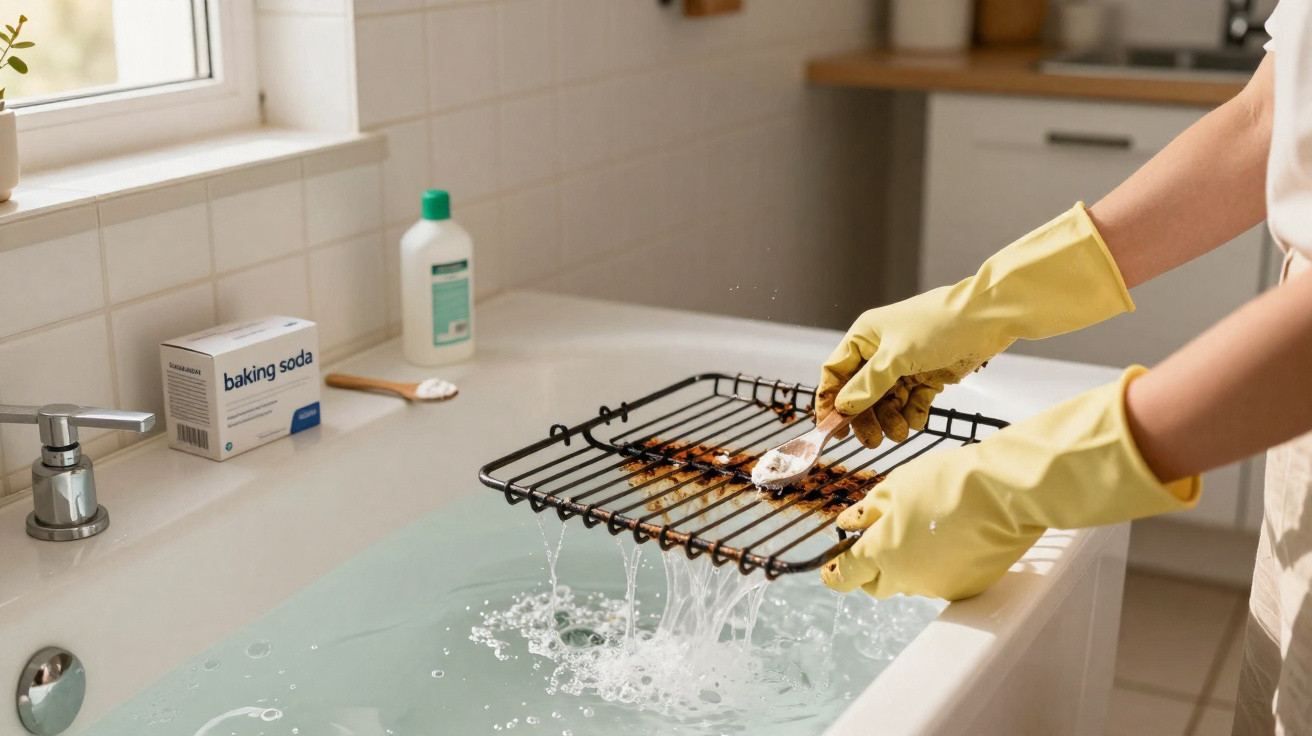
Oven racks can end up coated in grease, baked-on sauce and cheese residue. They barely fit in the sink and can make scrubbing incredibly frustrating. Household forums are full of suggestions, yet one simple, gentle and highly effective method still goes surprisingly unnoticed: using the bath as a secret weapon against burnt-on oven racks.
Why oven racks become so stubbornly dirty
In everyday life, oven racks rarely make it onto the cleaning to-do list. Many people wipe the oven door, take out the baking tray – then simply slide the encrusted rack straight back in. Yet this is exactly where much of the grime builds up.
- The exposed bars catch dripping fat and roasting juices.
- High temperatures effectively bake the residue onto the metal.
- Warped or roughened areas grip dirt almost like Velcro.
- They are difficult to submerge fully in a kitchen sink.
Anyone who then reaches for harsh oven cleaners and a wire scourer is not only attacking the dirt, but the surface too. The result is dull steel and fine scratches where fresh residue can settle even more quickly.
The bathroom solution: why the bath becomes a kitchen helper
The crucial factor is space. A standard oven rack is too large for most sinks, whereas it can be fully submerged comfortably in a bath.
To keep the bath enamel intact, there is a simple household trick used by experienced cleaners:
Spread a thick towel across the bath, place the racks on top, and only then run the water.
The towel serves as a soft protective layer: it prevents scratches, muffles noise and keeps the racks steady so they do not slide about while the water is running.
A simple three-ingredient cleaning recipe for oven racks
Rather than using harsh chemicals, a mixture of items found in almost every kitchen is enough:
- very hot water
- bicarbonate of soda (baking soda)
- grease-cutting washing-up liquid
How it works is remarkably straightforward:
| Ingredient | Purpose |
|---|---|
| Hot water | Softens baked-on layers and loosens dried crusts. |
| Bicarbonate of soda | Provides mild abrasion while chemically loosening grease and deposits. |
| Washing-up liquid | Breaks grease into tiny droplets that disperse in the water. |
A tried-and-tested ratio is around 150 grams of bicarbonate of soda to approximately 50 millilitres of washing-up liquid for a fully filled bath. This mixture cuts through grease far more effectively than ordinary washing-up water alone.
The cleaning process, step by step
With just a few simple actions, the cleaning task can be reduced to very little effort:
- Spread a towel in the bath and place the racks on it.
- Fill the bath with the hottest water possible until the racks are completely covered.
- Scatter the bicarbonate of soda evenly over the surface.
- Add the washing-up liquid and briefly stir the water with your hand or a brush.
- Leave it to soak for at least 30 minutes – or for several hours or overnight if the build-up is severe.
The longer it is left to soak, the less scrubbing is needed afterwards – often, a light wipe is enough.
Once the soaking time has passed, many brown marks and greasy streaks will already be visibly releasing into the water. Any remaining deposits can be removed without much pressure using a soft sponge or a brush that is not too stiff.
Gentle care instead of physical effort
The main advantage of this method is that the protective surface of the oven racks stays intact and the bars retain their shine. Abrasive scouring pads, steel wool and knives are unnecessary and should deliberately be left in the cupboard.
Finally, rinse the racks with clean water, ideally using the shower attachment, to remove every trace of washing-up liquid and bicarbonate of soda. Drying them immediately with a tea towel prevents water marks and reduces the risk of small rust spots on damaged edges.
How often should oven racks be cleaned?
There is no fixed rule, as this depends greatly on how often and what you cook. However, a few general guidelines can help:
- After every large roast or greasy bake, it is worth at least wiping the rack with a damp cloth.
- A thorough bath treatment every few weeks is sensible, especially for frequent oven users.
- Those who bake only occasionally can manage with one or two intensive cleans each year.
The sooner fresh splashes and drips are removed, the less work there will be later. Layers baked on over many months will not disappear in five minutes, even with the bath method.
Benefits compared with aggressive oven-cleaning sprays
Many conventional oven cleaners rely on highly caustic alkaline substances. Although they dissolve dirt, they also bring several drawbacks:
- irritating fumes that can be unpleasant in poorly ventilated kitchens
- a risk to skin and eyes when used carelessly
- added strain on wastewater systems and the environment
- the possibility of permanently damaging coatings
Bicarbonate of soda and washing-up liquid are considered considerably gentler. They neither irritate the airways nor attack the steel, as long as excessive scrubbing is avoided. At the same time, there is less chance of overlooking harsh residues in the oven that could evaporate the next time it is used.
What to do with extremely old black crusts?
If an oven rack has not been cleaned for years, a second treatment may sometimes be necessary. In these cases, it is worth extending the soaking time significantly and giving the rack a brief preliminary scrub with a brush after the first bath before returning it to the mixture.
There is another useful trick for especially stubborn patches: make a thicker paste from bicarbonate of soda and a little water, then spread it onto the affected areas. Leaving this targeted treatment to work for another 20 to 30 minutes can noticeably loosen the last black marks.
Practical everyday kitchen tips
Building the process into a normal cleaning routine saves time and effort in the long term. A few additional habits also help:
- Slide a baking tray underneath the rack if cheese or marinade may drip.
- Wipe away larger residues with kitchen roll once the oven has cooled.
- Do not wrap aluminium foil tightly around the bars, as this can cause discolouration.
- Do not leave racks in a still-hot oven unnecessarily, as this bakes on residue without need.
It is also worth noting that, while many modern ovens offer cleaning programmes for the interior and baking trays, oven racks usually benefit far more from the bath method because the cleaning mixture works evenly across their entire surface.
Background information on bicarbonate of soda and washing-up liquid
Bicarbonate of soda is a mildly alkaline substance. When dissolved in water, it reacts with fatty acids and converts them into compounds that dissolve more readily. Its fine powder also provides a light abrasive action without heavily scratching the metal. Combined with heat, this effect becomes noticeably stronger.
Washing-up liquid contains surfactants – substances that surround grease particles and draw them into the water. This means even old, sticky fat can be released from the tiny pores in the metal surface. The key is not merely applying both ingredients briefly, but allowing the mixture enough time to do its job.
A small effort that extends the life of the oven
Regularly maintained racks do not simply look better; they also contribute to the performance of the whole oven. Clean metal bars conduct heat more evenly, support baking trays more securely and stop old grease crusts from smelling again at high temperatures.
Anyone who gives their oven racks one or two bath cleaning sessions per year, while removing major splashes in between, helps the oven, kitchen and sense of smell in the long run – all without specialist chemical cleaners.


Comments
No comments yet. Be the first to comment!
Leave a Comment