
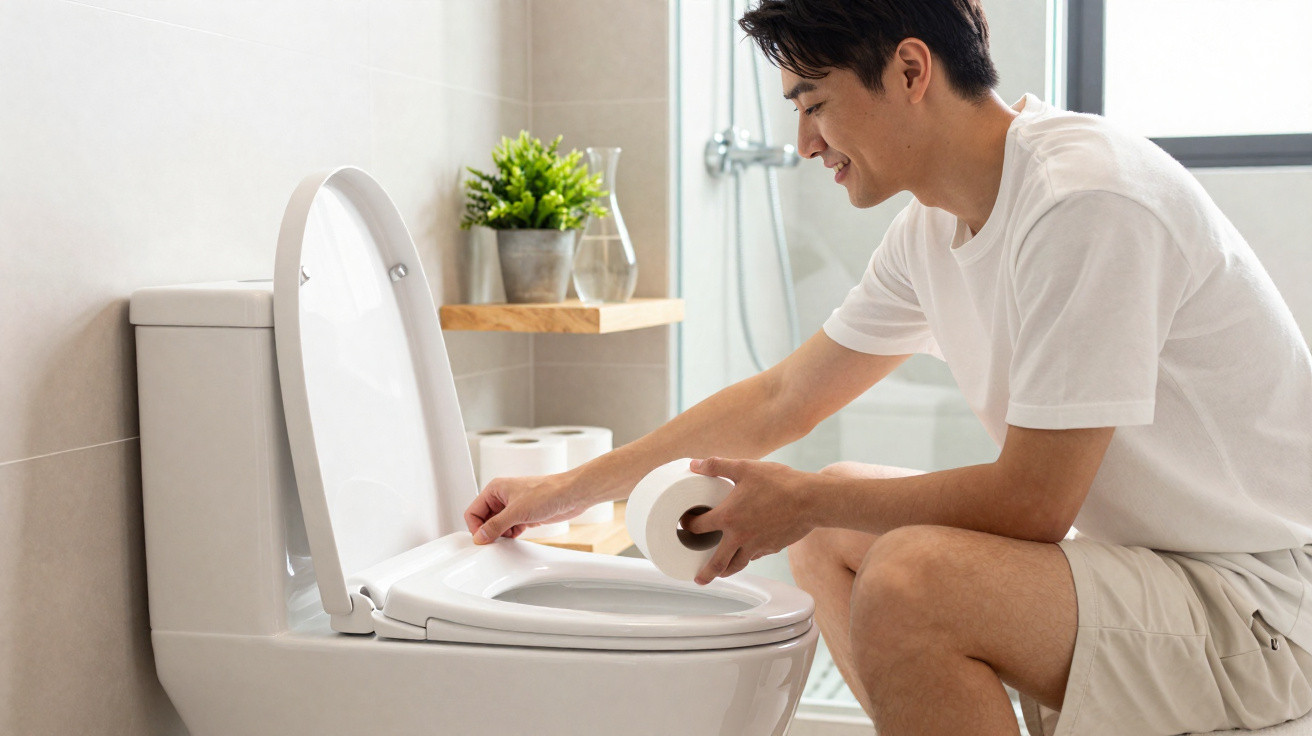
More and more bathrooms are gaining a helper that was long considered unusual in the UK: the bidet, or a toilet seat attachment with a water jet. What has been commonplace in Japan for years is now making its way into Europe, changing how people clean themselves after using the toilet. The reason is simple: water outperforms dry paper in almost every respect.
Why water cleansing is clearly better than toilet paper
On honest reflection, dry wiping with paper soon feels like little more than a makeshift solution. It tends to smear rather than remove everything thoroughly. Residue can remain even when there is no longer anything visible on the paper. These microscopic traces may later cause itching, odour and irritation.
“Water removes what paper merely spreads around – and many people notice that after just a few uses.”
Dermatologists repeatedly report that problems such as burning, redness or persistent itching around the anal area are often linked to inadequate cleansing. Dry wiping rubs the skin without properly cleaning it. A gentle jet of water simply rinses away residue, with no rubbing and no pressure.
Particular relief for sensitive or damaged skin
People with haemorrhoids, anal fissures or those recovering from surgery know how painful ordinary toilet paper can be. Every wipe can feel like sandpaper against already irritated skin. Water cleansing removes the pain from the process: no rubbing, no reopening of wounds and far less inflammation.
Many users say that problems they had experienced for years disappear once they switch to a bidet or a toilet seat attachment with a shower function. This is not only relevant to people with medical conditions; children, pregnant women and older people can also benefit, as their skin may react particularly sensitively.
Fewer germs, less touching and better hygiene
One frequently overlooked benefit is that modern bidets and shower toilets mean hands barely need to touch this sensitive area. The water jet does the actual cleaning. This reduces the risk of transferring bacteria and viruses from the toilet to hands, door handles or other surfaces.
This can be particularly important during waves of colds or stomach bugs. Less contact with contaminated areas lowers the likelihood of spreading pathogens within the household.
Modern bidets: functions in the new bathroom standard
The traditional separate porcelain bidet familiar from southern European countries is no longer the only choice. Toilet seat attachments and fully integrated shower toilets are becoming much more widespread. They look like an ordinary toilet, but incorporate considerably more technology.
- Continuously adjustable water pressure for gentle or more powerful cleansing
- Temperature control for pleasantly warm water
- Warm-air drying, making toilet paper entirely unnecessary
- Self-cleaning nozzles for consistent hygiene
- Eco and energy-saving programmes for ongoing operation
At first, this may sound like luxury spa equipment for the bathroom. In everyday use, though, it is mainly about practicality: older people have to twist and stretch less, children can manage more independently, and everyone benefits from consistently thorough cleaning.
The overlooked environmental harm caused by toilet paper
Toilet paper appears harmless: a soft, lightweight product that disappears within seconds. Behind the scenes, however, it creates a substantial burden for the environment and climate.
“Millions of trees are cut down every year for global toilet paper production, alongside the use of chemicals, water and transport emissions.”
Deforestation, water use and a cocktail of chemicals
Huge areas of forest are cleared to obtain the cellulose used in paper. This destroys animal habitats, worsens the climate crisis and causes soil to dry out more quickly. Even recycled alternatives only partly reduce the issue.
Large quantities of water and energy are also required to manufacture and bleach the rolls. Ironically, the life cycle of toilet paper uses considerably more water than a bidet used every day. A modern shower toilet attachment operates with a comparatively small jet of water per wash, while each individual roll already consumes many litres during factory production.
Bleaching produces substances that pollute rivers and lakes and accumulate in ecosystems. Switching to water cleansing largely removes households from this chemical chain.
Transport, plastic and mountains of waste
Logistics are another issue. Toilet paper is bulky and light, so it takes up considerable space. Lorries transport pallets of rolls from factories to distribution centres and supermarkets. Every pack is wrapped in plastic, and is often additionally packaged in cardboard. All of it becomes waste shortly after use.
A bidet attachment or shower toilet is installed once and, ideally, lasts for many years. There is no continual repurchasing, packaging or supply chain. For households aiming to reduce their environmental footprint, the calculation makes sense.
Japan as an example: how technology reinvented the bathroom
Anyone who has visited Japan often remembers the toilets first. Few other countries have modernised this everyday room so radically. Shower toilets, often called “Washlet” there, are standard equipment in many homes, much like a dishwasher is in the UK.
“In Japan, the mundane everyday object known as the ‘toilet’ became a high-tech appliance combining cleanliness, comfort and sustainability.”
Manufacturers combined precise water jets, individual temperature settings, warm-air dryers and often even heated seats. As a result, toilet paper plays only a supporting role in many Japanese households, or disappears altogether.
The trend is now reaching Europe. Architects are including shower toilets from the outset in new-build homes. In existing properties, residents are choosing retrofit solutions that can be fitted directly to their current toilet.
Installation is often easier than expected
Many people are put off by the thought of extensive alterations. In reality, simple attachments usually need only a T-piece at the isolation valve, a flexible hose and a little DIY confidence. Only models with seat heating or a warm-air dryer require electricity.
Anyone who has replaced a tap or changed a shower head can generally fit a bidet attachment too. Those who are unsure can call in a plumber once, then enjoy years without further concern.
The cost question: does switching really pay off?
Perhaps the most important question is whether the investment makes financial sense. The short answer is that, in many cases, it does - and sooner than expected.
- Basic non-electric attachments: often available for a two-figure price
- Comfort models that heat water within the unit: mid-price range
- Fully featured shower toilets with drying and seat heating: higher initial cost, but suitable for long-term use
An average household gets through surprisingly large quantities of toilet paper each year. When several people and rising prices are factored in, the total over a few years can easily cover a good toilet seat attachment. Many users report that the unit pays for itself through reduced paper purchases within one to two years.
The real sticking point: mindset rather than technology
The greatest obstacle is rarely the installation; it is usually habit. From childhood, people in the UK have been taught to reach for the roll after using the toilet. For some, water cleansing initially feels unfamiliar or even strange.
Interestingly, attitudes often shift very quickly in households that take the step. After a few days, the water jet feels normal; after one or two weeks, many describe returning to paper alone as “unimaginable” or “unhygienic”.
Practical tips for beginners
Anyone wanting to make the change at home is best advised to take a practical approach:
- Try a small, inexpensive cold-water attachment first - ideal for a downstairs toilet.
- Set the water jet to a lower pressure at first, then increase it gradually.
- Initially, use toilet paper only for patting dry.
- Consider upgrading to a model with warm-air drying if paper is to disappear completely.
- Introduce family members to the controls calmly, ideally with a brief demonstration.
Water cleansing is particularly suitable for children because they intuitively understand that rinsing is cleaner than wiping. Older people and those with reduced mobility benefit because they need to turn and stretch less.
Frequently asked questions: hygiene, health and everyday practicality
Many concerns relate to germs and water quality. The nozzles on modern units rinse themselves automatically before and after use. In most models, they are protected inside the housing when not in use. The mains water supplied through the spray has the same quality as the water used for handwashing or toothbrushing.
From a medical perspective, there is much to support water cleansing: less friction, fewer tiny injuries and less strain where existing anal conditions are present. For people with chronic bowel problems or frequent diarrhoea, this can provide noticeable relief.
Anyone currently using moist toilet paper can save money with a bidet while also reducing the risk of fragrance allergies and drainage problems. Wet wipes block pipes and sewage treatment works, even when they are marketed as “flushable”.
Bathroom of the future: water instead of paper as the new standard
In some countries, combining a toilet with water cleansing has long been standard; in the UK, this change is only beginning. Yet the arguments are mounting: less irritation, a stronger feeling of cleanliness, a significantly lower environmental impact and, in the long run, often lower costs.
Anyone already planning to modernise their bathroom should at least allow for a shower toilet connection: electricity near the toilet, an easily accessible isolation valve and, if necessary, a seat area that can be adapted easily. Even if the high-tech toilet is not installed straight away, the option remains open.
Whether it is a simple attachment solution or a fully integrated system, more and more households are gradually moving away from the roll as the bathroom’s main feature. Water takes over - more quietly, more thoroughly and often more convincingly than expected before the first try.
Comments
No comments yet. Be the first to comment!
Leave a Comment