
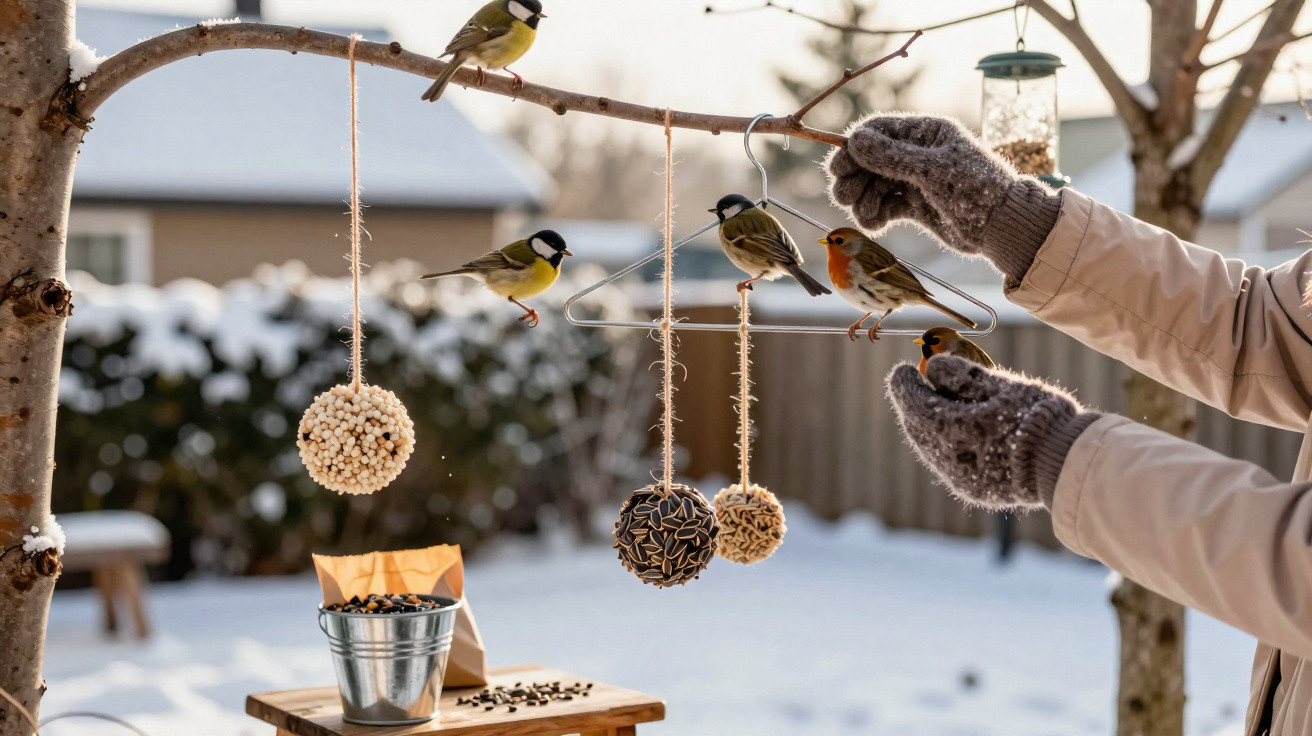
Many people assume winter feeding means buying costly specialist equipment from a garden centre. Yet conservation professionals and experienced home gardeners increasingly rely on a solution hanging in almost every home: an ordinary metal clothes hanger. With just a few adjustments, it becomes a sturdy, adaptable support for bird feeders – and a genuine lifeline for tits, sparrows and other garden birds.
Why birds need urgent help in winter
When temperatures drop, songbirds can barely find insects, seeds or berries. In towns and cities, wild hedges are disappearing, gardens are being ‘tidied up’, and their natural food supply is shrinking as a result. Small species in particular can lose a substantial proportion of their body weight overnight during winter.
Feeding birds properly in winter helps them survive the cold season – while bringing fascinating wildlife watching right to your window.
Experts therefore recommend well-positioned feeding stations. It matters not only that food is available, but also where and how feeders are suspended. A straightforward set-up can make the difference between safety and danger.
The overlooked aid: a metal clothes hanger from the wardrobe
The idea sounds almost too simple: an ordinary wire clothes hanger from the wardrobe is repurposed as a support for bird feeders. Rather than fixing the feeder directly to a branch or balcony railing, it hangs from an extended wire hanger.
This creates greater distance from possible hazards on the ground or tree trunk, including cats, rats and martens. At the same time, the hanger can be shaped easily to suit a wide range of locations.
How to turn a hanger into a secure bird feeder support
This everyday item can be made into a useful tool for bird conservation in only a few steps:
- Carefully straighten the metal hanger until it forms a longer length of wire with a hook shape.
- Shape a robust hook at the upper end, ensuring it fits securely over a branch, pole or balcony railing.
- Bend a smaller loop at the lower end to hold feeders, fat balls or coconut shells.
- Make sure every wire end is neatly folded over so that neither birds nor people can be injured.
Within minutes, this creates a kind of ‘extended arm’ that places the feeder in an ideally protected position – without a drill, specialist hooks or expensive accessories.
Safety first: essential rules for using a metal clothes hanger
Although the method is simple, several points need attention to ensure the arrangement remains genuinely safe.
Check stability and material
Not every hanger is suitable for heavy feeders. The key considerations are:
- Wire thickness: Thin, cheap wire hangers bend easily, whereas sturdier versions can carry considerably more weight.
- Resistance to rust: Coated or galvanised hangers are the better choice; heavily rusted models should be discarded.
- Load testing: Give the wire a firm pull before hanging it up – if it deforms significantly, it is too weak.
Anyone unsure should use two hangers joined together to double the wire. This allows the support to carry larger bird tables or several fat balls at once.
The ideal height and position in the garden
The height has a major effect on how safe birds feel. Specialists recommend:
- Positioning the feeder at least 1.5 to 2 metres above the ground so cats have no jumping advantage.
- Leaving sufficient space from walls, gutters or beams, allowing birds an unobstructed view of predators.
- Placing it close to shrubs or trees to provide escape routes – but not so close that cats can creep up unnoticed.
Anyone who can clearly see the feeding spot from the living-room window is not only entertained, but also unconsciously keeps an eye on whether everything remains stable and safe.
Which foods work especially well on the hanger
The metal hanger is particularly effective for suspended food options. Especially suitable choices include:
- Fat balls without plastic nets, ideally in reusable holders
- Plastic or metal seed feeders for mixed seeds
- Homemade fat blocks in cups or moulds
- Halved coconuts filled with fat and seeds
Simple handled cups can also be hung from the wire. They are well suited to homemade fat-and-seed mixtures made with vegetable fat and bird food. With only a few ingredients, they create a durable, weather-resistant source of energy.
Examples of a simple winter bird-food mix
A traditional basic mixture can be prepared as follows:
| Ingredient | Quantity | Benefit for birds |
|---|---|---|
| Vegetable fat (for example, coconut fat) | 2 parts | Provides quickly available energy against the cold |
| Sunflower seeds | 2 parts | Popular with many species and easy to crack |
| Oats | 1 part | Suitable for soft-billed birds such as robins |
| Chopped unsalted nuts | 1 part | Provides additional fats and protein |
Briefly combine the ingredients with the fat in a saucepan, allow the mixture to cool slightly, spoon it into cups or coconut shells, and leave it to set – then the food is ready to hang from the wire.
An ecological bonus: upcycling instead of buying new
Many conservation organisations welcome ideas like this because they meet several goals at once. The metal clothes hanger from the wardrobe is given a second use instead of ending up in the bin or remaining unused. It also saves the materials, packaging and transport involved in buying dedicated hanging systems.
Using everyday objects creatively conserves resources and makes wildlife protection in your own garden practical and accessible.
The clothes-hanger trick is particularly suitable for rented flats with balconies, small patios or backyards. Feeding stations can be moved easily if they are too close to glass surfaces or if neighbours feel disturbed. Once shaped, the hanger can be reused year after year.
Avoid common winter feeding mistakes
Even the most thoughtful suspension method offers little benefit if mistakes are made around it. Several measures help maintain healthy bird populations over time:
- Clean feeding stations regularly to help prevent disease.
- Never offer salted or seasoned leftovers.
- Avoid bread, as it swells in the stomach and has little nutritional value.
- Mark glass surfaces if the feeding station is placed near windows.
- Keep cats indoors, especially at dawn and dusk, when birds are particularly active.
By following these points, you can create a safe meeting place for a wide variety of species with very little effort – from great tits and blue tits to sparrows and nuthatches.
Why simple ideas are often the most sustainable
The metal hanger idea demonstrates how close practical solutions can be. Instead of purchasing new products, it is worth looking in cupboards, cellars and storage rooms. Old plant pots can become feeding stations, jam jars can serve as water dishes, and spare pieces of wood can be turned into perches.
These projects are particularly well suited to families with children. Bending, making and hanging the feeder together creates not only a feeding station, but also a direct connection with the animals in the garden. Children can see at close range how much small actions can influence birds’ chances of surviving winter.
Anyone who has watched sparrows and tits gather around an improvised feeding station will probably look at the next clothes hanger in the wardrobe very differently – no longer merely as a way to prevent creases in a shirt, but as a small tool for active wildlife conservation on their own doorstep.


Comments
No comments yet. Be the first to comment!
Leave a Comment