
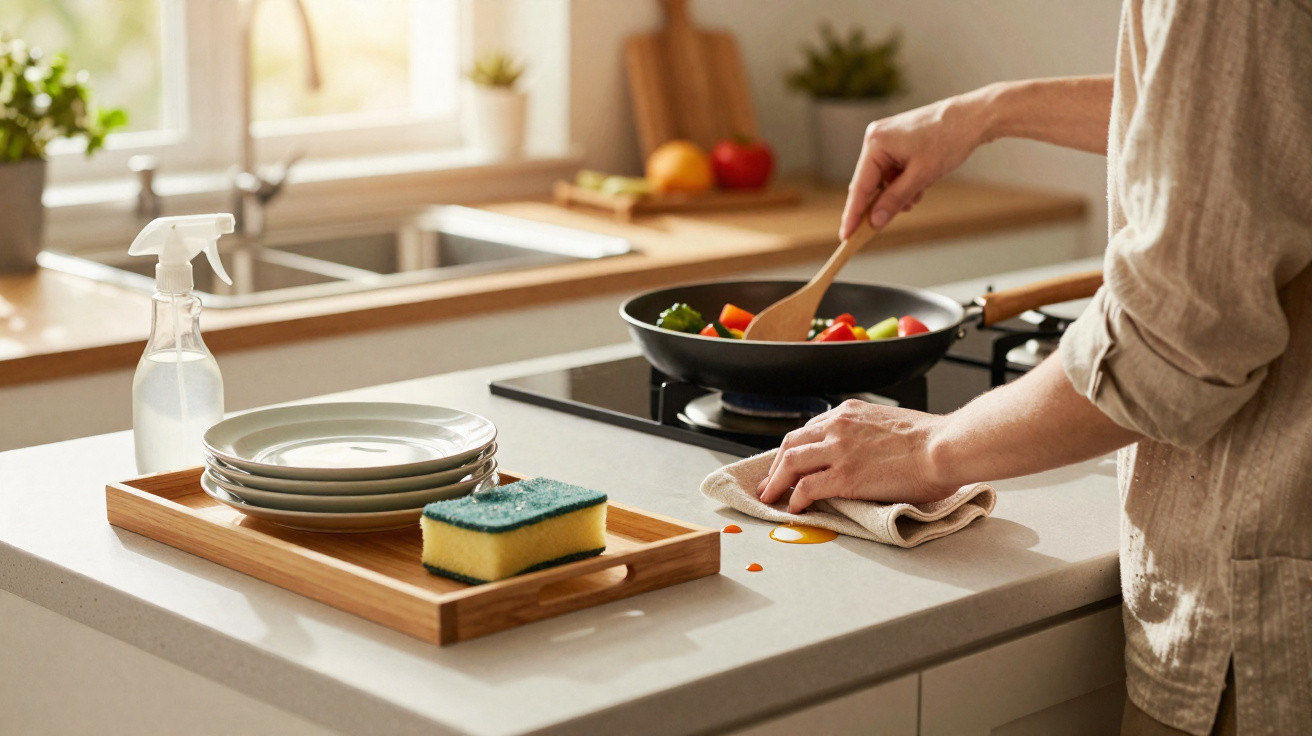
Dinner may be finished, but the aftermath is not. The plates are bare, the pan is sitting resentfully on the hob, and the sink resembles a collection point for stray forks. You rest against the worktop, already wishing you had not used so many pans for that “simple” dinner. The meal was delicious, yet all you can see now is the sticky evidence of the effort it took.
You spend a few minutes scrolling on your phone, wondering whether there is an easier way to live than enduring this evening kitchen hangover.
What if the answer were not another gadget or a magical cleaning product, but a small, almost unnoticed action while you cook-one that removes half the mess before it can build up?
One simple gesture can transform the post-dinner scene.
And most of us do not do it.
The tiny habit that changes everything
The simple kitchen practice that drastically reduces washing up is almost laughably easy: clean as you cook, in short bursts, with a “landing zone”.
This is not a complete clean-up or an attempt to make everything perfect. It is simply a gentle, ongoing routine of rinsing, wiping and binning things while food simmers, bakes or boils.
Your landing zone is a single area of the worktop or sink where used utensils, vegetable peelings and packaging go as soon as you have finished with them.
Rather than allowing clutter to spread over every surface, you keep it all contained in one place.
When you eventually sit down to eat, most of the work has already been done without much fuss.
Imagine making an easy pasta dinner on a Wednesday evening. In the first version, you chop garlic on three separate chopping boards, leave the knife in the sink “for later”, then open tins, jars and packets that end up scattered around like confetti. The sauce bubbles away, the pasta water boils, and every available surface gradually vanishes beneath clutter.
In the second version, you place a large bowl or tray on the worktop. Each empty tin, onion skin and piece of plastic wrapping goes straight into it. Every utensil you finish using gets a quick rinse and is placed upright in one cup beside the sink.
It is the same recipe, but the outcome is completely different.
There is a good reason this approach works so well psychologically. At the end of a tiring day, our brains dislike broad, unclear jobs such as “clean the whole kitchen”. The task feels overwhelming, so we put it off or tackle it hurriedly and resentfully.
Small, specific jobs feel far more manageable: rinse this pan, throw away that peel, wipe up this splash as the onions soften. You are already in the rhythm of cooking, so these extra movements feel much easier than beginning the entire job from scratch after dinner.
You are discreetly shifting work from the point when you are exhausted to the point when you still have momentum.
The benefit is not only a tidier kitchen. It also means less mental resistance, night after night.
How to make “clean as you cook” a genuine habit
Begin by setting up the landing zone.
Before handling any ingredients, take a large bowl, baking tray or even a shopping bag and place it on the worktop. Use it as a catch-all for peelings, packaging and food scraps. It stops the mess from spreading and leaves you with only one container to empty at the end.
Then fill one side of the sink, or a washing-up bowl, with hot soapy water before you begin cooking.
The moment you have finished with a knife, spatula or chopping board, either give it a five-second rinse or put it directly into the water to soak.
By the time dinner is on the table, most of your equipment will already be partly clean.
Many people assume that “clean as you go” means being intensely organised or continually scrubbing. That is usually why the idea fails. You do not need an immaculate worktop while dinner is still cooking. You simply need to prevent the mess from growing.
Concentrate on only three opportunities: when water is boiling, when something is simmering and while food is in the oven.
Those brief pauses are valuable. Rather than doomscrolling or watching the pan, put rubbish in the bin, wipe one area or rinse a couple of items.
Realistically, no one manages this every single day.
Yet doing it even three evenings a week can completely change how your kitchen feels.
“Once I started rinsing things the second I was done with them, I realized most of the ‘big cleanup’ I dreaded didn’t even need to exist,” says Laura, 34, who cooks for a family of five. “By the time we sit down, the counters are kind of… calm. After dinner, it’s just plates and one pan. It feels like cheating.”
- Create a landing zone: use one bowl, tray or bag for all scraps and packaging.
- Prepare the sink first: fill it with hot, soapy water before cooking rather than after eating.
- Make use of waiting time: clean only during natural pauses, not when you are actively stirring.
- Rinse instead of scrubbing: a quick swish now avoids stuck-on disasters later.
- Stop at “good enough”: the aim is less mess, not a showroom-standard kitchen.
When clean-up becomes almost an afterthought
What stands out is how quickly this modest change alters the emotional feel of an evening. The kitchen no longer seems like a battlefield you abandon, only to dread returning to later. Instead, it becomes a room that gradually resets itself in the background while the rest of life carries on.
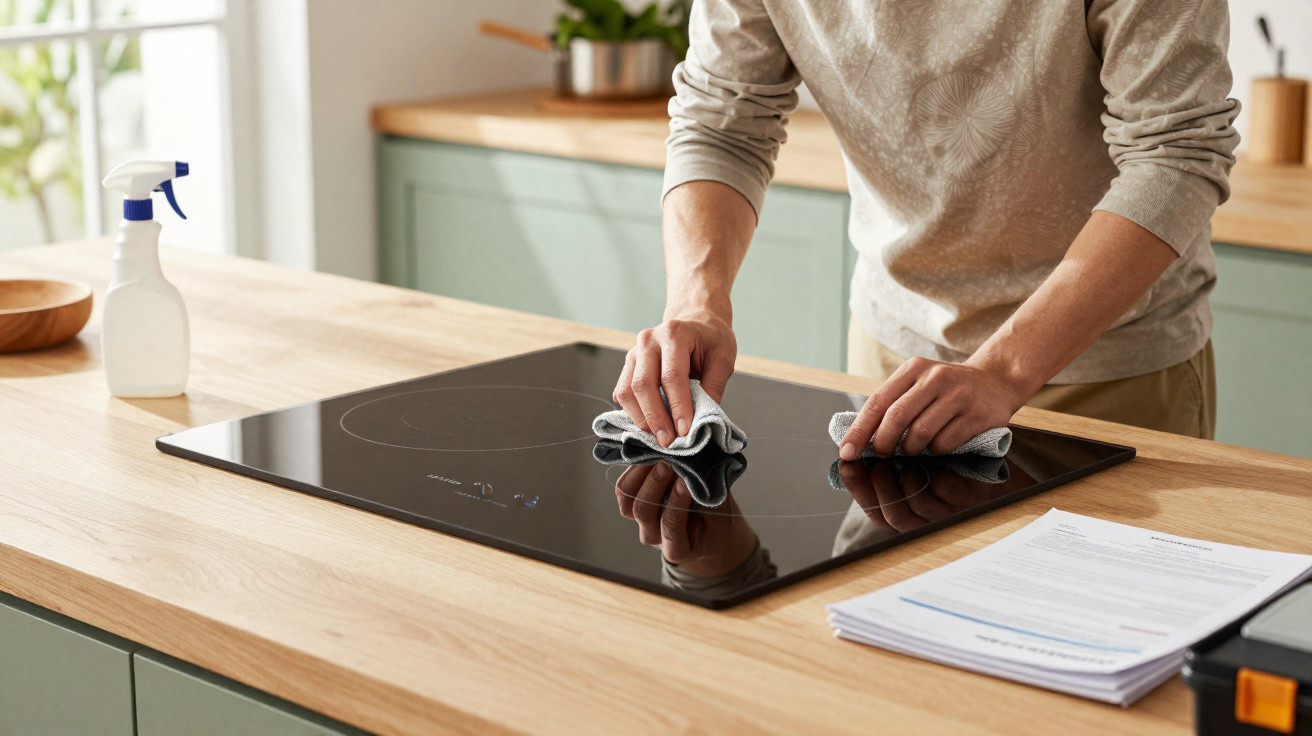
You begin noticing small things: how a wiped hob makes you want to cook again the next day; the lack of a sticky ring around the chopping board; and the fact that you can move straight from the table to the sofa without that quiet feeling of guilt lingering in your mind.
We all know the moment of looking at the sink and thinking, “I don’t have this in me tonight.”
When half the mess has already disappeared, that moment seldom arrives.
| Key point | Detail | Value for the reader |
|---|---|---|
| Use a landing zone | One bowl, tray, or bag collects all waste and small clutter | Reduces visual chaos and speeds up end-of-meal cleanup |
| Prep the sink first | Fill with hot, soapy water before cooking begins | Makes rinsing effortless and prevents stuck-on food |
| Clean in natural pauses | Use boiling, simmering, and baking time for tiny cleaning bursts | Cuts total cleanup time and feels lighter on busy nights |
FAQ:
- Question 1 What if my kitchen is tiny and I barely have counter space?
- Answer 1 Use a vertical landing zone, such as a shopping bag hanging from a drawer handle, plus a small tray that can rest partly over the sink. The idea-contain, then clear-works in even the smallest kitchens.
- Question 2 Do I need special tools or organisers for this habit?
- Answer 2 No. An ordinary bowl, an old tray or a reusable bag will work perfectly. The benefit comes from the routine, not from purchasing new equipment.
- Question 3 What if I’m already exhausted when I start cooking?
- Answer 3 Keep it minimal: set up the landing zone and fill the sink. Even if that is all you do, you will still reduce the later clean-up without needing extra thought.
- Question 4 Won’t cleaning while I cook slow me down?
- Answer 4 Initially, it may seem that way. Once it becomes automatic, you will see that you are using existing waiting time rather than adding to the total time spent in the kitchen.
- Question 5 How do I get other people in the house to follow this?
- Answer 5 Keep the instruction straightforward: “Everything you finish using goes into the bowl or into the soapy side of the sink.” Avoid lectures. Repeat the same phrase, and allow the new routine to become the default.
Comments
No comments yet. Be the first to comment!
Leave a Comment