
You switch on the air conditioning, feel that first blast of air and, for a second, could swear the climate inside your home has genuinely changed.
Yet along with the cool air comes an odd smell. It is faint, almost unnoticeable, but persistent. Days pass, the electricity bill rises, the unit starts making a different noise, and you tell yourself: “it must be in my head”. Then someone says: “Blimey, this air feels heavy.” That is when the uncomfortable realisation lands. It is not only the heat outdoors. Something is wrong with the filter. There is dirt you cannot see but are still breathing in. The question that keeps nagging away is simple, almost obvious: what if the problem is exactly the part we never clean properly?
Why the air-conditioning filter becomes a silent culprit
When people look at a wall-mounted air-conditioning unit, they see only a quiet white appliance, almost another part of the décor. Inside that casing, however, the filter works silently all day, trapping dust, pet hair, pollution and potential fungi. It is an invisible barrier between what is in the air and what you breathe while sitting on the sofa. Once it becomes clogged, the unit is effectively starved. Airflow weakens, the compressor is put under strain and energy consumption shoots up. What should provide comfort instead becomes a cycle of tiredness, headaches and irritation. A dirty filter takes its toll without making a fuss.
An air-conditioning company in São Paulo carried out an interesting internal review: in over 70% of residential call-outs for “weak air” or “air that is not cooling enough”, the main issue was a filter completely covered in dirt. Homes with pets are especially prone to it. Fine hairs cling to the plastic mesh as though it were Velcro. Some people also say their rhinitis flare-ups clearly eased after they cleaned the filter. That is not laboratory scientific evidence, but it is real life. It is the sort of story an uncle tells over Sunday lunch and you assume he is exaggerating-until you try it yourself.
It makes sense. With an obstructed filter, the unit has to “draw” air more forcefully, placing extra demand on the indoor fan, heating components and wearing parts out prematurely. The machine works harder, uses more electricity and delivers less. Meanwhile, some of the built-up dust may start coming loose as fine particles, spreading what the filter was supposed to stop. The logic is almost cruel: the item designed to protect your health begins working against you when it is neglected. Let us be honest: nobody does this every day. But leaving it for months is an invitation for the problem to grow quietly.
How to clean an air-conditioning filter: the right method, step by step
The first step is almost a household ritual: switch the air conditioning off at the mains or at the circuit breaker, then wait a few minutes. The unit needs that pause before you start handling it. Next comes a gentle touch on the front cover. Most split-system models open with light pressure on the lower section. There is no need to pull with brute force. Once the cover is raised, the filters are immediately visible-usually two plastic pieces fitted with fine mesh. Remove them carefully, following the direction shown on the appliance itself, so that you do not bend or break the frame. Even this opening step changes your relationship with the unit: it stops being a mysterious box and becomes something you actually understand.
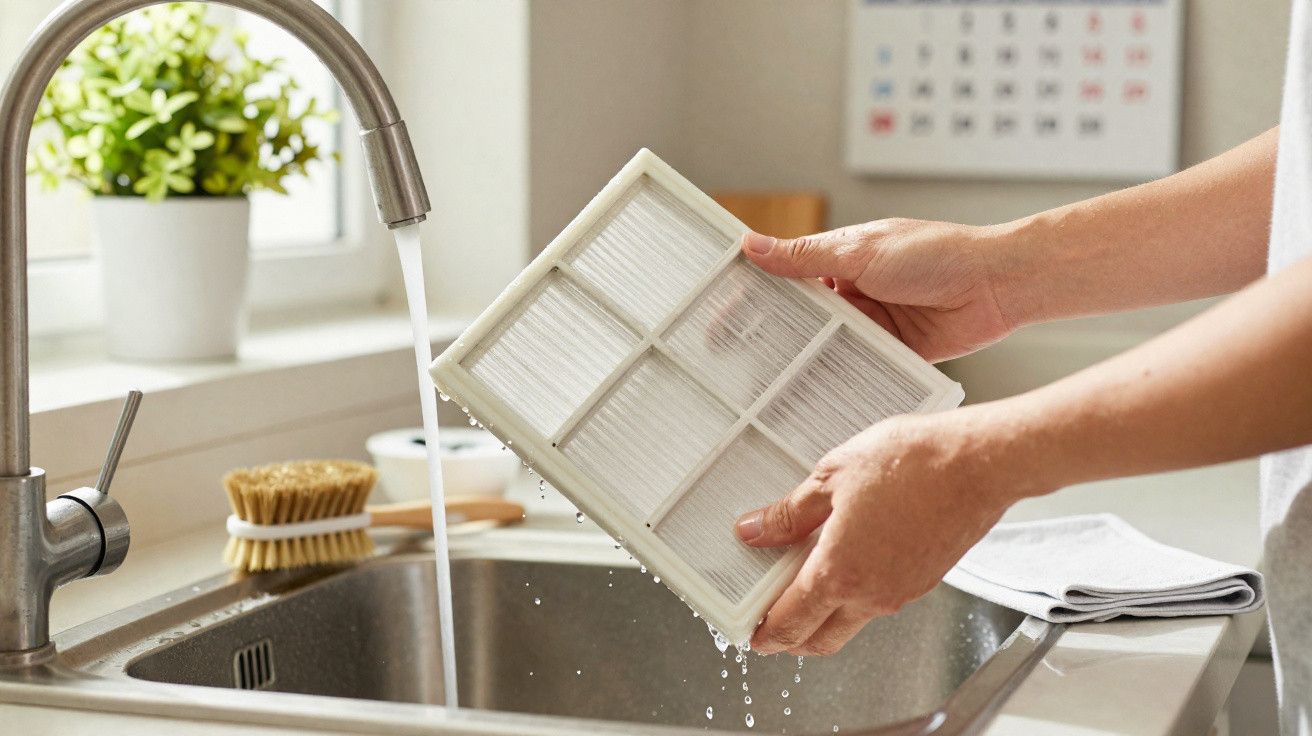
With the filter in your hand, you are faced with what many people prefer not to see: a layer of grey, sometimes yellowish dust, strands of hair and small dark marks. This is where people often make mistakes on impulse-washing it in very hot water, using an abrasive sponge or applying strong chemicals. That can damage the mesh, widen its openings and weaken the structure. The straightforward method works best. Use cool or slightly warm running water, with a gentle flow, always rinsing from the back towards the front so that dirt is pushed out rather than further in. If extra cleaning is needed, a small amount of mild washing-up liquid diluted in your hand will remove much of the staining. Take your time; do not scrub it as though it were a cast-iron pan.
A refrigeration technician with 18 years of experience put it this way during a brief chat in a corridor:
“An air-conditioning filter was not made to suffer; it was made to be cared for. Anyone who mistreats the filter will end up fighting with their own wallet later.”
The ideal sequence is almost a simple routine that anyone can follow:
- Remove the filter while the unit is switched off.
- Wash it under running water using mild washing-up liquid.
- Leave it to dry naturally in the shade, without using a hairdryer or strong sunlight.
- Refit the filter only once it is completely dry.
- Write down the cleaning date on paper or in your phone to establish a routine.
Routine, timing and a little honesty about your own air
After the first thorough clean, something interesting happens. You switch the unit on and notice that the airflow feels fuller and more even. The room feels different, even though you have not changed the temperature on the remote control. Some people report that the internal noise is reduced, as if the appliance were breathing more easily. That immediate result creates a small but welcome habit: you want to repeat the care. It becomes clearer that the filter is not some distant technical detail; it is practically part of the household cleaning routine, like sweeping the floor or cleaning the bathroom-just hidden behind a plastic cover.
The biggest challenge is turning that one-off task into a habit. Specialists recommend intervals ranging from 15 days to 2 months, depending on how much the unit is used, the city and whether there are animals at home. In flats near busy roads, grime builds up more quickly. In clinics, beauty salons and gyms, the routine needs to be even stricter. Not everyone will follow a perfect timetable. Still, it is worth being honest with yourself and checking the filter whenever the air feels unusual, the smell changes or the electricity bill rises too much without a plausible explanation. Sometimes your body notices before your wallet does.
One detail is often overlooked: cleaning the filter does not replace regular professional maintenance, including checks of the refrigerant, drains and coils. It is a separate, complementary level of care. At the same time, keeping the filter visibly clean reduces the risk of mould, improves the quality of the air circulating in your living room and may extend the appliance’s working life. It is no exaggeration to say that this piece of plastic and mesh, calmly washed under the tap, can prevent plenty of trouble. And one thing becomes clear when you hold the filter for the first time, dry and ready to go back in place. Air that looks “clean” at first glance always has a story. You decide whether that story feels light or heavy.
| Key point | Detail | Value for the reader |
|---|---|---|
| Cleaning routine | An interval of 15 days to 2 months, depending on use and surroundings | Helps keep the air healthier and the unit efficient |
| Correct method | Filter removed with the unit switched off, washed with water and mild washing-up liquid, then dried in the shade | Prevents filter damage and improves performance at no extra cost |
| Warning signs | Odd smell, weak airflow, a different noise, rising electricity bills | Lets you act quickly before the issue becomes an expensive outlay or a health risk |
FAQ:
- Question 1 How often should I clean my home air-conditioning filter? With daily use, a good average is every 30 to 45 days. If you live in a very dusty area or have pets, it is worth reducing this to around 15 days.
- Question 2 Can I use a vacuum cleaner instead of washing it? A vacuum helps remove excess dry dirt, but it does not replace washing with water and mild washing-up liquid, which removes fine particles and grease.
- Question 3 Is it safe to use bleach or disinfectant on the filter? No. Harsh products can damage the mesh and release residues into the air. Use only mild washing-up liquid and, in some cases, a specialist cleaner recommended by the manufacturer.
- Question 4 What happens if I never clean the filter? The unit loses performance, consumes more electricity, runs hotter and the air is more likely to become laden with dust and micro-organisms, increasing the risk of allergies.
- Question 5 Does a clean filter mean I can skip annual technical maintenance? No. Filter cleaning is basic care that can be done at home. Technical maintenance checks refrigerant, leaks, the drain and internal parts you cannot reach.



Comments
No comments yet. Be the first to comment!
Leave a Comment