
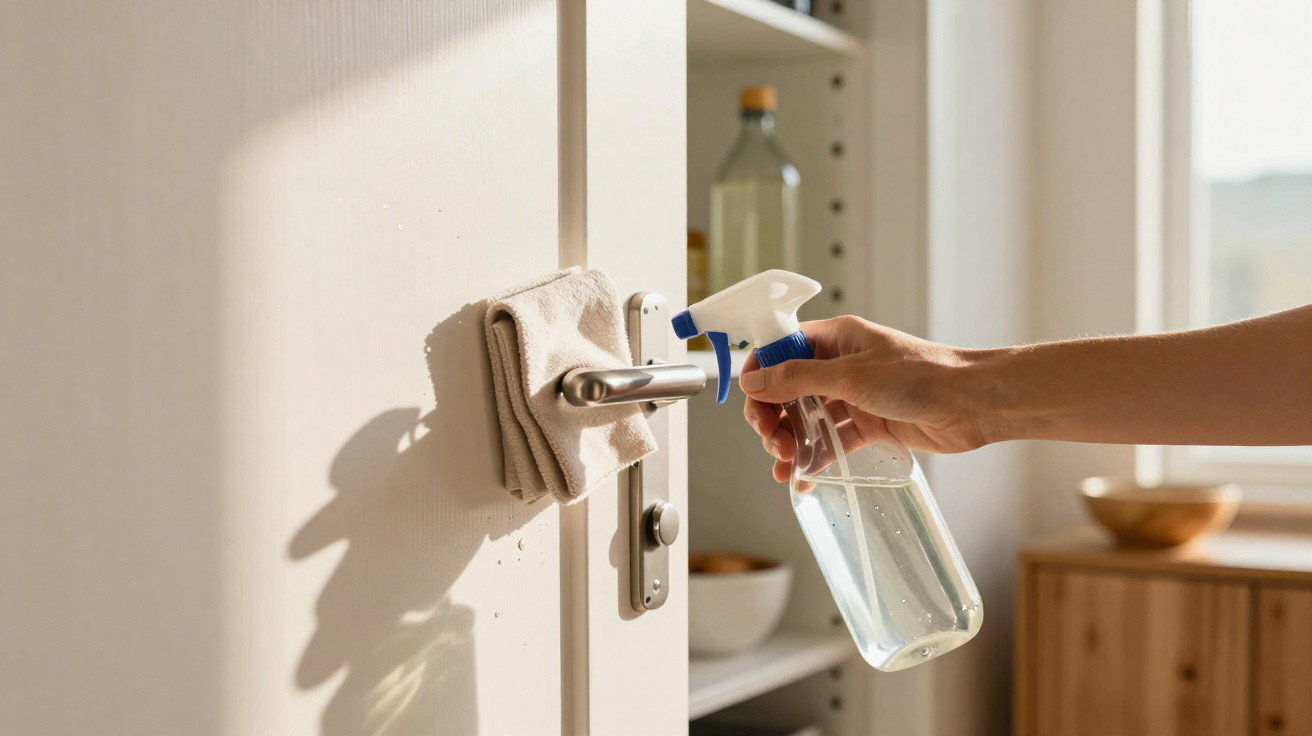
Your doors may be filthier than your floors, but you tend not to see it until the light falls at a particular angle. Smears by the handle, a dull ring around the panels and fingerprints at children’s height build up gradually. The answer is probably in your kitchen cupboard, and it needs barely any elbow grease.
One evening, the low, unforgiving sun skimmed across the paintwork, exposing a galaxy of prints and a smear that I could have sworn had not been there the day before. When I traced a finger along the edge, it came away grey, as though the door had recorded every hurried exit and midnight snack trip of the past month.
We have all had mornings when the house seemed perfectly presentable the night before but suddenly looks chaotic. Doors reveal the reality. The solution sits beside the ketchup.
Why doors become grimy more quickly than walls
Doors are not merely flat surfaces: they are high-contact points, which makes them magnets for dirt. Each touch after cooking, applying lotion or returning from the gym leaves a fine layer of oil that holds dust as effectively as Velcro.
Air also moves differently around a door. Opening and shutting it draws a small current through the home, carrying airborne kitchen grease and fine dust from footwear towards the tacky area around the latch. A passing sleeve then smudges the build-up around like charcoal.
It is no coincidence that grime gathers around eye level and near the handle. A household of four can readily push or pull one door 80 to 100 times a day. Over a week, that amounts to thousands of tiny deposits of skin oils and soap residue, alongside traces of whatever was made for dinner.
I once met a tenant who took a tote bag down from her bedroom door and discovered a cleaner rectangle beneath it, like an old photograph faded into the past. She had not cleaned that door for years. It had never seemed necessary-until that moment.
The type of paint finish makes a difference. Matte paint traps dirt in its micro-textured surface, whereas satin and semi-gloss finishes are more resistant but still collect grime where hands touch them. In kitchens, an invisible mist of cooking fat settles and then sets, particularly on warm doors close to ovens.
In humid bathrooms, dust and oils combine into a film that deepens along panel edges and moulded trim. Candles and incense also produce minute particles of soot, which travel in HVAC air currents and leave ghostly marks around the door edges. It may look like ordinary dirt, yet it is a combination of daily life, breath and everything your home releases.
White vinegar: the overlooked cupboard essential for a five-minute door refresh
For the fastest, most effortless deep clean, start with distilled white vinegar. In a spray bottle, combine 2 cups of warm water with 1 cup of white vinegar. Include one small drop of mild washing-up liquid and, if you prefer, several drops of lemon or eucalyptus to cover the vinegar smell.
Lightly mist the entire door from top to bottom. Leave the solution for 60 seconds so it can release the film. Using a clean microfibre cloth, wipe in long downward strokes and turn the cloth over as it picks up grime. Buff with a dry microfibre cloth afterwards to avoid streaking. That is the whole refresh.
For a wooden door or one with an aged varnish, use a gentler dilution: 1 tablespoon of vinegar for each cup of water is sufficient. The 2:1 water-to-vinegar mixture is safe for painted doors with satin or semi-gloss finishes. If you are unsure whether a finish is delicate, test an inconspicuous corner first.
Pay particular attention to the knob, latch plate and the edge you pull with your fingers, as these collect the most oil. A soft toothbrush is extremely useful for panel grooves and the areas around fittings. Cotton buds can clean hinge knuckles without leaving drips.
Avoid making too many suds. Extra soap means extra rinsing and more streaks. If the door has visible fluff or dust, begin with a dry dusting; then spray and wipe. Place a towel at the bottom to catch drips, particularly where there are hardwood floors.
Do not saturate the door, and prevent liquid from entering screw holes or unsealed wood joints. A single light application will often be enough. After all, no one cleans doors every day.
“I can clean ten doors in under 20 minutes with a vinegar mix,” a professional cleaner told me. “It’s the dwell time and the right cloth that make it feel effortless.”
“Vinegar breaks the bond between oil and dust without stripping paint, and it flashes off quickly so you don’t chase streaks.”
- Mix: 2 cups warm water + 1 cup white vinegar + 1 small drop dish soap.
- Mist from top to bottom, wait 60 seconds, wipe with microfibre, then buff dry.
- Clean the hardware and panel grooves last, using a toothbrush or cotton bud.
- For wood: reduce the vinegar considerably and use a barely damp cloth.
- Use a clean cloth on the door edges and frame where hands tend to grip.
Turn door cleaning into a small habit, not a chore
There is no need for a major cleaning session. Add door wiping to routines you already have: after washing up, after showering or while the kettle boils. One door takes one minute, and the effect is like improving the lighting.
There is a subtle pleasure in seeing a handle gleam again, as though you have restored a little order without working up a sweat. Freshly cleaned doors make a room feel cleaner, almost as if it has been repainted. Visitors notice the difference, even when they cannot explain why.
That neglected bottle of white vinegar can serve several purposes-kitchen, bathroom and now the surfaces your hands touch a hundred times a day. A door is your home’s handshake. Keep that handshake clean, and everything else follows.
| Key point | Detail | Benefit for the reader |
|---|---|---|
| Grime recipe | Oils, dust and airflow form sticky rings near handles and panels | Explains why dirt returns and which areas to target |
| Vinegar mix | 2 parts warm water, 1 part white vinegar, 1 drop washing-up liquid | A quick, inexpensive, low-effort clean with very little streaking |
| Micro-habits | A one-minute wipe during everyday routines | Easy upkeep without demanding intensive cleaning days |
FAQ:
- Can I use vinegar on every door finish? Use the standard mixture on painted doors with satin or semi-gloss finishes. For natural wood or old varnish, dilute it heavily and keep the cloth only barely damp. To be safe, test a concealed corner first.
- What if my door is sticky from kitchen grease? Dust it dry first, then spray on the vinegar mixture and leave it for 90 seconds. Wipe with microfibre and finish with a second clean cloth. If it remains tacky, repeat the process once instead of scrubbing vigorously.
- Will vinegar smell linger? It should last only a few minutes. A few drops of lemon or tea tree can help. Good ventilation or an open window disperses it quickly, leaving a neutral, clean finish.
- How often should I clean doors? Give high-traffic doors a quick wipe each week. Clean bathroom and kitchen doors every few days if a film is appearing. For less-used rooms, once a month is adequate. Pair it with an existing routine so it does not feel like another task.
- What about stubborn marks or crayon? Begin with the vinegar mixture. If the mark remains, put a very small amount of washing-up liquid on one corner of the cloth, wipe it, then go over the area again with the vinegar mixture. Magic erasers can be used on painted doors, but apply them lightly to prevent dull patches.


Comments
No comments yet. Be the first to comment!
Leave a Comment