
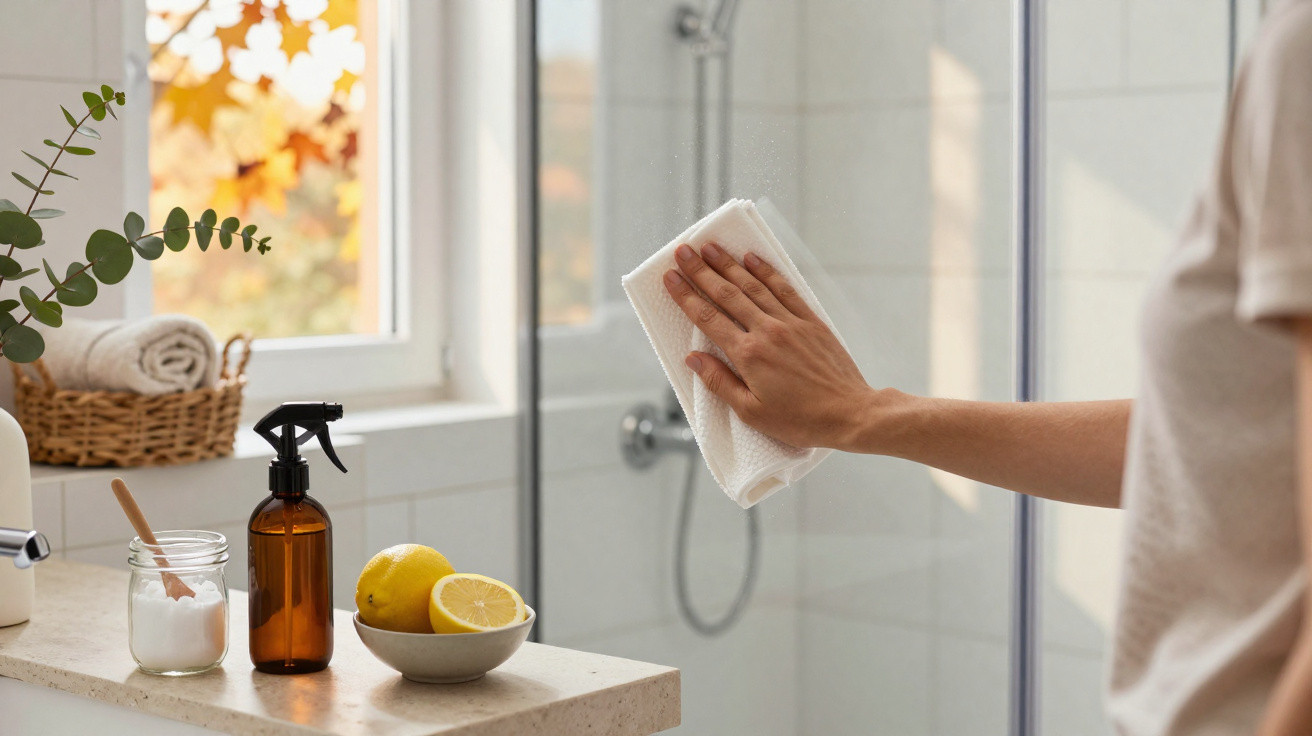
Autumn light is unforgiving in the best possible way. It falls across the bathroom, exposing the limescale circle you overlooked, misty edges on the mirror, and grout stained the colour of cold tea. Eco-friendly cleaning in autumn is about more than making things gleam. It clears the air, helps prevent winter mould, and makes warmth go further as evenings draw in.
A radio murmurs in a distant room as a kettle warms a bottle of citric acid on the worktop. I work a baking soda paste into the grout, slowly enough to spot the line where summer left its mark. July still lingers in streaks across the mirror, while the showerhead looks as though it could do with a lie-down. A fresh lemon-and-vinegar smell takes the place of the overpowering perfumed products that always seemed to hide rather than clean. Winter begins in the bathroom.
Why autumn is the ideal time for a greener deep clean
Autumn brings the useful conditions together: cooler air for ventilation, even daylight that uncovers what summer sheen concealed, and a natural break before winter habits set in. Leave the door ajar, open the window a little, and allow steam to escape without turning your feet numb. Soap scum is easy to see in clear daylight, rather than under a phone torch’s hard glare at 10 p.m. A proper autumn reset helps the shower run freely, lets towels dry sooner, and stops the room feeling clammy by dinnertime.
Here is a small example. Two Sundays ago, my neighbour Jade replaced her usual bleach-heavy clean with a jar of citric acid, a bag of sodium percarbonate, and one determined brush. She soaked the showerhead in warm water and citrus powder, spread a thick soda paste over the grout, and returned to it with a gentle scrub. The grout lines came up a shade lighter, the glass lost its chalky coating, and the room smelled of lemon peel rather than a swimming pool. Many public health guides say indoor air can be several times more polluted than outdoor air. In that instant, the room seemed to breathe out.
The reasoning is straightforward: remove mineral deposits now and moisture has fewer surfaces to hold on to once the windows remain closed. Reduced build-up and improved ventilation mean the extractor fan has less work to do, while condensation vanishes instead of nourishing mould. Descaled fittings and clean grout dry fast, so you are not heating a damp cave in January. Small, non-toxic shifts compound-the bathroom becomes simpler to keep dry, faster to wipe down, and more pleasant to breathe in when the heating comes on.
Eco-friendly bathroom cleaning methods: low-waste recipes, high-impact shine
Begin with limescale. Dissolve 1 tablespoon of citric acid powder in 250 ml of warm water to create a 5–6% solution, spray it over taps and glass, then leave it to work while you clean the shelves. To descale a showerhead, fill a bag with the same warm mixture, secure it around the showerhead, and leave it to soak for 20–30 minutes before rinsing. For grout, apply a dense baking soda paste made with 3 parts soda to 1 part water, lightly spray it with vinegar to create fizz, leave it for 10 minutes, then scrub. Particularly stubborn grout may need a scoop of sodium percarbonate in hot water for an oxygen lift, followed by a thorough rinse.
Never combine vinegar with chlorinated products, and do not rely too heavily on essential oils: they may smell pleasant, but they do not do the cleaning. Thick powder pastes can block drains when too much is washed away at once; scoop up the residue, put it in the bin, and then rinse. Tackle the bathroom in sections so the task does not become overwhelming: mirrors and glass first, followed by metal, tiles and grout, then the floor and drain. Honestly, no one keeps up this routine every day. Create a 15-minute weekly “wipe and dry” circuit, and you will make winter easier bit by bit.
There is a helpful approach that prevents overwhelm while keeping the room brighter.
“Clean for dry, not for perfect. Dry surfaces are what stop mold, save heat, and make a bathroom feel freshly washed three days later.”
- Quick autumn checklist: descale the showerhead; use a squeegee on the glass after every shower; wipe the tops of tiles, where steam gathers.
- Wash the shower curtain at 40°C with a spoonful of sodium percarbonate; if possible, hang it in sunlight to dry.
- Vacuum the extractor fan cover and run the fan for 10 minutes after every hot shower.
- Keep a dry microfibre cloth on a hook-tools in sight are tools that get used.
Maintain that low-tox glow through winter 2025
An autumn deep clean is not the finishing point. Instead, it prepares the room for uncomplicated winter routines. Place the squeegee where your hand naturally reaches for it. Store a small citric-acid spray on the shelf so limescale never turns into a major project. Alternate between two bathmats so one is always completely dry, and open the window just long enough to refresh the air without chilling yourself. This is the moment the room starts to breathe again. The aim is warmth without stickiness, shine without perfume, and a routine your half-awake future self can manage.
| Key point | Detail | Benefit for the reader |
|---|---|---|
| Autumn is prime time | Cool air + steady light make drying and spotting buildup easier | Faster results with less effort and fewer products |
| Simple green formulas | Citric acid for limescale; baking soda + oxygen bleach for grout | Low-tox shine that lasts into winter 2025 |
| Dry beats perfect | Focus on squeegee, venting, and quick weekly wipes | Blocks mould, saves energy, keeps the room fresh longer |
FAQ:
- What’s the best natural descaler for taps and glass? Citric acid in warm water (about 5–6%) dissolves limescale without harsh fumes. Spray it on, wait 10–15 minutes, then wipe and rinse.
- How do I whiten grout the eco-friendly way? Begin with a baking soda paste and a stiff brush. For deeper staining, dissolve sodium percarbonate in hot water, apply it, wait 10 minutes, scrub, and rinse thoroughly.
- Can I use vinegar on natural stone? No. Vinegar and other acids can etch marble, limestone, and travertine. For stone surfaces, use pH-neutral soap, such as diluted castile soap, with a soft cloth.
- How do I keep mirrors fog-free without chemicals? Wipe them with a 1:1 mixture of vinegar and water, then buff dry. A pea-sized dot of mild soap, buffed into a thin layer, can provide temporary resistance to fogging.
- How often should the extractor fan be cleaned? Vacuum the cover each month and wipe the blades every season. Running it for 10 minutes after showers helps control moisture and odours.



Comments
No comments yet. Be the first to comment!
Leave a Comment