
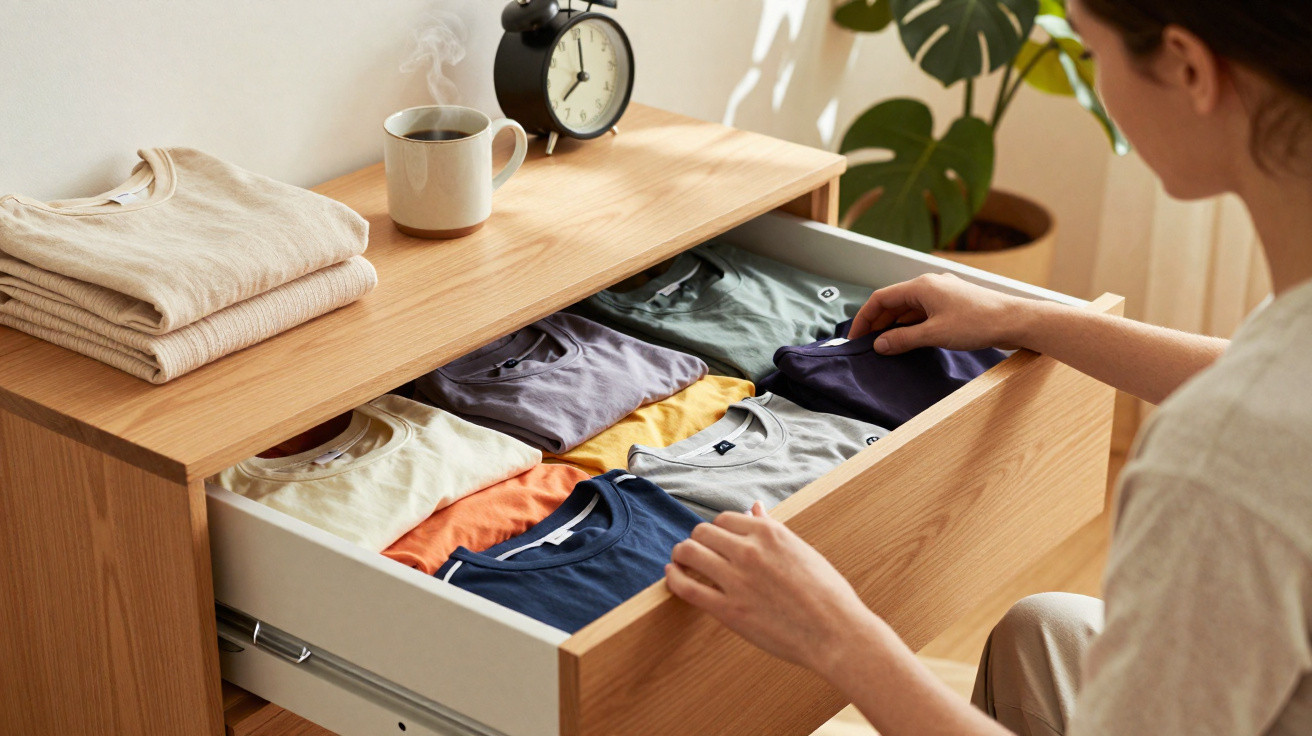
Inside the drawer: a soft landslide of T-shirts and jumpers, a sleeve caught around a sock, a collar bent the wrong way, and pale pressure marks resembling miniature railway tracks. You lift out the top T-shirt and find a crease running straight across the chest – precisely where it cannot be concealed. When clothes refuse to cooperate, the morning clock seems to tick even faster. City flats are not getting larger, yet our wardrobes appear to keep expanding. We all know the outcome: a panicked blast of steam, a missed or late bus, and a shrug that says “it’ll do”. That was my habit until somebody introduced me to another way of folding. It was neither a gimmick nor magic, simply a method that lets clothes stand upright. The drawer itself had not changed, but it seemed transformed. The fold had been the problem.
How weight affects fabric – and why the file fold resists it
Begin with gravity’s inconvenient reality. When clothes are piled into a stack, the items at the bottom support everything above them. Their fibres are compressed and displaced, eventually settling into those recognisable creases. You notice the resulting friction when you pull out one garment and several others come along too. Wrinkles thrive on weight and movement. Put that stack on its side, however, and the pressure is removed. Garments stored vertically act differently: they are not being squashed, and there is no need to rummage for the item you want. Less tugging means fewer lines.
I tested this in a slim drawer that previously seemed to stick if I so much as glanced at it. During the first week, I folded every T-shirt into tidy rectangles and filed them upright by colour. All at once, each item was visible like the spine of a book. I could take a tee without toppling the rest. It felt strangely pleasing, like managing a miniature supermarket shelf at home. After four weeks of commuting, only three shirts required an emergency press before work. Before making the change, the figure was nearer to most of them. One adjustment, the same drawer, and far calmer mornings.
There is an understated sense behind the method. Creases develop when fibres are pressed and kept in an altered position, particularly where there is a little heat or moisture. A high pile produces concentrated pressure points around fold edges, while the garment at the bottom often develops a pronounced ridge where the weight rests. The upright fold distributes that pressure instead. Every item has a modest “spine” holding slight tension, which stops the fabric from drooping. It also eliminates the friction of searching through a pile, which can pull shoulders and hems out of shape. Allow some air between pieces and any creases that do form are generally gentler and easier to flatten by hand.
The upright fold: a simple routine for compact drawers
Place the shirt face down on a clean, level surface. Run your palm over the fabric to smooth it; there is no need for anything elaborate, just a quick stroke to revive the fibres. Bring one side inward so that its sleeve lies flat against the body, then do the same with the other side, creating a long rectangle. Starting at the hem, fold the garment upwards in thirds or quarters to produce a compact parcel. Aim for a spine firm enough for it to stand on its edge. Rotate it and file it vertically in the drawer, with the spine at the bottom and the label facing you like a book title. The same basic sequence suits jumpers and joggers, with minor adjustments.
Two issues tend to cause trouble: bulk and overfilling. A parcel that is too thick will slump, while one that is too slim will fall over. Try to make the thickness suit the height of your drawer, allowing garments to sit together without tilting. Different fabrics need different treatment. Knitted tees and gym clothing can take a tighter fold, whereas crisp cotton benefits from a looser one. You can roll stretchy pieces if preferred, but fold woven shirts to avoid spiral-shaped marks. Realistically, nobody manages that perfectly every day. Make the system forgiving instead: fold neatly on laundry day, then use a quick half-fold in the middle of the week when life gets in the way.
We have all experienced the moment when a drawer flies open like a confetti cannon, with the item you need buried at the back.
“Clothes don’t need perfection. They need a consistent fold and a space that respects their shape,” said a London wardrobe consultant I once shadowed. “Upright beats stacked for most drawers, every time.”
- Keep every item standing on its edge; avoid creating leaning towers.
- Sort by category first, then by weight: put lightweight tees at the front and heavier jumpers at the back.
- Maintain a finger-width gap at the front as a “breathing strip”.
- Before filing, smooth each piece once with a flat palm. That one pass counts.
- Fill the drawer only to 80%. A little room helps parcels remain crisp.
Small drawers, greater calm
Alter the fold and the whole room can feel different. Opening the drawer reveals what you genuinely own rather than an uncertain selection beneath a mound of cotton. There is less clutter, both literal and mental. Take the grey tee you were after and everything else remains in place, as though it is cheering you on to leave the house intact. A neat drawer is not a personality trait. It is a practical kindness to your future self. With time, the advantages build: fewer last-minute ironing sessions, fewer “where is that top?” panics, and a little more breathing room in the morning. Pass the technique on to a housemate, or show a child how to create “book spines” from their tops. It is a modest win that can be repeated without much thought. Eventually, you may realise that your cramped drawer was never the issue. The fold was.
| Key point | Detail | Benefit for the reader |
|---|---|---|
| File-fold upright | Store clothes on their edge with a firm “spine” | Reduces the weight and friction that create creases |
| Match parcel size to the drawer | Fold in thirds or quarters so garments can stand | Stops slumping and keeps lines smooth |
| Leave breathing space | Stop at 80% full and sort by weight | Makes items easier to take out and keeps folds crisp |
FAQ
- Does rolling or folding make fewer wrinkles? Rolling is effective for stretchy fabrics. For woven cotton and shirts, a firm upright fold produces fewer pronounced lines and is easier to maintain in a drawer.
- Will this method work for jeans and trousers? Yes. Fold them in half to line up the seams, then fold in thirds to create a standing parcel. Keep heavier denim at the back so lighter garments do not topple.
- What if my drawer is very shallow? Create thinner parcels by folding into quarters rather than thirds. Reduce the width so that each item can still stand on its edge without leaning.
- Can I do this with delicate fabrics like silk? It is better to hang silk. If drawer storage is unavoidable, place tissue between folds and make a loose parcel filed upright to prevent tight crease marks.
- How do I keep it up when life gets busy? Create a weekly reset: five minutes for one drawer. Set aside a “to file” area so clean clothes do not turn into another stack. Small routines work better than major overhauls.




Comments
No comments yet. Be the first to comment!
Leave a Comment