
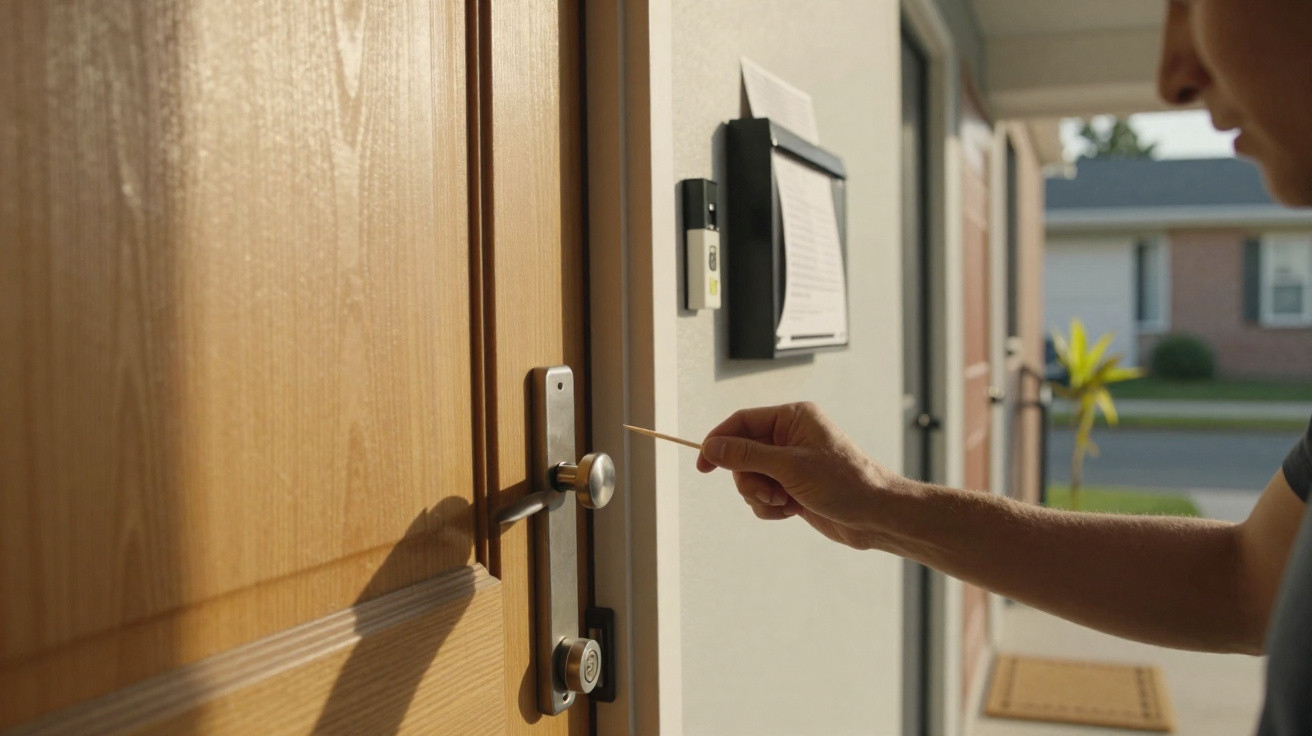
An inconspicuous wooden stick in your door could become a key tool for burglars – and many people notice it only when it is already too late.
Police and residents in several European countries have reported a new tactic used by burglars: a simple toothpick placed in a door or lock can tell them whether anyone is at home. Anyone unfamiliar with this trick can easily miss the tiny piece of wood, unknowingly making their home an ideal target.
How burglars check whether a home is genuinely empty
Burglaries are rarely random. Offenders deliberately look for addresses where they can operate without interruption, often watching houses and flats for several days beforehand.
For years, organised groups have used small, unobtrusive items to establish whether residents are away. Common examples include:
- a tiny adhesive dot on the front door
- a folded piece of paper placed in the gap around a door
- promotional leaflets deliberately pushed into a letterbox
If these items remain untouched for hours or days, burglars take it as a clear sign: nobody is returning home and nobody is likely to disturb them.
The toothpick method at the front door
Investigators are now focusing on a particularly devious variation: a toothpick inserted into a lock or wedged into a door frame. The principle behind it is simple, yet effective.
“A single toothpick is enough for burglars to know with confidence: this door has not been opened for hours or even days.”
This is how the tactic works:
- The offenders insert a thin toothpick into the keyhole or wedge it into the door frame.
- They watch the property or return the following day.
- If the wooden piece is still in exactly the same position, they consider the household “probably empty”.
- They then prepare the actual burglary – generally after dark or when there is little activity in the street.
The issue is that many residents do not notice the toothpick at all, or dismiss it as coincidence. The tiny wooden object is particularly easy to miss on dark doors or in poorly lit communal hallways.
Why this burglary tactic is so dangerous
Unlike obvious markings such as spray-chalk symbols or stickers, a toothpick appears harmless. That is exactly what makes this method appealing to criminals.
For them, the trick offers several advantages:
- Discretion: Neighbours are unlikely to see it as deliberate preparation.
- Low risk: The offenders only need to approach the door briefly, without tools or force.
- Clear information: If the toothpick remains undisturbed, there is a strong chance that the residents have been away for a longer period.
There is another concern: the toothpick method is suitable not only for detached houses but also for rented flats in apartment blocks. Even in busy buildings, some entrances are seldom used in the evening.
Warning signs to look out for from now on
Anyone wishing to protect their flat should pay closer attention. Being alert to your own door and communal hallway can ruin a burglar’s plans.
Suspicious signs directly around the door
- toothpicks or wood splinters in the lock
- small foreign objects in the door frame that should normally fall out when the door is opened
- adhesive dots, threads or narrow paper strips between the door and frame
An overflowing letterbox can also be seen as an invitation. It signals not only to burglars but also to opportunistic thieves that nobody is looking after the property.
Unusual notes, flyers and “advertising”
In some cases, offenders use advertising leaflets as a pretext. If the same flyer remains attached to every door for several days, that is normal. However, if it appears only on selected flats or houses, it is worth taking a closer look.
“Anyone who finds anything unusual on their front door should not hesitate to remove it – and should remember when and where it appeared.”
Making your home less appealing to burglars
Complete protection does not exist. However, you can make things considerably more difficult for burglars and make your property appear less attractive.
Create the impression that someone is home – even when they are not
Burglars generally avoid homes that appear occupied. Just a few straightforward steps can indicate that people return home and that there is activity inside.
- Use timer switches: Turn lamps on and off at set times in the evening.
- Vary shutters or blinds: Do not leave all of them permanently closed at the same time; use timers instead.
- Install motion sensors: Fit exterior lights that switch on automatically when someone approaches.
- Use a radio or smart speaker: Create sounds at irregular intervals.
Involve neighbours – the best early-warning system
Trusted neighbours are an important security asset. They can quickly spot when something is wrong.
- Agree who will empty the letterbox while you are away.
- Ask them to occasionally leave a window on the latch or adjust a shutter or blind.
- Tell them that unusual markings or objects at the door should be removed immediately.
Many areas also have organised schemes in which residents look out for one another and report suspicious activity directly to the police and local authorities.
What to do if you spot a toothpick
Anyone who discovers a toothpick or other suspicious traces at their door should take action rather than simply removing them without thought.
- Carefully remove the toothpick or object and keep it.
- Record the date, time and location.
- Ask neighbours whether they have noticed anything similar.
- Inform the police, especially if there have recently been burglaries in the area.
“Every report helps investigators identify patterns and narrow down hotspots – and could prevent the next burglary.”
Why simple tricks are often so effective
Many people imagine burglary gangs as heavily equipped and perfectly organised from a technical perspective. In reality, offenders usually use whatever is quick, cheap and inconspicuous. A toothpick costs almost nothing, attracts little attention and can be used anywhere.
The best response is not a high-tech system, but a combination of awareness, neighbourly support and a few well-considered routines. Anyone who consciously checks their door every day is more likely to notice when something is not right.
Practical additions for greater everyday security
Alongside the toothpick method, other simple techniques are also used to mark or test homes. People who understand the issue can identify patterns more quickly and respond with greater confidence.
- Door viewers and intercom systems: give you control over who is actually at the door.
- Strong locks and additional bolts: deter opportunistic offenders looking for quick gains.
- Documenting valuables: serial numbers and photographs can help if a burglary happens despite all precautions.
If children or older relatives live in the household, it is worth gently informing them about these tactics. A brief explanation of what to check when they come home – such as toothpicks, adhesive dots or notes on the door – is usually enough.
Over time, this creates exactly what burglars dislike: an alert environment where small details are noticed and nobody silently looks away when something seems strange around doors and locks.






Comments
No comments yet. Be the first to comment!
Leave a Comment