
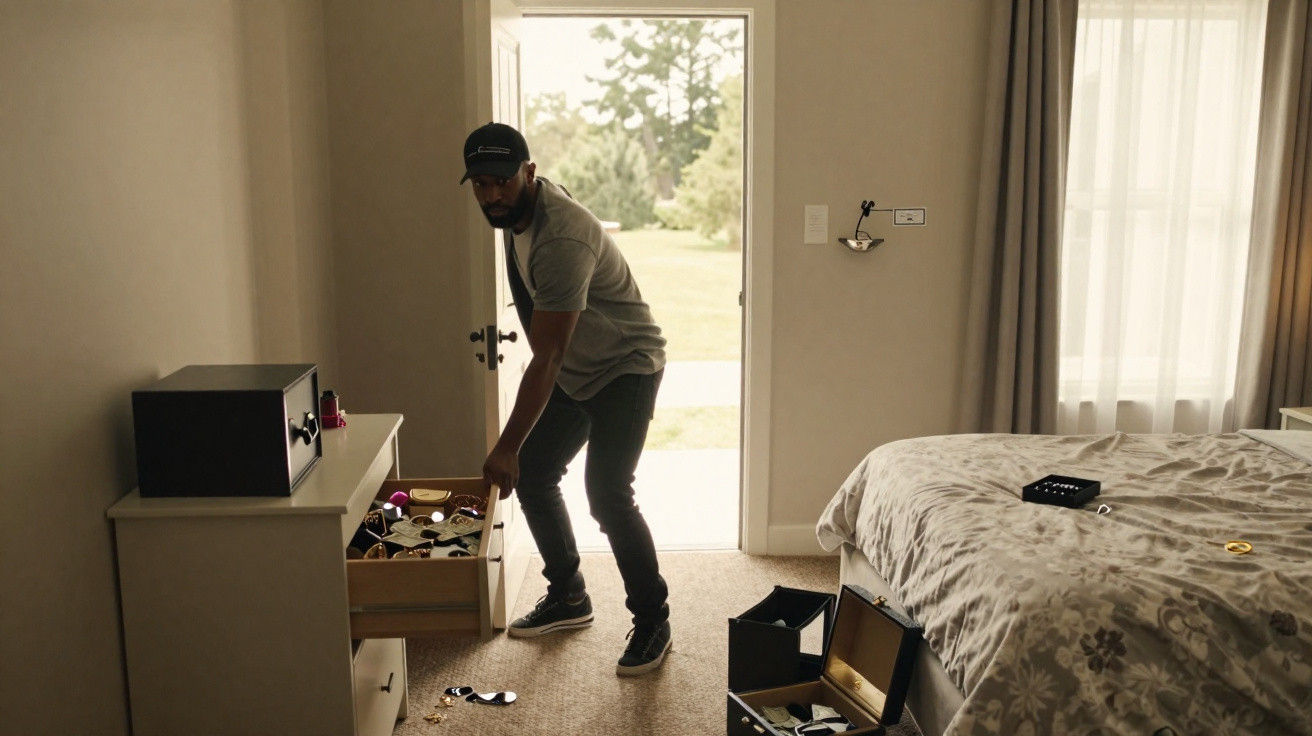
Police, insurers and former burglars describe a clear pattern: offenders nearly always follow the same route and deliberately target particular rooms and hiding places. Keeping valuables in precisely those locations makes their job alarmingly easy.
How burglars really operate
From the outside, a burglary may look chaotic, but it generally follows an established script. On average, an offender spends 5 to 15 minutes inside a home, and only rarely as long as 20 minutes. They use that time with intense focus.
They are not searching for everything, only for the most valuable items: cash, jewellery, watches, luxury accessories, small electronic devices, medicines with black-market value and important documents. Large televisions may be desirable, but they are cumbersome. A small envelope containing £3,000 is worth considerably more.
“Burglars do not go on treasure hunts. They follow routes that have paid off time and again – and they know the usual ‘secret hiding places’ better than many homeowners do.”
The standard route: from the front door straight to the main bedroom
Virtually every practical account identifies the same starting point: the front door. This is where offenders first check anything that appears to have been left out.
The danger zone around the entrance
- Key hooks and bowls holding car and house keys
- Hallway chests of drawers
- Bags, backpacks and jackets within easy reach
- Wallets, envelopes, parking or fuel cards
Leaving car keys or cash here gives an offender the ideal quick start – including the possibility of vehicle theft.
Why main bedrooms are so popular
After the hallway, the route almost always leads to the main bedroom. In interviews, many burglars said this was the first place they looked. The reason is straightforward: this is where households commonly keep their traditional valuables.
Particularly risky locations include:
- Bedside tables and their drawers
- The top drawers of chests of drawers
- Piles of clothing and laundry compartments
- Jacket and coat pockets in wardrobes
- Small jewellery boxes placed on chests of drawers
“The romantic idea of keeping emergency cash beneath a pillow is among burglars’ favourite finds – the ‘bank account under the bed slats’ has long been a joke in burglary circles.”
These “safe” hiding places are almost always searched by burglars
Many hiding places once considered clever are now part of every standard search. Anyone storing valuables there is gambling on time – and will usually lose.
Bedroom classics
- Under the mattress cover or bed slats: One reach, one look, and it is done.
- Under the bed: Boxes, shoe boxes and bags are all pulled out.
- Underwear and sock drawers: Jewellery and cash are especially often kept there.
- Stacks of jumpers and towels: Burglars deliberately rummage through layers of fabric.
- Small safes that are not bolted down: Offenders often simply take these away intact.
Bathroom, kitchen and living room: the overlooked hotspots
Other rooms also contain numerous familiar hiding places that are no longer secret.
| Room | Typical hiding places | Why they are insecure |
|---|---|---|
| Bathroom | Medicine cabinet, cosmetic baskets, dirty laundry, cupboards beneath the sink | Jewellery, cash and medicines are often kept here – all in a small area. |
| Kitchen | Refrigerator, freezer compartment, “empty” tins, biscuit tins, bread bins | Old “grandmother’s tricks” have long been familiar to offenders. |
| Living room | Vases, decorative boxes, “book safes”, drawers in the TV unit | Popular places for cash, watches and small devices. |
Criminals also specifically search medicine cabinets for drugs that can be resold. The resulting loss is therefore not only financial.
Why a false sense of security is so dangerous
Many people overestimate their hiding places and underestimate offenders. A burglar does not merely have a quick look; they work methodically. They know how wardrobes are arranged, how to feel for an envelope behind a drawer and what an unbolted mini-safe feels like.
“The greatest risk is not so much the burglary itself, but the illusion: ‘Nobody will find that anyway.’ It is precisely this self-deception that offenders rely on.”
In addition, some insurers reduce payouts where particularly large sums were kept in easily accessible hiding places or were not secured at all. Anyone hoarding £5,000 in cash in a bedroom wardrobe is taking a double risk.
Store valuables away from the usual search route
There is no perfect secret hiding place. The aim is instead to disrupt the offender’s routine and increase the time pressure. The further an item of value lies from the standard route, the less likely it is to be found.
Using safes correctly
A safe offers protection only if it is properly fixed to a wall or floor. Burglars can simply carry lightweight steel boxes kept in wardrobes or chests of drawers out to the car.
- Always bolt down or have a safe built into the wall
- Choose a location in a less obvious room, such as a storage cupboard or utility room
- Tell as few people as possible the combination
- Keep valuable documents, rare watches and larger jewellery collections inside it
For exceptionally valuable items, a bank safe-deposit box is often worthwhile. It may be inconvenient, but it greatly reduces the risk.
Make use of inconspicuous rooms
Burglars are guided by assumptions: where are valuable items kept, and where is there “just clutter”? Residents can use this to their advantage.
Less obvious spaces include, for example:
- A pantry or food storage room
- A workshop or basement storage area within the home
- A utility room containing a washing machine and cleaning products
- An office with lots of paperwork and lever-arch files
Keeping valuables in heavy, unremarkable objects in such places forces offenders to make a choice: do they really want to spend minutes moving bags of provisions for only a vague chance of finding cash?
Hiding places that take time – and therefore protect valuables
A good hiding place does not have to be invisible; it needs to be inconvenient. Offenders do not like hard work – they favour speed.
“Anything that creates mess, requires strength or needs tools reduces the likelihood that burglars will tackle it during the few minutes of their operation.”
Examples of time-consuming storage locations within the home include:
- Firmly bolted-down or very heavy furniture with difficult-to-reach undersides
- Large plant pots containing dense, firmly compacted soil
- Behind securely fitted skirting boards attached with screws, rather than only clips
- Among unattractive lever-arch files, neatly filed and labelled
Anyone using such places should still regularly check that they do not interfere with everyday life or fire safety – keeping cash close to radiators or inside electrical equipment is not a good idea.
More protection than simply a better hiding place
Hiding places are only one element. Many burglaries fail before the door is even opened when the right technology and habits are in place. Multi-point locks, lockable window handles, light timers and an alert network of neighbours can significantly reduce the risk.
Crime statistics often show that burglary rates fall where homes appear regularly occupied, post is not left piling up, blinds are not left unchanged for weeks and strangers in communal hallways are challenged. Hiding places then become a second line of defence – rather than the only one.
What many people overlook: burglars’ psychological patterns
Burglars rely on routine because they are afraid too – of being discovered, of noises and of unexpected residents. As soon as something does not fit the pattern, many abandon the attempt or move to another room. You can benefit from this by changing your habits.
Anyone who regularly keeps large sums of cash at home does not only attract opportunistic offenders over time. Rumours, tradespeople and acquaintances – information travels. The safest strategy therefore remains simple: keep as few vulnerable valuables as possible in your own home, and consciously keep everything else out of sight along the typical burglar’s route.




Comments
No comments yet. Be the first to comment!
Leave a Comment