
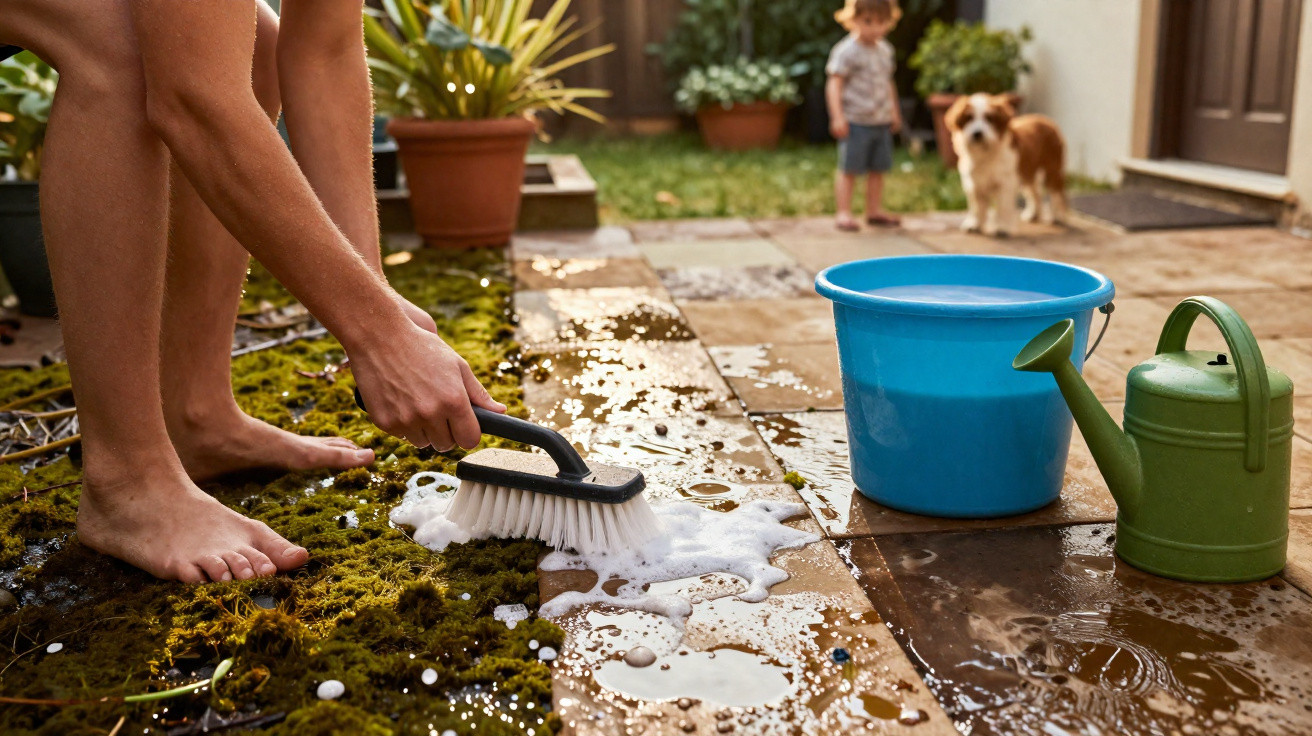
In spring, many people step out onto their terrace and find the same problem: slippery green growth, damp joints and uncertain footing. The usual instinct is to fetch the pressure washer from the shed, only to wonder a few weeks later why the surface looks exactly as it did before. Yet a far gentler and surprisingly effective answer may already be sitting in the kitchen cupboard.
Why moss on terraces is more than a cosmetic issue
On natural stone or aged timber, moss can sometimes look quaint and almost romantic. However, on paths, steps and terrace surfaces, it can quickly become hazardous. The soft cushions absorb water and create a slippery layer, particularly after rain or in shaded areas.
“Moss significantly increases the risk of falls – especially for children, older people and anyone walking around in wet shoes.”
There is also a second issue that is often overlooked: moisture. Moss retains water like a sponge directly against the surface. This can lead to the following:
- Stone slabs may crack or develop fine fractures when frost sets in during winter.
- Timber terraces weather more rapidly, swell and may begin to rot.
- Jointing material comes loose, leaving the surface unstable and uneven.
If green deposits are tackled only half-heartedly, the problem returns year after year – and is often worse than before.
Why a pressure washer is usually the wrong tool
Many homeowners regard a pressure washer as the ultimate solution. High-pressure water sends the dirt flying, which sounds perfectly sensible at first. In reality, though, the machine can create fresh problems.
Surface damage and only partial results
A powerful jet of water removes more than moss: it can also damage the surface itself. Natural stone may become rougher, concrete slabs can turn porous, and soft woods may splinter. The joints are particularly vulnerable, as the pressure washer can wash out sand, grit or cement-based material.
There is another issue: moss has no conventional roots. It reproduces through spores and tiny plant fragments lodged deep within micro-cracks and joints. While the water jet reaches the visible growth, it leaves countless spores behind. As a result, the green layer can return within a few weeks – often sooner than expected.
“A pressure washer creates a quick visual result, but it only addresses the underlying moss problem on the surface.”
The overlooked miracle solution: washing-up liquid instead of harsh chemicals
Frustrated homeowners often turn to aggressive moss killers from DIY shops. These products frequently contain biocides, which affect not only moss but also soil organisms, insects and neighbouring flower beds. The same effect can be achieved with a much milder product: ordinary washing-up liquid.
How washing-up liquid works against moss
Washing-up liquid contains surfactants. These substances break down grease and dirt, while also attacking moss’s waxy protective coating. This is exactly what makes the method useful:
- The surfactant solution penetrates the moss cushions.
- The protective wax layer on the tiny plants breaks down.
- The moss dries out and the spores lose their viability.
This treats not only visible growth but also spores lodged deep in joints and pores. It reduces the likelihood of the surface turning green again shortly afterwards.
Step-by-step guide: removing moss from a terrace with washing-up liquid
The approach is straightforward, but it works best when a few details are observed. Choose a dry day with no rain forecast.
1. Mix the right solution
For an effective treatment, all that is needed is a bucket of warm water and some washing-up liquid. Use the following as a guide:
| Amount of water | Washing-up liquid |
|---|---|
| 10 litres of warm water | Approx. 6–9 tablespoons (biodegradable) |
Where sensitive plants are growing very close by, choose a biodegradable washing-up liquid without bleach or strongly perfumed additives wherever possible.
2. Apply the solution and leave it to work
Pour the mixture generously over moss-covered sections or spread it with a watering can. The surface should be thoroughly wet, but not left standing in water.
Then leave it alone. Depending on the thickness of the moss, several hours of contact time can be helpful. During this period, the soapy solution breaks down the mosses’ protective layer and gradually dries them out. After a while, the growth turns brownish or grey, indicating that the plants have died.
3. Sweep away and rinse
Once the moss appears dry and brittle, use a broom. A stiff plastic-bristle or natural-bristle brush is ideal; metal bristles should be avoided, as they can scratch stone and timber.
Use firm strokes to dislodge the dry remains from the surface and joints. Any residue can usually be removed easily with a little extra water and further brushing.
Finally, rinse the surface with clean water using a watering can or garden hose. The aim is to dilute any washing-up liquid residue so that lawns and beds are not harmed.
“The result is a clean surface, achieved with an inexpensive product that is already found in almost every household.”
How long will the surface remain moss-free?
New moss growth can never be prevented entirely, as spores arrive on the wind and in rain. However, the washing-up liquid method considerably reduces the number of spores in joints and pores. Many surfaces therefore stay clean for an entire season, particularly if they receive sufficient sunlight.
In shaded corners that remain damp, moss can reappear sooner. In these areas, a regular maintenance treatment in spring and autumn using a mild washing-up liquid solution helps remove new growth at an early stage.
Further tips for preventing moss on terraces and paths
Anyone wanting a longer-lasting result can plan a few additional measures:
- Remove leaves and dirt regularly: Organic matter holds moisture and provides moss with an ideal growing medium.
- Repair the joints: Refill loose joints with suitable sand or jointing mortar so less moisture can collect there.
- Improve air and light: Where possible, thin out dense hedges or privacy screens that leave surfaces completely shaded.
- Check the slope: Standing water encourages moss growth. Where feasible, ensure a slight drainage fall.
For timber terraces in particular, regular cleaning with mild products and occasional oiling are worthwhile, as this helps prevent water from penetrating the boards for prolonged periods.
What to consider around pets, children and garden beds
Washing-up liquid is among the less harmful cleaning products, but several precautions still matter:
- Keep pets off the wet surface while the solution is working.
- Keep young children away until everything has been rinsed and has dried.
- Around sensitive perennials or herb beds, avoid allowing the solution to run directly into the beds.
For added reassurance, choose an eco-friendly washing-up liquid, rinse the surface thoroughly after treatment and do not deliberately distribute the wastewater around the garden.
When professional help is still worthwhile
Very old, damaged terraces with deep cracks and heavily weathered joints can sometimes only be improved to a limited extent with household remedies. If entire slabs are loose, joints are breaking away or water permanently pools in particular spots, a specialist contractor can help renovate the surface properly.
For most ordinary stone or timber terraces, however, using a bucket, washing-up liquid and a brush once a year is enough – without a noisy pressure washer or aggressive chemicals. This keeps the area safe to walk on, looking well maintained and lasting considerably longer than many people might expect.




Comments
No comments yet. Be the first to comment!
Leave a Comment