
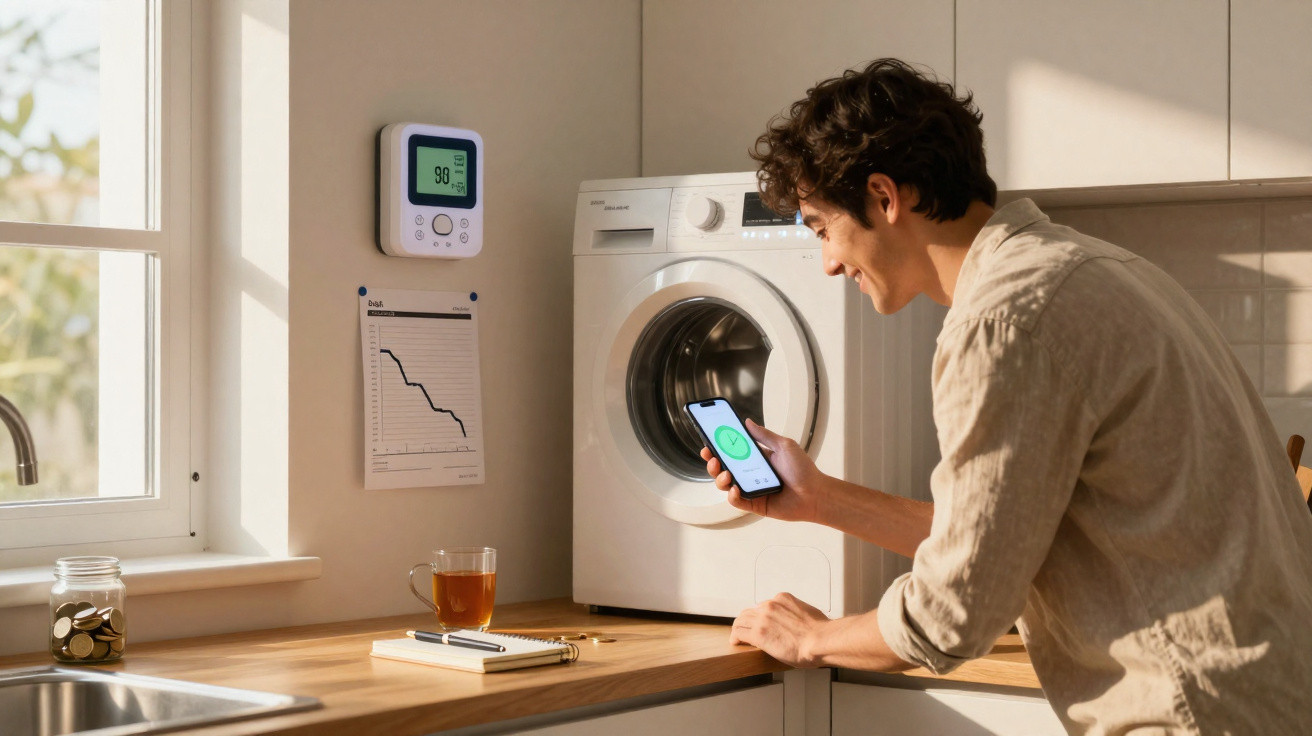
Running your washing machine, dishwasher or boiler at the wrong time can cost you real money. So-called off-peak times – often referred to as low-load periods – have changed in many regions and are also set differently from one town or city to another. Once you know the relevant hours, a few small changes to your routine can make it considerably cheaper.
What the new off-peak times are based on
For years, many European countries, including France, have used electricity tariffs with two price bands: more expensive peak periods and cheaper off-peak times. The idea is straightforward: the network operator aims to spread electricity demand across the day so that the grid is not overloaded at particular times.
The key point is that these hours are not set by your electricity supplier, but by the local network operator. In France, for instance, this is Enedis. The times assigned to a particular house or flat apply regardless of which supplier you choose. Switching supplier therefore does not alter the specific hours when the cheaper tariff applies.
Knowing your off-peak times and using them strategically can noticeably reduce your annual electricity costs without sacrificing comfort.
Why cheaper hours vary between towns and cities
Many customers assume that cheaper electricity is always available overnight, from 22:00 to 06:00. In practice, the arrangement is more varied. In France, for example, the time windows depend heavily on the town or city and can sometimes differ even between neighbourhoods.
This is due to technical requirements on the grid and local patterns of electricity use. Peak demand in densely populated cities differs from that in rural areas. The network is managed so that cheaper periods are scheduled where they help keep demand as evenly distributed as possible.
In larger cities, the usual framework falls between 20:00 in the evening and 08:00 the following morning. Within that span, the network operator designates eight discounted off-peak hours. These eight hours may be delivered as one continuous block or split into two separate periods.
Examples from major cities
France’s large cities illustrate just how much the schedules can vary:
- Paris: Many households have an uninterrupted off-peak window from 23:00 to 07:00. At other addresses in the city, it runs from 23:30 to 07:30.
- Lyon: Particularly in the 1st arrondissement, cheaper hours are mainly concentrated overnight, for example from 22:00 to 07:00, with minor variations depending on the street.
- Rennes and Toulon: Here, the network operator combines a continuous overnight period with a short discounted slot in the early afternoon.
The busy periods from 08:00 to 12:00 and from 17:00 to 20:00 are considered peak times almost everywhere. Electricity costs most during these windows because demand rises sharply: breakfast, the start of the working day, evening cooking, television and lighting all happen at once.
How to find your exact off-peak times
One of the most common mistakes is relying on information from neighbours or acquaintances in the same area. That may be accurate, but it is not guaranteed. Different blocks can be activated within the same municipality, and sometimes even along the same street.
The only reliable source for your hours is your own electricity bill or direct confirmation from your supplier.
Step-by-step guide
- Check your electricity bill: Your annual or monthly statement will usually list the peak and off-peak time windows. There is often a separate section labelled “HT/NT”, “day/night” or “peak/off-peak”.
- Call customer services: If the details are unclear or missing altogether, a quick call to your electricity supplier is enough. Its staff can look up the precise times using your metering point number.
- Use online tools: In France, Enedis provides an online tool that displays the possible time windows for each municipality. Similar overviews are often available from German-language comparison websites and network operators.
A special point about modern meters
Anyone using a digital electricity meter such as France’s Linky should look particularly carefully. In some cases, the network operator automatically and randomly assigns time windows from various existing blocks on the network. This means your neighbour may have entirely different off-peak times, even if you both use the same type of meter.
Checking the meter display and asking your supplier is the quickest way to clarify the situation. Many meters have a menu showing which tariff is currently active – peak or off-peak – and a brief test using the washing machine or boiler can help confirm it.
Adjust your routine and save real money
Once you know your eight cheaper hours, many electricity-hungry tasks can simply be moved. It takes a little planning, but it often pays off within just a few months.
- Washing machine: Set the start time so that the main part of the cycle takes place during the off-peak period, such as by using delayed start overnight.
- Dishwasher: This is a typical appliance to run late in the evening or very early in the morning.
- Hot-water heating: Where controllable, boilers and instantaneous water heaters should operate mainly during the cheaper window.
- Electric car: Schedule charging consistently for off-peak times; many wallboxes have their own timing profiles.
- Fan heaters and supplementary electric heating: Where possible, restrict their use to the lower-priced hours.
| Household appliance | Typical consumption | Best time window |
|---|---|---|
| Washing machine (60 °C) | 1–1.5 kWh per wash cycle | entirely during the off-peak period |
| Dishwasher | 0.8–1.2 kWh | late evening or overnight |
| Boiler / storage heater | varies considerably | a long overnight block |
| Electric car | 10–20 kWh per charging session | entirely during off-peak times |
When an off-peak tariff is genuinely worthwhile
A two-band tariff only delivers a benefit when a noticeable share of your electricity use falls within the cheaper hours. As a broad rule of thumb, experts say that around one third of annual consumption should be used during off-peak times, ideally more.
For example, people who are at home almost exclusively during the day, use electric heating and rarely do laundry overnight often benefit less. In the worst case, they may even pay more, because the peak tariff can be slightly higher than under a single-rate tariff.
A close look at your own routine can help you decide:
- Are several people in the household active late in the evening or early in the morning?
- Are there many larger appliances with timer functions?
- Is hot water produced electrically, and can its timing be controlled?
- Is there an electric car in the garage that mostly charges overnight?
The more often the answer is “yes”, the more appealing an off-peak tariff becomes.
Practical tips and common pitfalls
A frequent issue is a change in daily life that goes unnoticed. Someone who starts working from home may shift the use of many appliances into daytime hours. Shift workers will use different time windows from the rest of the family. In such cases, it may be worth reassessing the tariff.
Changes made by the network operator are another consideration. In other European countries, time blocks are adjusted repeatedly to help stabilise the grid. If you notice a change on your bill or in the tariff name, check whether the underlying time windows have also moved.
It is worth carrying out a quick check at least once a year: do your own habits still match the off-peak times that have been set?
For clarity, terms such as “peak time” and “off-peak time” do not refer to fixed hours; they describe tariff bands. They can vary by network area, neighbourhood or meter type. Digital meters in particular give network operators more flexibility in managing the grid, but they also require customers to pay a little more attention.
Taking the time to check your hours and align the biggest electricity users with them brings two benefits: your electricity bill is lower, while the grid is stabilised through a more even distribution of demand. Simply moving washing machine, dishwasher and electric-car charging into the off-peak period can make a noticeable difference, without anyone at home having to give up comfort.






Comments
No comments yet. Be the first to comment!
Leave a Comment