
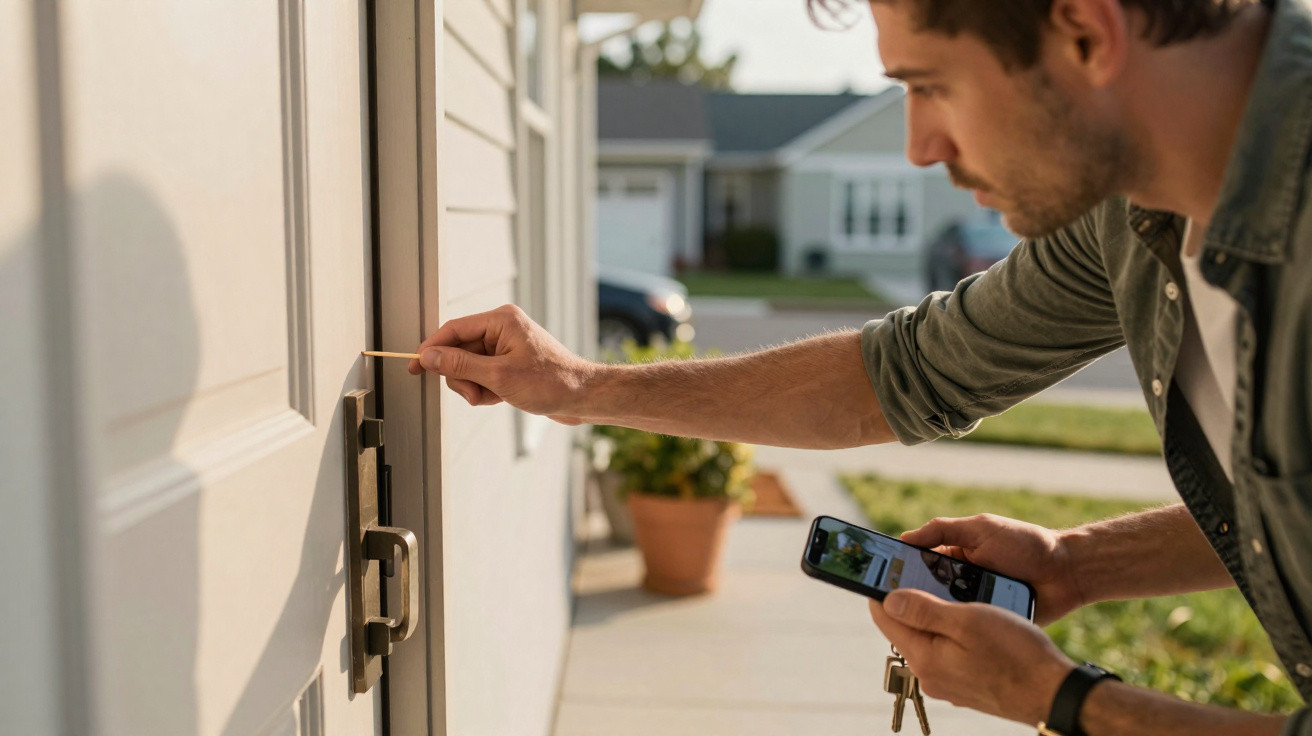
A seemingly harmless sign can conceal a calculated burglary tactic.
Police and residents in several European countries have reported a new method used by criminals to assess flats and houses. A single toothpick placed in a door can be enough to establish whether somebody is at home or whether a property has been vacant for some time. Although it may initially look like a childish prank, it could be a serious warning sign.
How burglars specifically check whether homes are “empty”
Burglars rarely act on impulse. In many cases, they watch a property for several days and check whether people genuinely live there or whether it is “safe” for them to target. To do this, they use subtle markers that are difficult to spot.
Examples that have been known for some time include:
- a dab of glue on the front door or door frame
- a narrow strip of paper in the door rebate
- promotional leaflets or notes left visibly protruding from a letterbox
- inconspicuous chalk symbols on a wall or letterbox
If the paper is removed, the door is opened or the glue is disturbed, the house is considered “occupied”. If everything remains unchanged for days, offenders may interpret it as an invitation. The toothpick method follows precisely this pattern.
Toothpick in the door: how the new tactic works
The principle is straightforward, which is exactly what makes it risky. Burglars push or wedge a small piece of wood - usually a toothpick - into the gap between the door and its frame, or directly near the locking cylinder.
“If the toothpick remains lodged in the door unchanged, offenders regard it as a clear signal: nobody has been inside for hours or days.”
From the criminals’ perspective, the process typically works like this:
- They select a property that appears isolated or whose residents seem to be away from home often.
- They discreetly position a toothpick at the front door, often where it is barely visible from outside.
- They return after several hours or the following day to check it.
- If the toothpick is still there, they assume the occupants are absent and plan the burglary.
- If it has disappeared or moved, they generally abandon the property or continue monitoring it.
A particular danger of this approach is that many residents will not notice a toothpick at all, or will dismiss it as a joke by children. Anyone unaware of its possible meaning may not report the discovery - unintentionally communicating exactly what burglars want to know: that the property is not being watched closely.
Where reports of the tactic have emerged - and what they indicate
Several police authorities in France have warned about this approach in recent months after a number of burglaries occurred in quick succession in certain communities. In affected streets, investigators repeatedly found toothpicks in door locks or frames, often at properties that were later targeted.
Experience shows that methods of this kind can quickly spread to neighbouring countries. Familiar chalk markings and paper traps also appeared in several countries within months of their first reports, often in slightly altered forms but with the same purpose: identifying empty properties without attracting attention.
There is a simple reason criminals are relying on increasingly discreet tricks: conventional security measures are improving, and many people now use cameras or smart lighting. As a result, the focus has shifted more towards observing household routines - and this is where the toothpick trick comes in.
Recognising warning signs at your own front door
Anyone who stays alert can spot this tactic relatively easily and become a greater risk to offenders. Residents should look out for these subtle signs:
- unfamiliar wooden sticks or splinters in the lock area or door gap
- thin pieces of paper, cardboard strips or plastic threads on a door, gate or garden gate
- unusual blobs of glue, adhesive dots or marks on the frame or letterbox
- promotional leaflets that appear in clusters at particular homes and are left there
If you find something like this, remove the item, inspect the immediate area and, ideally, notify the police briefly. Better still, alert your neighbours so that they can also remain vigilant.
“Inconspicuous traces on a door or letterbox are often not accidental, but a trial run by burglars.”
How to make your home less appealing to burglars
No home can be made completely secure, but the risk falls considerably if criminals never develop an interest in it. Specialists recommend combining technology, neighbourly support and sensible routines.
Create the impression of occupancy - even when nobody is home
Criminals tend to avoid properties where someone could return at any moment. Anyone away for an extended period should therefore simulate activity:
- use timer switches for indoor lighting or shutters
- install smart lights that can be controlled through an app
- activate a television simulator or radio timer that produces sounds in the evening
- fit motion-sensor outdoor lighting at the entrance and on the garden side of the house
A property where lights regularly come on and sounds can be heard appears occupied, even when it is empty.
Involve neighbours and do not publicise your absence
A strong local support network is at least as important as technology. Maintaining a good relationship with neighbours is one of the most effective burglary deterrents available.
Practical measures include:
- asking a trusted person to empty the letterbox regularly
- arranging for wheelie bins to be put out on collection day and brought back in
- asking someone to open and close shutters occasionally during longer trips
- avoiding public announcements that you are away - do not post holiday countdowns on social media
Many police forces run schemes in which patrol cars pass reported addresses more frequently during holiday periods. Using such a service significantly increases the level of monitoring around your home.
What to do if you find a toothpick
If you suddenly discover a toothpick in your front door, there is no need to panic, but you should treat the situation seriously. The following steps are sensible:
- remove the toothpick and take a quick photograph of it, in case the police ask about it later
- check for further signs, such as scratches around the lock or other markings
- speak with immediate neighbours to find out whether they have made similar discoveries
- call the police and describe the incident, especially if several homes in the street are affected
Anyone who no longer feels safe can take extra short-term steps, such as fitting a temporary camera, asking friends to visit more frequently or paying particularly close attention to unfamiliar people nearby over the following days.
Why such simple tricks work so effectively
The toothpick method seems almost absurdly simple. That is exactly what makes it effective: few people expect an ordinary wooden stick to form part of a planned crime. Many people overlook minor details in everyday life as long as nothing has been damaged or visibly tampered with.
Burglars rely on precisely this lack of attention. They do not need high-tech equipment when a low-cost item from a chemist can provide reliable information. The less conspicuous the tool, the lower their risk of being caught.
For residents, this means that paying close attention to their surroundings can often offer more protection than the next expensive camera system. Those who consciously inspect their door, letterbox and communal hallway can notice minor changes and, if necessary, take action early.




Comments
No comments yet. Be the first to comment!
Leave a Comment