
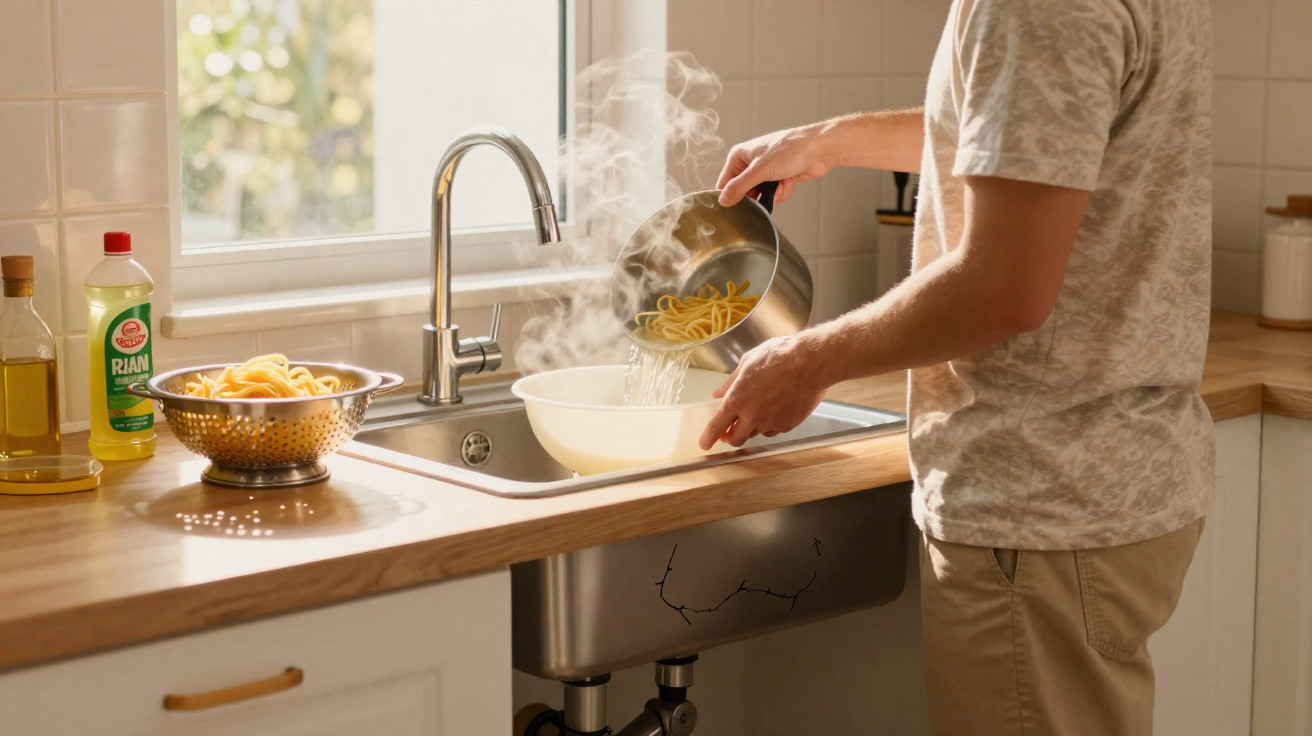
This everyday habit, however, can cause serious damage to both your pipework and your wallet.
In millions of homes, the same routine takes place every evening: the saucepan comes off the hob, the lid is removed, and its contents are tipped into a colander in the sink – with the near-boiling water gurgling away down the drain. It feels clean, convenient and familiar. What goes unseen is that every time this happens, the pipes, seals and trap beneath the worktop suffer a little more. Eventually, this quiet problem makes itself known through gurgling sounds, unpleasant smells or damp patches inside the cupboard.
Why hot pasta water is a problem for modern pipes
Many homes now have PVC plastic pipework beneath the sink. Although the material is considered durable, it has one weakness: high temperatures. PVC can start to soften at around 60 to 70 degrees. Pasta water is often far closer to 100 degrees.
Pouring boiling water straight down the drain on a regular basis exposes the pipework to repeated thermal shocks. The following parts are especially vulnerable:
- Joints and bends: Heat can build up here, causing tiny distortions in the material.
- Rubber or silicone seals: Over time, they can become hard and develop microscopic cracks.
- The section immediately below the sink: This is where cold tap water and boiling liquid meet.
The effects are seldom visible immediately. Instead, the strain tends to become apparent only after months or years: a drip in one place, a hairline crack elsewhere, or a warped trap that no longer seals properly.
Tipping boiling water directly from the pan into the drain may seem harmless – but in PVC pipework, this thermal shock acts over the years like a slow, destructive force.
Costly consequences: from blockages to water-damage repairs
Once the first leaks or blockages appear, costs can mount quickly. A sink that no longer drains properly will often require a professional call-out. A standard drain-cleaning visit typically costs between €80 and €200, depending on travel, the amount of work involved and the time of day.
If water damage is involved as well, the bill rises sharply. Swollen chipboard in the base unit, damaged flooring or mould on a wall can easily result in costs of several hundred euros – and potentially more if an assessor is needed or furniture has to be replaced.
Leaks that remain unnoticed for a long time are particularly troublesome. Common warning signs include:
- a musty smell inside the cupboard below the sink
- swollen or rippled flooring beneath the sink
- discolouration or dark patches on nearby walls
- small puddles of water that seem to appear “out of nowhere”
Starch and fat can block pipes as well as heat
Temperature is only one part of the issue. The cooking water from pasta, rice and potatoes contains large amounts of starch. This starch is what gives the water its slightly cloudy, milky appearance – and what makes it sticky inside the pipes.
When starch residue enters the drain, it can leave a thin, slimy coating on the inner pipe walls. The following then gradually stick to it:
- crumbs and food scraps
- small pieces of pasta or rice
- sauce residue and fats
- coffee grounds or tea residue
What begins as a light coating becomes thicker every time water is poured away. A stubborn plug can gradually form, especially in the trap and pipe bends where water flows more slowly.
Starch acts like glue inside pipes: it binds fats and food residue into a tough plug that gradually narrows the full width of the pipe.
Why the boiling-water-and-fat “trick” rarely works
Many households believe they have the issue under control. The reasoning is: “If I pour boiling water down the drain now and then, it will dissolve the fat and clear everything out.” Although that sounds convincing, in practice it often has the opposite effect.
What actually happens is this:
- The heat briefly loosens and liquefies the fat.
- The mixture of fat and water travels further along the pipe.
- Further away from the sink, the pipe is cooler, so the fat cools and hardens again.
- Combined with starch, it can form a compact plug that is much harder to remove.
Drain cleaners and harsh chemicals often make matters worse. They can attack seals and pipe materials while failing to address the actual cause: unsuitable kitchen habits.
How to drain pasta without damaging the sink
The good news is that a few simple habits can greatly reduce the risk. There is no need to eat pasta cold; only the way the cooking water is handled needs to change.
A gentler way to deal with hot water
Rather than placing a pan of boiling water directly into a colander in the sink, try these steps:
- Drain the pasta through a colander placed over a large pan or bowl, rather than directly over the sink.
- Collect the hot water and allow it to cool until it is merely warm.
- Pour the cooled liquid into the drain in several small amounts.
- Run cold or lukewarm tap water at the same time to keep temperatures low inside the pipework.
Anyone who regularly cooks large amounts of pasta can even dispose of the cooking water on a balcony or suitable outdoor surface – but only if it contains no salt and cannot harm plants or the surface.
Simple kitchen rules for fewer blockages
A few everyday rules can keep pipes clear for longer and reduce hassle considerably:
- Wipe fats and oils from frying pans and saucepans with kitchen roll, then dispose of it in the general waste bin.
- Scrape food remnants from plates into the food-waste bin or general waste before washing up.
- Do not pour coffee grounds down the drain, not even “just a little”.
- A sink strainer prevents larger pieces from reaching the trap.
Gentle pipe care instead of harsh chemicals
Those wanting to care for their pipes can achieve a great deal with simple household products. A mild clean once or twice a month is enough:
- pour some warm, but not boiling, water into the drain
- add one to two tablespoons of coarse salt or bicarbonate of soda
- follow with a splash of household vinegar
- leave it to work, then rinse through later with plenty of warm water
This combination removes light deposits without putting the material under as much strain as many strong drain cleaners. If blockages are already a recurring problem, a plunger can also be used from time to time to loosen trapped particles mechanically.
Useful ways to reuse pasta water
Pasta cooking water does not have to end up in the drain. In many kitchens, it is an underrated helper:
- For thickening sauces: Its starch creates a creamier texture, particularly in tomato or cheese sauces.
- For baking: Some bread recipes allow part of the liquid to be replaced with lukewarm pasta water.
- For plants: Unsalted, cooled water can occasionally be used for watering, as its minerals may benefit some plants.
Important: Salted water should not be poured in large quantities into plant pots or used regularly in the garden. Too much salt damages roots and soil organisms.
Thermal stress: what causes pipe “stress”
The physics behind thermal shocks in pipework is straightforward: materials expand when heated and contract again when cooled. When this change happens frequently and rapidly, the material loses elasticity and small cracks or distortions can develop. With plastic pipes and seals, this process is gradual and silent.
The transition between a metal or ceramic sink and plastic pipes is especially critical. Different materials meet here, and they expand differently. Avoiding boiling water and aiming instead for lukewarm mixed temperatures significantly reduces these stresses.
Why it is worth checking beneath the sink
If you are unsure about the condition of your own pipework, take a deliberate look inside the cupboard beneath the sink. A trap that sits at an angle, brittle seals, or wood that appears slightly swollen or discoloured may indicate that a problem is already developing.
Replacing a trap or seals early costs considerably less than a major repair. From now on, consistently allowing boiling water from a saucepan or kettle to cool before it enters the drain can noticeably reduce the risk of the next expensive plumber’s visit.





Comments
No comments yet. Be the first to comment!
Leave a Comment