
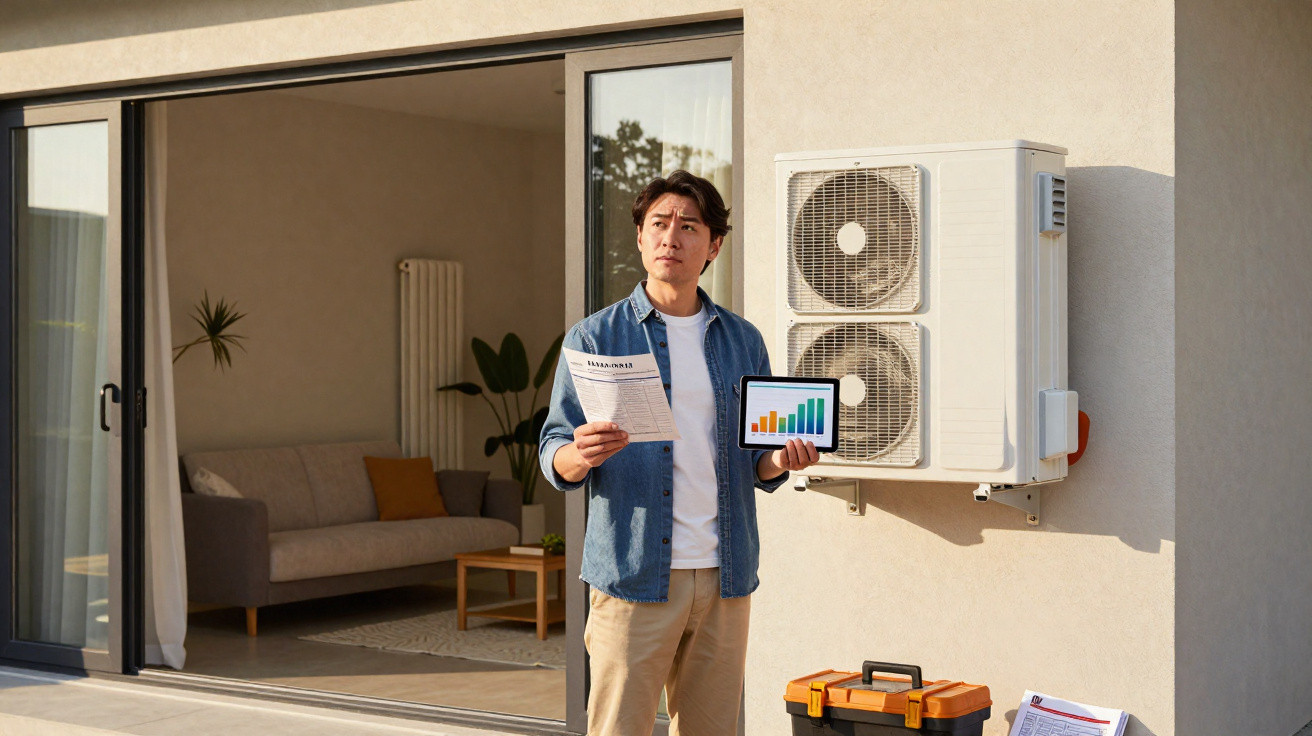
Across Europe, homeowners have been assured that heat pumps would reduce both household bills and emissions.
Now, many are questioning why that promise appears less certain.
Heat pumps entered the market surrounded by environmental optimism and government-backed incentives. However, reports of extremely high installation quotes, loud equipment and underwhelming savings are increasingly common. Are heat pumps genuinely a sensible long-term investment, or have they been oversold as a solution that comes with overlooked drawbacks?
The price tag that puts homeowners off
The initial quotation is often the first major surprise. A fully fitted modern heat pump system can cost roughly the same as a small car.
For an average home, an air-source heat pump may cost between £8,000 and £15,000, while ground-source systems, which involve drilling or excavation, can readily cost more than £20,000. Grants or tax credits may help, but the amount left to pay remains substantial for many households.
Many families hesitate not because they dislike the technology, but because the upfront cost feels like placing a very big bet on an uncertain outcome.
Installers and manufacturers commonly focus on savings over the longer term. The message is straightforward: spend more at the outset and benefit from lower energy bills for years afterwards. But this only works where the system is properly sized, the property has good insulation and local electricity prices remain manageable.
In older homes or properties with poor insulation, a heat pump must work considerably harder to keep rooms comfortable. That lowers efficiency and lengthens the payback period. Some owners in colder areas say that, once the early excitement fades, their yearly saving against gas or oil heating is much lower than they expected.
Heat pump performance differs between homes
Heat pumps cannot simply be fitted and forgotten. Their performance is closely tied to the property they heat and to the surrounding climate.
Why the same heat pump performs differently in two homes
- Insulation quality: Properties with effective insulation retain warmth, allowing the pump to operate at lower temperatures and with greater efficiency.
- Radiators and underfloor heating: Older, undersized radiators often need hotter water, reducing a heat pump’s efficiency.
- Local climate: Heat pumps perform particularly well in milder areas. Air-source models may find very cold winters more challenging.
- System design: A unit that is too large or too small can short-cycle, deteriorate more quickly and be more expensive to operate.
Manufacturers frequently refer to the “COP”, or coefficient of performance. This measures how many units of heat the system provides for every unit of electricity it consumes. A COP of 3 or 4 appears highly attractive on paper. However, that figure is commonly established under controlled test conditions rather than in a draughty semi-detached home in February.
The impressive performance numbers in brochures are not lies, but they are optimistic snapshots, not a guarantee of your day-to-day reality.
Actual performance is more accurately reflected by the “seasonal COP”, which records how the system performs across a full year. Before agreeing to a contract, few households know what this figure will be for their own installation.
Electricity reliance and worries about bills
Heat pumps are regularly promoted as systems that can “produce more energy than they consume”. While the wording sounds almost magical, the explanation is straightforward: they transfer heat rather than create it. They still require electricity, and their electricity use can be considerable when conditions become severe.
During cold weather, particularly with air-source models, the external unit must work harder to extract heat from the air. Efficiency falls precisely as the need for heating rises. At such times, the system may activate electric backup heaters, which are much less efficient and significantly more expensive to run.
For households replacing inexpensive gas with electricity, this may cause concern. Where local electricity tariffs are high, even an efficient heat pump may cost more to operate than anticipated. Fluctuating energy prices create a further uncertainty when deciding whether to invest.
Maintenance, repairs and reliability in practice
Heat pumps are often described as virtually maintenance-free, but that is optimistic at best. A modern installation is sophisticated refrigeration equipment containing sensors, compressors, valves and electronic controls.
| Aspect | Typical requirement | Impact on owner |
|---|---|---|
| Annual check | Inspection of refrigerant circuit, cleaning of filters and coils | Service cost once a year, often required for warranty |
| Outdoor unit | Clearing leaves, snow, and dirt from around the unit | Regular attention from the homeowner |
| Repairs | Specialist technician, sometimes long wait in peak season | Potentially high bills and days without heating |
Many manufacturers state that their systems should last 15 to 20 years. That can be achievable in a well-designed installation. However, surveys and anecdotal evidence suggest that some units experience serious failures much sooner, particularly if they were oversized, badly installed or required to operate continuously at high output.
The weakest point is often not the machine itself, but the quality of installation and the availability of skilled technicians when things go wrong.
Homeowners who expected a low-maintenance, low-stress option may feel stuck when repeated engineer call-outs begin to reduce the savings they had relied upon.
Marketing claims and the problem of trust
Governments and energy suppliers have strongly promoted heat pumps as the clean future of domestic heating. Campaigns often focus on sizeable subsidies and striking promises of lower bills and reduced carbon footprints.
Brochures tend to give less prominence to the conditions needed to achieve those outcomes: strong insulation, accurate sizing, realistic temperature expectations and an ongoing maintenance budget. When these requirements are not made clear, disappointment can follow.
Some households report feeling pushed into a quick decision, as salespeople stress that grants may soon end or present heat pumps as suitable for every home. If the reality fails to match the sales message, confidence in the wider energy-transition agenda is weakened.
Smarter combinations: heat pumps are not the only option
Heat pumps can be highly effective, but they are seldom a standalone magic answer. Many experts now advocate a “fabric first” approach, improving the property itself before replacing its heating system.
What a more balanced approach involves
- Improve loft, wall and floor insulation to reduce the need for heat.
- Replace windows and seal draughts to limit cold-air infiltration.
- Explore hybrid systems that pair a heat pump with a gas or oil boiler for periods of peak demand.
- Fit low-temperature radiators or underfloor heating to improve efficiency.
- Combine the heat pump with roof-mounted solar panels to offset electricity consumption.
Hybrid arrangements can be especially valuable in very cold locations or older properties where a complete retrofit is difficult. The heat pump supplies day-to-day heating in milder weather, with a conventional boiler taking over when temperatures fall sharply and helping to limit spikes in electricity use.
Running the figures: a simple example
Consider a three-bedroom home heated by an ageing gas boiler. Its owner receives a £12,000 quotation for an air-source heat pump and can access a £5,000 grant. Once the subsidy is applied, the cost is £7,000.
If the replacement system cuts energy bills by £500 per year, the payback period is approximately 14 years, excluding maintenance and later price changes. Better insulation could increase the yearly saving, whereas higher electricity prices could make the payback period longer still.
This type of broad calculation provides more realistic expectations. A heat pump is not so much a quick bargain as a long-term infrastructure choice, more comparable to reroofing a property than purchasing a new appliance.
Key terms heat pump buyers should know
Before entering into a contract, it is useful to understand several technical expressions:
- COP (coefficient of performance): The relationship between heat produced and electricity used under particular test conditions.
- SCOP (seasonal COP): Average efficiency across an entire heating season, offering a more realistic way to compare systems.
- Low-temperature system: Heating that uses cooler water, generally through underfloor heating or large radiators, and is well suited to heat pumps.
- Defrost cycle: A process in which the heat pump briefly reverses to melt ice on the outdoor unit, temporarily reducing heating output.
Knowing these terms allows homeowners to ask installers more precise questions and challenge excessively optimistic claims. A trustworthy installer should be able to set out the expected SCOP, explain how existing insulation affects performance, and describe how maintenance will be managed over the coming decade.
For many households, the key question is not “are heat pumps good or bad?” but “is a heat pump right for this particular house, budget and climate?”. Where that question receives an honest answer, heat pumps can still make a meaningful contribution to reducing emissions and energy consumption without homeowners feeling misled or short-changed.






Comments
No comments yet. Be the first to comment!
Leave a Comment