
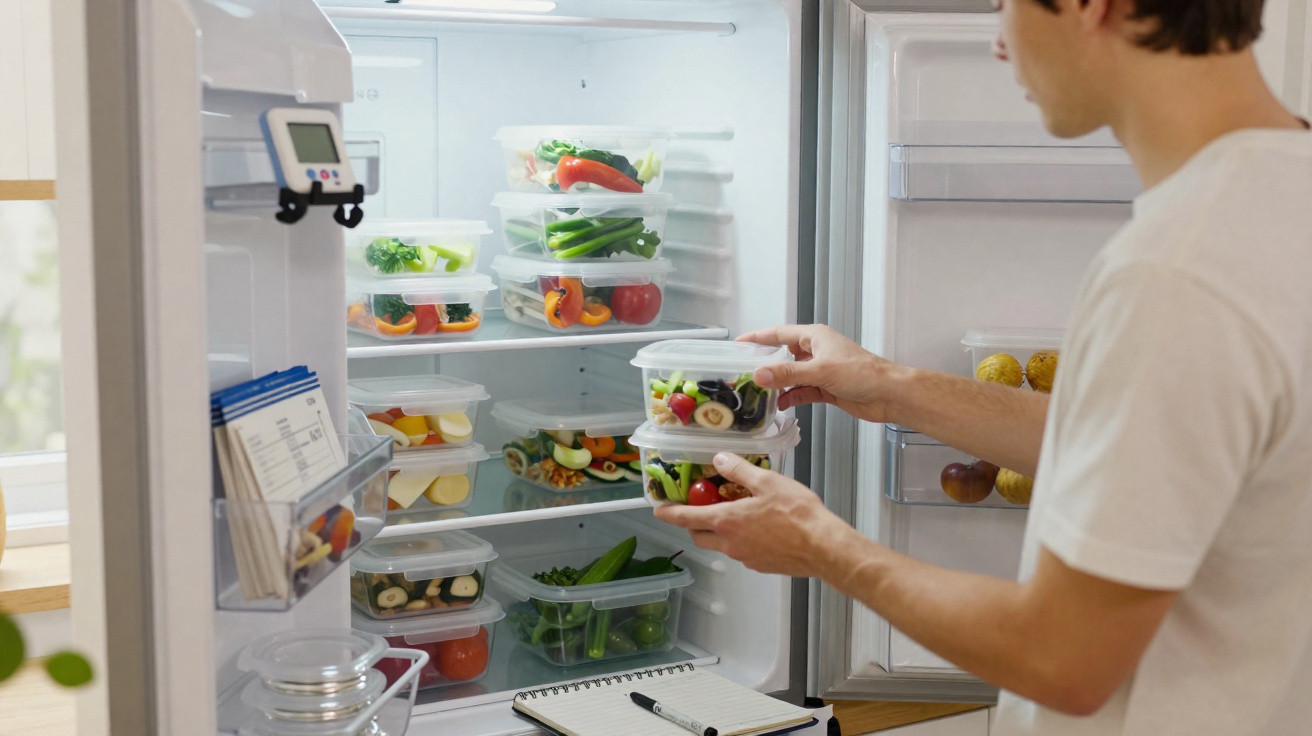
You open the freezer door and a blast of icy air hits your face.
Inside, an open bag of peas slides over a lidless container, bits of ice cling to the drawer, and old meat trays create an impossible game of Tetris. You pull one out and another falls; the floor becomes a bowling lane for frozen nuggets. You take a deep breath, slam the door shut and think: “I’ll organise it at the weekend.” Two months later, it looks exactly the same, except there is more forgotten food at the back, unrecognisable beneath a coating of ice crystals. Nobody mentions it during a tour of a new flat, but the freezer is the dark cupboard of the modern kitchen. Quietly, your electricity bill notices every lapse. The persistent question is: can you keep a freezer full, organised and economical at the same time?
The hidden chaos inside your freezer
From the outside, it is simply a white door. Behind it sits a parallel world of Sunday leftovers, supermarket bargains and all those things you will “use one day” but never do. The freezer becomes a car park for unlabelled containers, where nobody knows what arrived first. Food loses space, cold air cannot circulate properly and ice creeps along the edges. It may seem ordinary, yet it affects your routine, your budget and even your mood. An appliance designed to make life easier starts delaying dinners, spoiling food and using energy unnecessarily. A disorganised freezer is noisy without making a sound.
Take a real-life example: a family of four in an ordinary flat, with a freezer compartment above the fridge. At the start of the month, they do a large shop, buying meat in bulk packs, frozen vegetables and bread for the week. In daily life, they pile everything up wherever there is room. After a while, the signs begin to show: freezer-burned meat, torn packaging and numerous duplicate items nobody remembered buying. The mother finds three bags of minced chicken purchased in separate promotions, all approaching their use-by dates at roughly the same time. Meanwhile, the electricity bill has risen by almost 15% over a year, despite no change of appliance. That is not coincidence; it is habit.
Technically, an overfilled and chaotic freezer hinders the movement of cold air. The motor has to work harder, switching on and off more often and consuming more electricity. When a heavy layer of ice builds up on the walls, temperature exchange becomes slower still. Every time you open the door and stand there searching for an unlabelled container, the appliance must make up for the lost cold. It sounds like a minor detail, but organisation and energy efficiency go hand in hand. A neatly arranged freezer is not merely about appearance; it is engineering applied to real life. Ultimately, it determines whether food is used or thrown away.
The secret is a few freezer rules you can actually keep
The turning point starts with one simple change: treat the freezer like a supermarket shelf, rather than a storehouse for things you will sort out later. That means creating clear zones. For instance, use the top shelf for meat, the middle for prepared meals, a drawer for vegetables and fruit, and the door for quick-use items such as butter, herbs and ice. Within those zones, flat packaging is the useful trick. Rather than freezing meat in thick blocks, divide it into thin, book-shaped portions in tightly sealed bags. They stack more efficiently and freeze and defrost faster. The freezer stops being a jumble and becomes a logical file of possible meals. It is less glamorous than buying a new appliance, but it works.
Let us be honest: nobody manages this every day. Life gets in the way, frozen food is shoved into the remaining gap, a child shouts and the phone rings. What truly changes things is having a small number of very simple rules that still hold up in the middle of chaos. Add a date label, keep a fixed spot for every food category and set a limit for unlabelled containers. Once that limit is exceeded, it is time to review what is inside. Many people feel guilty when they open the freezer and find spoiled food. Rather than seeing it as guilt, it makes more sense to view it as a system: if you repeatedly lose the same kind of food, perhaps you are freezing too much of it or storing it incorrectly. Organisation is not perfection; it is ongoing adjustment.
A nutritionist who works with families in São Paulo said, half laughing but serious: “The freezer has become the graveyard of good intentions. Everyone freezes food to ‘eat better’, but without a clear plan. Then they waste food, waste money and still think the problem is a lack of willpower.”
Now consider three practical, almost automatic actions that fit into any routine:
- Choose one day each month for a “freezer forage” and create a menu from what is already there.
- Always follow the FIFO system - first in, first out - for meat and prepared food.
- Use standardised, stackable containers and bags with space to write the date and contents.
These are small actions, but they establish a rhythm. The freezer starts working for you rather than against you.
When the freezer becomes a routine ally, not a silent enemy
There is a curious point when someone who always hated opening the freezer starts to take a certain pleasure in seeing everything in order. Containers are lined up, packaging is labelled and nothing tumbles out when the door opens. The cooking experience changes: you know where the cooked beans are, find homemade tomato sauce in seconds and do not buy a fourth pack of burgers “just in case”. Freezer organisation makes decisions easier. On a tiring day, the difference between ordering a takeaway and putting together a quick dinner can be recognising, in a second, what is available inside. The efficiency is emotional as well as energy-related.
Another quiet benefit is greater control over waste. When you know what comes in and what goes out, you are more willing to use what you already have. That portion of soup that would have been forgotten at the back becomes lunch on a rainy day. A bag of frozen vegetables becomes the basis for an improvised pie. Freezing is no longer just storage; it becomes a planned extension of the kitchen. This has a direct impact on your budget. There is less lost food, fewer duplicate purchases and less of that feeling of having “nothing in” despite a full freezer. Your routine benefits, your electricity bill gets some relief and so does your conscience.
Perhaps the most interesting realisation is that a well-organised freezer is not always full. It has breathing room, enough space for air to circulate and a place set aside for the unexpected: an unplanned visitor, a supply of prepared meals for the week or an unmissable chicken offer. When everything is crammed in, any new item becomes a problem. When there is a system, there is room for improvisation. True efficiency lies in this dynamic balance: neither too empty nor overflowing. It is a space that reflects the real life of a household, with its ups, downs and adjustments. At heart, organising the freezer is simply another way to organise the small daily decisions that, when added together, can change quite a lot.
| Key point | Detail | Value for the reader |
|---|---|---|
| Defined freezer zones | Separate areas for meat, prepared meals, vegetables and small quick-use items | Makes food easier to find and reduces the time the door stays open |
| Flat, labelled packaging | Freeze thin portions with the date and contents written on them | Better use of space, faster defrosting and less waste |
| Monthly review routine | Set a fixed day to “forage”, reorganise and use food that has been sitting there | Savings on grocery bills and fuller use of food |
FAQ:
Question 1: How often should I defrost and clean the freezer?
Answer 1: For freezers that build up ice on the walls, a thorough clean every 3 to 6 months is usually sufficient, depending on use. Frost-free models need less maintenance, but a quarterly internal review - removing old packaging and cleaning the drawers - greatly supports efficiency.Question 2: Can I fill the freezer to capacity to save energy?
Answer 2: A moderately full freezer is more stable than one that is nearly empty, but filling it completely makes air circulation more difficult. Ideally, leave small gaps between packages and never block internal ventilation outlets.Question 3: How long can food remain frozen without losing quality?
Answer 3: It depends on the food: meat usually lasts 3 to 12 months, vegetables 3 to 6 months, and prepared meals 2 to 3 months. Food may remain safe for longer, but its texture and flavour begin to decline. Labelling items with dates is the only way to keep genuine control.Question 4: Is it better to freeze food in rigid containers or plastic bags?
Answer 4: Freezer-safe plastic bags take up less room and create flat portions that are ideal for stacking. Rigid containers work well for stocks, sauces and liquid dishes. The best approach is to use both, always leaving a small amount of room for liquids to expand as they freeze.Question 5: Can I refreeze food that has already been defrosted?
Answer 5: If the food spent only a short time in the fridge and was not left at room temperature, it can be refrozen, although the quality will suffer. A safer option is to turn it into a prepared dish, such as a stir-fry or sauce, and freeze that new preparation, reducing risks and preventing total waste.



Comments
No comments yet. Be the first to comment!
Leave a Comment